
Yellow Arrow Publishing Blog
An Expedition into the Nature of Our Hearts
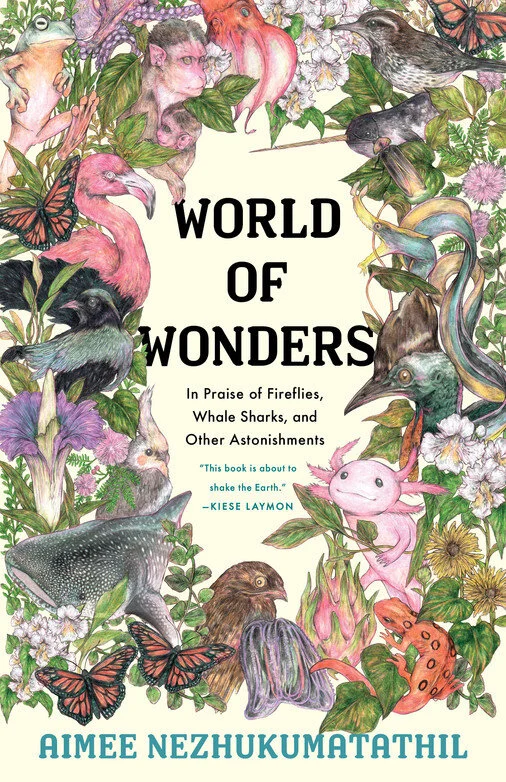
Read Siobhan McKenna’s book review of World of Wonders: In Praise of Fireflies, Whale Sharks, and Other Astonishments by Aimee Nezhukumatathil, published in Yellow Arrow Journal’s Vol. V, No. 3 (Re)Formation issue (fall 2020). Information about where to find World of Wonders and (Re)Formation is below.
Catalpa trees or catalpa speciosa can grow to be almost 60 ft tall, have “foot-long leaves,” and “can give two brown girls in western Kansas a green umbrella from the sun.” So begins Aimee Nezhukumatathil in the first essay of World of Wonders: In Praise of Fireflies, Whale Sharks, and Other Astonishments. This book of 28 lyrical essays weaves together fascinating tidbits about species in our natural world with Nezhukumatathil’s own journey of finding self-acceptance and the meaning of living in a country where being ‘other’ must be navigated on a daily basis. Through the essays, characteristics found within nature reflect Nezhukumatathil’s own qualities as she moves through everyday life.
In her included essays—most titled after a natural wonder and its scientific name—Nezhukumatathil acts as the narrator of a National Geographic documentary. As our guide, she begins in the landscape of her youth where she realized that growing up with a Filipina mother and Indian father set her apart from other children and would color nearly every aspect of her life in the years to come. From there, she whisks the reader from the sweet fields of love as she knew her husband was the one when he “didn’t blanch” at her adoration for the corpse flower (whose scent is reminiscent of “a used diaper pail left out in the late August sun” (70)) to the depths of motherhood where in swimming with a whale shark, she realized that she was “unprepared to submit [herself] so completely to nature” (89) with the implications of the worst occurring: a motherless son.
Nezhukumatathil, an author of four other collections of poetry, spellbinds the reader with her sensory imagery. She compares the petals of a touch-me-not to something that “look[s] as if someone crossed a My Little Pony doll with a tiny firework” (25) and envelops the reader in the smell of a monsoon: like the “wind off the wings of an ecstatic teeny bat” mixed with “banana leaves drooping low,” and “clouds whirring so fast across the sky” (58–59). In fact, every essay is saturated in lush prose that transports the reader alongside Nezhukumatathil as she is slowly sipping a dragon fruit cocktail in “Mississippi when the air outside is like a napping dragon’s exhalations” (115).
But the beauty found in her lyricism does not detract from the gravitas of the messages that underlie her essays. As a daughter of immigrant parents, Nezhukumatathil calls us to be better to one another when faced with diversity and to not succumb to tropes where racism can be chalked up as a sign of older times or the ignorance of children.
In her essay “Monodon monoceros,” she speaks of channeling the narwhal’s preference for swimming through “chunky ice rather than open seas” (35–36) when a boy on her school bus “flipped his eyelids inside out” (38) after she explained to him that her mom was in fact Filipino and not Chinese. And in “Ambystoma mexicanum,” she presents that remembering the smile of an axolotl (thin and tough) “can help you smile as an adult even if someone on your tenure committee puts his palms together as if in prayer every time he sees you off-campus, and does a quick, short bow, and calls out, Namaste!” (45) despite telling him repeatedly that she’s Methodist. Nezhukumatathil demands that we alter what we teach our children about those different from ourselves and how we internalize these differences as adults. By illustrating these cringeworthy and far too common microaggressions, she cries for us to be curious, not assumptive about the questions to which we do not know the answers.
Yet, instead of seeking pity, Nezhukumatathil burns with a firm resolve to find home wherever her feet seep into the soil by calling on the natural world around her. Similar to a red-spotted newt, which takes time “wandering the forest floor before it decides which pond to call home” (139), Nezhukumatathil moved from places such as Arizona, Iowa, and Western New York, before settling in Mississippi with her husband. And although her move from Western New York was precipitated after she became weary “of acquaintances at the post office asking about ‘my people,’” she wonders what would have happened if she saw a red-spotted newt in the midst of a bleak New York winter “skittering under the surface of the ice” (142) as they often do. Like the perseverant newt, Nezhukumatathil thinks she might have stayed, calling to mind that “all this time, my immigrant parents had been preparing me to find solace in multiple terrains and hoping to create a feeling of home wherever I needed to be in this country” (143).
Nezhukumatathil’s disposition toward finding goodness in the face of adversity and using the natural world as a guiding light is what ultimately defines her work and seems especially timely in light of our country’s current social and ecological climate. To me, Nezhukumatathil’s essays serve as a call to action as unmatched wildfires continue to ravage the west coast and racial discrimination is brought to the front of a long-overdue national conversation. Her skillful synthesis of these intense topics into short digestible anecdotes—while still channeling hope—is the precise writing we need right now for us to feel stirred to work toward the daunting tasks of preserving our earth and dismantling racial injustice in our country.
As the compilation winds down, Nezhukumatathil introduces the reader to a Casuarius casuarius or southern cassowary. These flightless birds are native to New Guinea and Australia and are relied upon to preserve biodiversity as a keystone species. Most interestingly, Nezhukumatathil teaches us, in her colorful, rhythmic prose, cassowaries have a call that can’t be heard by humans, but only felt—a “rumble” (148) deep in our bones. She ponders on this feeling: “suppose that boom shaking in our body can be a physical reminder that we are all connected” (149). This musing echoes again and again as the reader encounters each creature and sees a reflection of themselves staring back. Because, Nezhukumatathil warns, in order to reform how we commune with human beings—nature—we must remember that all that is precious in our world will be lost if we do not slow down and feel the vibrations of the earth; feel the beat of each other’s hearts.
Paperback and pdf copies of (Re)Formation are available in the Yellow Arrow bookstore or through most online bookstores. Book of Wonders was published by Milkweed Editions (2020; 184 pages). For more information, visit milkweed.org/book/world-of-wonders.
Siobhan McKenna is a middle child and a lover of bike-packing and practicing yoga. She enjoys writing essays, poetry, and long-winded letters to friends. For the past nine years Siobhan has lived in the charming city of Baltimore, but beginning in the spring she will start work as an ICU travel nurse—moving to a different city every three months to work, write, and explore all that this crazy, broken, and beautiful country holds. You can follow her on Instagram @sio_han.
******
Yellow Arrow Publishing is a nonprofit supporting women writers through publication and access to the literary arts. Thank you for supporting independent publishing.
Guest Post - The Outcast Woman
Hi Everyone,
Brad here – I’m a new volunteer here at Yellow Arrow. (Learn more about the rest of our staff here.) One of the things that has drawn me to YAP is the part of its mission that involves giving a voice to the voiceless. This attraction is, in part, because YAP’s mission dovetails with my own academic interests, which have most recently been focused on a modernist technique that I usually refer to as “textual exclusion.” Textual exclusion is the manner in which authors silence marginalized – often female – voices in their texts, rather than simply describing characters’ alienation and exclusion and letting the reader draw his or her own conclusions. For the last couple of years, I have worked pretty exclusively on exploring this technique in a single, almost forgotten Italian novel called L’esclusa.
L’esclusa translates in English most happily as “the outcast woman” – my own translation of the novel is called simply The Outcast. This is the earliest novel written by Luigi Pirandello, who completed a first draft in 1893. The novel was eventually serialized in 1901, then published as a stand-alone volume in 1908, and finally published in its definitive edition in 1927. You struggling authors out there know very well that it can take many years for projects to see the light of day, but The Outcast’s road to publication was particularly long, dark, and twisty. The funny thing is, Pirandello wrote many highly regarded novels and short story collections early in his career, and later, when he shifted his main literary output from literary fiction to drama, his work gained international recognition, inspired Absurdism and any number of other modernist movements, and he eventually won a Nobel Prize for works like Six Characters in Search of an Author and Henry IV. So why did this novel have such a hard time finding its way to publication?
The Outcast tells the story of Marta Ajala who, as our story begins, is a young wife who has been kicked out of her marital home by her husband, Rocco, after he has discovered her standing in their kitchen, reading a letter from a man he suspects is a potential suitor, Gregorio Alvignani. The strictures of 19th-century Sicilian village life being what they are, Rocco is compelled to “send her back” to her father’s house, despite her not having committed adultery, and indeed despite her being several months pregnant with their (Marta and Rocco’s) first child. This act puts into motion a series of events, including the death of her baby in childbirth, the loss of the family business and their home, and the death of her father, who agrees with Rocco’s decision and has retired from public life out of shame. She and her mother and sister are plunged into poverty. The people of the village, led by Rocco’s corrupt father, turn on her, and despite acing the national examination to become a teacher, she is not allowed to work for “moral” reasons. She flees to Palermo and starts a new life, but despite her ingenuity and drive, she encounters many of the same problems there. With nowhere left to turn, she is – irony of ironies – driven into the arms of Alvignani, who by that time has become a senator and is in a position to help her. In the end – spoilers ahead – Rocco has a change of heart as he and Marta sit vigil before his dying mother, who was kicked out of her home by Rocco’s father for reasons similar to those that compelled Rocco to send Marta packing. Rocco’s mother has, we come to learn, almost certainly committed suicide. In a final climactic scene, Rocco sees the error of his ways, and even though she is now pregnant with Alvignani’s child, he offers Marta his forgiveness, and the novel leaves us there, with what seems like something of a happy ending.
But it’s not a happy ending at all, and the deeper below the surface of the novel one gets, the clearer it is that Pirandello’s intentions are not to point us in that direction. Rocco has attempted a reconciliation more than once over the course of the novel, and whenever he has done so, Marta reminds anyone who will listen that it is not up to him to forgive her; she has not forgiven him (or her father, or the townspeople), and remains vehemently and consistently opposed to returning to her previous life, even if it means poverty and difficulty for her and what remains of her family. Of course, in that final scene, we don’t get to hear Marta’s response to Rocco, which is presumably why many critics have mistakenly reported that Marta and Rocco are reconciled at the end of the novel. In fact, we don’t get to hear Marta say a whole lot in the novel. She doesn’t even get to speak in earnest until Chapter 4 of The Outcast, at which point all of the major characters have discussed her situation at length, and her fate has been decided. Marta is young, capable, intelligent, and resourceful, but her patriarchal society does not recognize those qualities as being valuable in a woman, and as a result, they shut her out. Rather than just describe this exclusion, Pirandello opts to reinforce this point by what amounts to excluding her voice from the novel, at least at key points.
And this, I think, is why the novel had such a difficult road. It’s not because of the subject matter – there are plenty of late-nineteenth-century novels that take adultery as their theme, and plenty with wronged women and strong female protagonists. Pirandello is doing something different here. By excluding Marta’s voice, he makes a leap towards the modern by making us feel her absence. She is silenced. Her voice is lost, and, despite the novel’s faux-happy ending, that voice is not recovered. Indeed, the death of Rocco’s mother reinforces the potential tragedy of this loss of voice. Later, more outwardly experimental writers would use this sort of metatextuality to incredible effect – one can hardly imagine the masterpieces of high modernism and, for that matter, postmodernism, without it – but in the 1890s and 1900s, I’d like to suggest, the world just wasn’t quite ready for it yet.
Most novels try to uncover lost voices – to demonstrate oppression and exclusion – by telling. What I love about this novel and novels like it is that it does just the opposite; it shows us exclusion, and, in doing so, makes us as readers of the novel complicit in Marta’s silencing. That wasn’t easy for readers to understand a hundred years ago. But we’re catching up.
All the best,
Bradford A. Masoni
Book Review: Sonic Memories

It's happy hour on a Saturday. Cija Jefferson and I order fried chicken sandwiches and pile into a booth at a neighborhood bar in Baltimore. My one year old is diving under the table and over the seat in constant motion. Luckily it's only us and the bartender so she avoids getting trampled.We've come here to discuss writing and being a writer and her book, Sonic Memories. She is a generous conversationalist, always turning the talk back to ask about me and my writing. When I tell her I just want to get honest with my words, she nods furiously.That's because Jefferson's collection of essays is exactly that, a raw and honest account of selected stories from her life. As she takes the reader from childhood to present day, her ability to create scenes and dialog that feel real have me forgetting these were not memories from my own life. Each essay is relatable on such a basic, human level. She is able to tap into those emotions that form our collective experience effortlessly.I was particularly haunted by a chapter in her book about leaving her life behind on the East coast for greener pastures in California. This particular story really captured her experience of living in the moment, of enjoying life despite not knowing what lie ahead, and not really caring what lie behind. It brought me back to that glow of youth and less responsibilities. Cija captures this rare, fleeting feeling beautifully in this story.Another theme Cija handles well is the experience of being an outsider. She writes about attending all white schools and reflects on her identity as it crosses worlds and boundaries as she comes of age. It was refreshing to read a unique perspective on life's ordinary episodes.What I like most about Sonic Memories is the overall tone. This writer never says these are things that happened to me and they are really sad, or happy, or embarrassing. No, she just tells her stories. The reader gets the sense that this is just life, and it's no big deal and also the only deal at the same time. It's a heartbreaking, inspiring, and joyful read.Support independent publishing. Pick up a copy of Sonic Memories by Cija Jefferson here.This review was unsolicited by the author. We just liked her book.Yellow Arrow Publishing is happy to review works of creative nonfiction by female identifying authors. If you have a book that fits this description and would like us to review it, please send an inquiry to info@yellowarrowpublishing.com