Yellow Arrow Vignette | BLAZE
Vibrant AF
Liz Swanson
As early as 2017, I began falling. I blew it off. I was used to blowing things off. On a continuum of persistent and productive, I had veered into stubborn and stuck. I’d brush myself off—literally—and get on with my day. There were early signs of illness—and of my terminal stubbornness
In February 2018, I was walking to my car after teaching an alternative-to-criminal-prosecution class at the University of Maryland. I woke up on the ground. A crowd had gathered. The campus police officer eyed my swollen face and scrapes. He insisted, “Miss, you have to file an accident report.” I thought this was excessive—I was just clumsy—but I complied. I drove the 30 miles back to Baltimore. Mile by mile, a black eye blossomed. This was going to be hard to hide.
That night at a party, a friend pulled me aside, out of earshot of my husband. “Can you tell me how you got that black eye?” I recognized his concern. He suspected domestic abuse. I’ve taught these signs in my classes. I laughed it off. “I just fell. Nothing’s broken but my ego.” He gave my husband the side-eye for the rest of the night. Our marriage wasn’t the issue. My illness—and my stubbornness—were
I experienced the shame, embarrassment, and despair of having my private health issues made public. I had been hiding the falls, but not well anymore. The symptoms were intermittent and often unwitnessed. And I refused to admit something was wrong.
In April 2019, I fell in front of a friend while we were hiking around Lake Roland. In mid-sentence, I dropped like a rock.
She helped me up. “What just happened?”
“I’m just clumsy,” I said.
“I’m not buying that. This is syncope.”
“What the heck is syncope? Is that Latin for ‘I don’t know what the heck just happened?’”
“No, Liz. It means you need to go to the doctor and find out what’s going on.”
She probably saved my life—or at least cured me of terminal stubbornness. I went to the doctor. I accepted that I was unsteady on my feet. I started using hiking poles when I hiked—and even when I walked. I stopped trying to hide my symptoms.
Months later at an art opening, a friend asked, “What’s with the hiking poles?”
I joked, “These sticks? All the cool kids are using them.” She laughed, then confided that she, too, felt unsteady since her diagnosis. She refused to use a cane. “I don’t want people to treat me differently.” In her voice, I heard the terminal stubbornness I knew so well. There’s a continuum between grit and denial. I knew how dangerous it was to ignore reality.
I loaned her a set of poles. She became a convert. Now she’s steadier on her feet. There’s no shame in using a reasonable accommodation. On my walks and hikes, the poles often start conversations. Am I cured of stubbornness? Probably not. But I’m in recovery. I’ve learned to listen to my body.
Since 2019, a tsunami of abbreviations has flooded my life: PAD, SVT, AFib, TIA, HTN, CAD, PH. With each acronym was a diagnosis—peripheral artery disease, supraventricular tachycardia, atrial fibrillation, transient ischemic attack, hypertension, coronary artery disease, and pulmonary hypertension. There were treatments, medications, and multiple procedures—including four cardiac ablations.
Each diagnosis brought disbelief and shame. How could my nervous system be stuck in constant inflammation and high alert? Where’s my “Get Out of Jail” card? I understood the mind/body connection.
My first cardiac ablation in December 2019 at Saint Joseph’s Hospital failed to stop the arrhythmias. I sought a second opinion at Johns Hopkins. My appointment was March 5, 2020. We elected to try again—with minimal sedation to better map the problem areas.
Then COVID hit. Elective surgeries were suspended due to the risk of infection, resource allocation, and the overwhelming burden on care systems. In April 2020, my electrophysiologist called: “Hopkins is gradually resuming elective surgeries. Would you consider April 20th?” I knew the risks were measured. No one—least of all me—wanted me to die on the table or of COVID. I elected to have the procedure.
The day of the procedure, we reviewed what minimal sedation meant: I wouldn’t feel pain, but I’d be awake and responsive. It would help map and ablate the arrhythmias. How did I experience this? Think of your heart injected with rocket fuel. I knew I was safe, but I was in the nose cone of a Star Voyager. Eventually, I returned safely to Earth. My electrophysiologist told me many patients were delaying care during COVID. I understood. I posted about my experience on Facebook to encourage others: seek care—pandemic or not.
*****
I struggled back to consciousness as I lay on the hospital gurney. Beds lined the walls. It was February 12, 2021, the height of COVID. How did I get here? The last thing I remembered was the masked EMTs wheeling the stretcher to the top of my steps at home. That’s when I thought, I’m closing my eyes through the scary parts. The rest of the night was nothing but scary parts. In the ER, the doctor kept shouting, “Smile! Smile! Smile!” I couldn’t scowl, let alone smile. I sputtered with frustration—my words garbled and incoherent. I couldn’t flee. I couldn’t fight. I was frozen. After some time, I heard the relief in his voice: “I think this is resolving.” I thawed and smiled at him. He responded, “You had a TIA—a transient ischemic attack—a mini stroke. Consider this your wake-up call.”
I flashed red. “A wake-up call? I’ve already done what doctors told me to do. I’m fit, sane, sound, sober, and tuned. I quit drinking in 1994. I stopped smoking in 1978. I exercise. I have an active social network. I’m compliant with my medications. I keep my appointments. My blood work and metabolic panels are good.” My frustration spilled out. “I have a skilled health care team and a robust family life. Are you blaming me for this?”
He backtracked. “No. Sometimes, it’s bad luck, tough breaks, and your family history.” He eventually released me, and I was home for Valentine’s Day.
Three months later, on May 22, 2021—just months after my TIA and during the COVID spike—I found myself back in the ER. The EMTs dropped me off at Johns Hopkins and left. I was alone, a low-priority patient in a sea of people struggling to breathe. The ER was overcrowded. Many patients stood, desperate for space. I sat on the floor until a public safety officer found me a chair. The lower back pain was so intense I doubled over and vomited into a paper bag. Once I was seen, the doctor asked, “On a scale of 1 to 10, how would you rate your pain?” I replied, “I’m at the digit where I’m throwing up in paper bags.”
My blood pressure was 200/100—lethally high—and my blood tests showed elevated troponin levels, a possible sign of heart attack. I was admitted.
They brought my pain under control with medication, and my blood pressure gradually returned to normal. When I was discharged, they told me I needed to get a better handle on my pain—as if I hadn’t tried. Physical therapy helped. Exercise helped. Acupuncture helped. Spinal nerve ablations helped—for a bit. Then they’d stop helping. The arrhythmias and hypertension sent my system into overdrive. Some days are tougher than others. Despair creeps into the gaps. On the hardest days, I crave a beer, a bourbon, and a cigarette. My pain therapist still provides core support. But I grapple with the question: Am I crazy, lazy, or weak?
In January 2025, test results from an external heart monitor sparked a coordinated response from my care team. This monitor recorded a staggering 4,574 arrhythmia incidents. Even after four ablations, my heart remained inflamed and hyperactive. My primary care provider ordered blood work and metabolic panels to rule out underlying issues for the arrhythmias. My lab work showed healthy levels of cholesterol, glucose, and sodium—the biochemical trinity of a healthy diet. I was managing what I could.
My cardiologist reviewed the lab work. He said, “Your lab work is good, but with your cardiovascular issues, I need you to be in the Fabulous Zone. A gazelle always keeps an eye on the lions.” I reminded my doctor that another ablation would be my fifth. He quipped, “I thought three times was the charm.” He consulted with the electrophysiologist.
On February 21, 2025, my Hopkins electrophysiologist and I discussed the Farapulse PVI (pulmonary vein isolation) ablation at Johns Hopkins. This FDA-approved procedure for atrial fibrillation wasn’t available in 2019. I wouldn’t be a guinea pig—but I’d be one of the early recipients. The science keeps evolving.
Afterward, my electrophysiologist walked into the recovery room with a smile, good news, and a postcard. “We found the source of the AFib and were able to ablate the arrhythmias.”
I was relieved. “Thanks for chasing them down! I appreciate your persistence. I appreciate you not giving up on me. How can I help others get access to this kind of care?”
He handed me the brightly colored postcard about the Farapulse research study on atrial fibrillation. I gasped, then laughed. The study’s name? Vibrant AF. The title must be the brainchild of a next-gen electrophysiologist. I welcome their expertise, enthusiasm, and humor. I intend to live Vibrant AF—that’s my conscientious enthusiasm. That’s the prose and poetry of who I am. I aim to be a success story for everyone involved. It’s the best way I know to say thank you. There is always a reason to despair—and—always a reason to hope.
The prose? I’m part of a research study on atrial fibrillation. I am thriving. (For more information, email the research team at VibrantAF@ucsf.edu.)
The poetry? I am Vibrant AF.
My mantra?
I am grateful.
I am hopeful.
Fuck despair.
I am Vibrant AF.
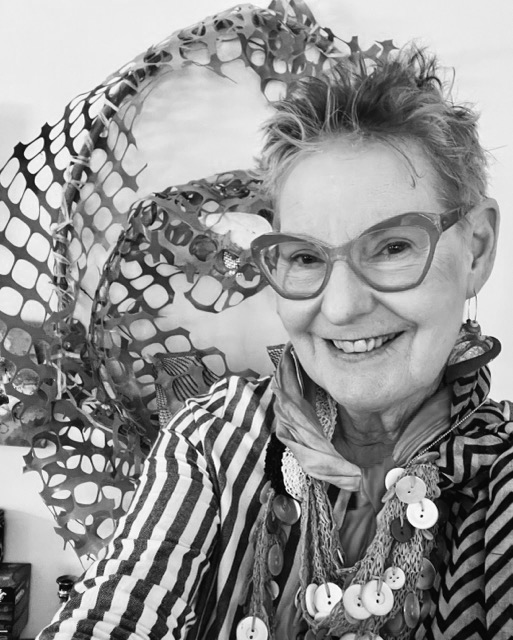
Liz Swanson is Vibrant AF—artist, writer, and accidental medical marvel. She’s spun construction fencing into gallery gold, turned neckties into social commentary, and uses hiking poles as mobility aid and conversation starter. Style matters. Fashion counts. Liz struts 70+ on the runway with flair. A performer, coach, and heart patient turned research subject, she bridges art, humor, and healing. With five cardiac ablations, decades of social practice, and zero tolerance for despair, she creates joy from chaos and community from crisis. Life is her canvas—and she paints it with sequins.
About the author