Yellow Arrow Vignette | LUMINATE
The Oyster
Alyssa Crogan
The shell looks insignificant and dirty in your hands. You run your fingers over its topography, pausing over the unlikely iridescence of its insides and the purple scarring from the muscle that once held fast.
“Where are the pearls?” you want to know. You sound angry. You squeeze the shells like it owes you something. You are trying to understand. You want to know the worth of this thing—this ugly, beautiful thing. This rock that is not a rock. It doesn’t make pearls.
You flip the shell in your palm, yanking at the bits of black that cling to its outside. No, these are not baby oysters. They are mussels. Opportunistic-hitchhikers, alive and clinging to the hardness of what once was. The examination continues. I watch as you pause, horrified. There is a worm squeezing its many-legged body between the barnacles growing clustered together. You lean forward in time to see it extend tiny mandibles from deep within its esophagus.
“It’s a worm!” you say.
The statement is redundant, but I forgive you.
I hand you a clump of closed shells, and you seem surprised by the heaviness. You cannot open these, but that is the point. The animal is alive—brainless but ever-determined to hold itself closed. You seem to respect this. Perhaps there are parts of you that are unknowable, too.
“Place it in the water,” I prompt you, and you do. All at once, the Martian landscape comes alive: barnacles kicking their feet in a lazy, curling motion; anemones unspooling tiny tentacles to wave up at you. Through the haze of the water, you spot a crab the size of your pinky nail as it scuttles out from an uninspected crevice. You smile for the first time. These animals move in a way that feels familiar. Everything makes more sense underwater than it did in your hand.
“But what does it do?” you ask. You’re starting to tune in to some inherent worth beyond profitability or sustenance. You refuse to underestimate this thing again. I don’t have the words to express to you the power of it all, so I invite you to sit. You watch as the cloudiness of the bucket begins to clear, a green hue you hadn’t noticed at first resolving. Sunlight plays over the crab as it crawls slowly along the bottom of the bucket. You squint hard at the clump and imagine the shells opening and closing, millimeters at a time, drawing the water in.
“Somehow, one of these rocks can cycle up to fifty gallons in one day,” I tell you. The scale of it escapes you. It is too big-small to understand.
You grow restless. You want to see inside it—to touch a live one. Never mind that you’ve eaten dozens in your lifetime with no comment beyond, “Pass the lemon.” But I oblige because there are still so many things you do not understand. I slide the knife inside the weakest point, fumbling inside to slice the muscle. I peel the shells apart.
With the gooey creature flayed open between us, I wonder if I’ve made a terrible mistake. You ask me if we could eat it—how it might taste. I’ve lost you somehow. I cut open its stomach instead, thumbing through the green algae within. You recognize the color from the water in the bucket. Pieces begin to slot into place. You notice, in a stroke of genius, a slow pulsing just above its muscle: the beating heart.
You are beginning to see yourself cut open and exposed. All the overlooked potential. The thankless labor.
You pick the shells up. You cradle one in each hand. “Will it die?” you ask, and you sound sad. This always happens.
I tell you about shell recycling, broadcast spawning, and mother shells; about decades-long wars and greedy pirates; about over harvesting and near extinction; about aquaculture, resource police, and volunteers working hard to undo an unnecessary mess.
Your expression softens as you take this in, absorbing what you can. It is time to return it, this small miracle, to the harbor. Your knuckles are white as you dangle the shell over the edge of the boat. Before you drop it into the water, I can see your lips moving, mouthing a silent thank you.
About the author
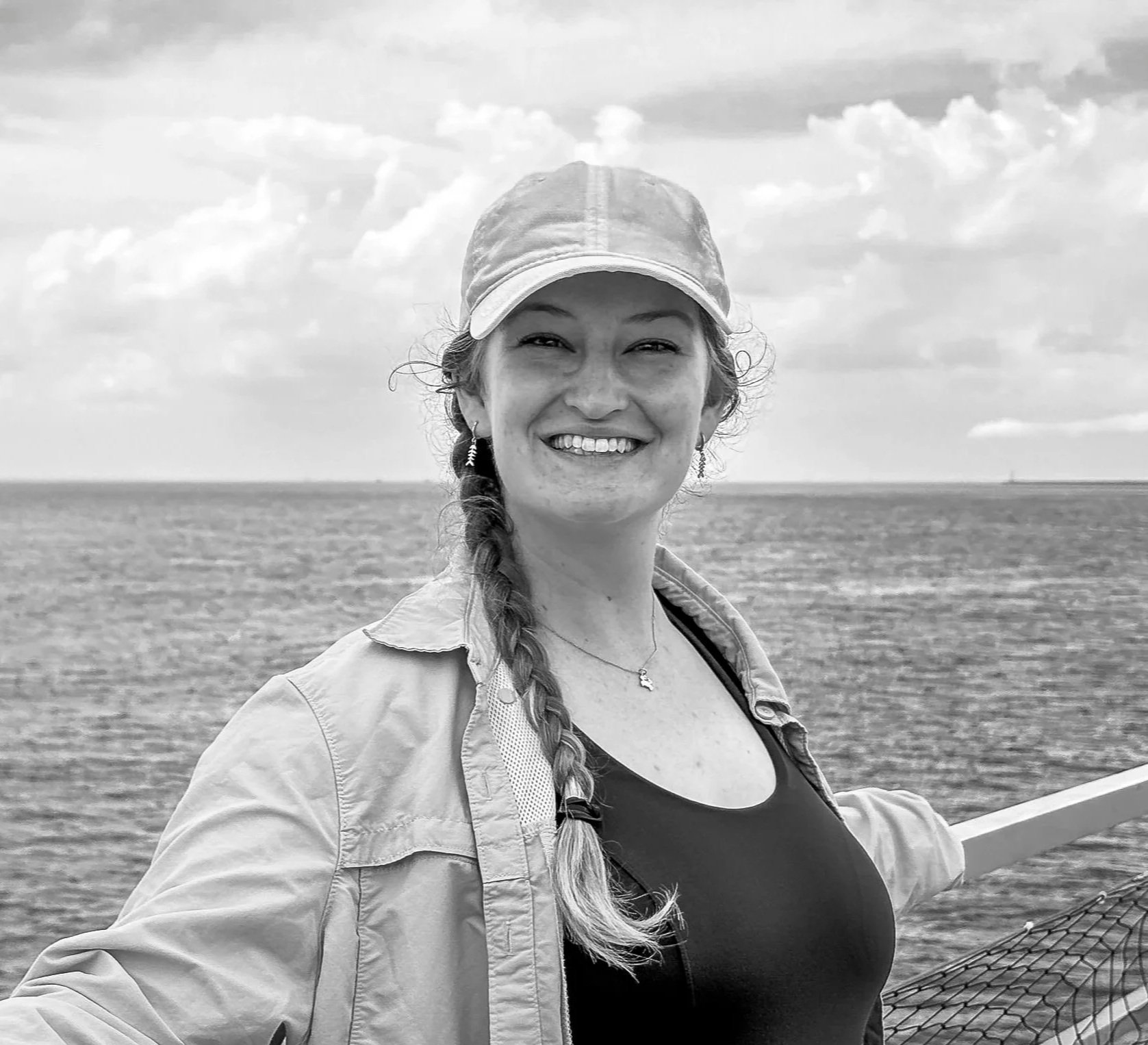
Alyssa Crogan is a writer, educator, and naturalist based in Baltimore. She works in the harbor, connecting students with their local watershed and exploring the relationships between people and place. Her writing is shaped by a deep connection to ecology, examining the intersection between human nature and the natural world. Her debut piece, “Hobby Farming,” published in The Hopper, was nominated for a Pushcart Prize.