.Writers.on.Writing.
Get to know our authors, the foundation and heart of Yellow Arrow Journal, and what writing means to them through our monthly series.
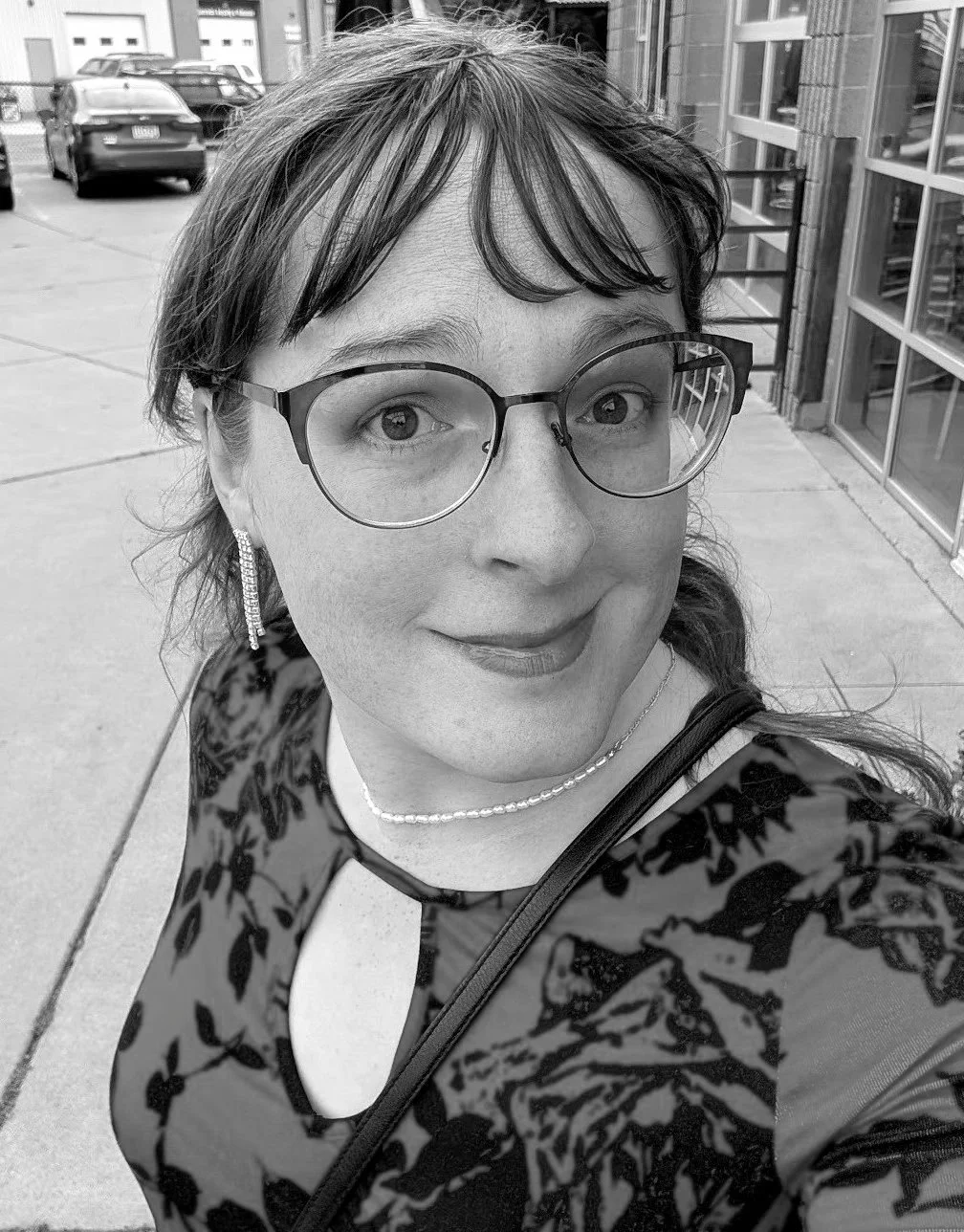
.W.o.W. #85
Rozalija Grace
Describe an early experience where you learned that language has power.
I grew up in Alaska—which, in addition to being a former Russian colony, has a large Russian immigrant and expat population. My mother’s ancestry was partially Russian, but her family had long since lost the language and the culture. I, however, was drawn instinctively to everything Russian as a child, being surrounded by the culture the way I was, and the language was the most important part. It drew the crucial dividing line between being passively of Russian descent, like my mother, and being actively part of the Russian diaspora. My Russian is still imperfect, but the power I gained through learning the language has been the power to define myself. I wouldn’t be out of the closet, I wouldn’t be engaged to my miraculous fiancée, and I wouldn’t be writing as I do—even in English—without it.
Why did you submit this piece to Yellow Arrow Journal? Why this piece at this time?
The WONDER call struck me with its emphasis on the “interplay between curiosity and creativity.” What came to my mind was the people I have been curious about in my life—people who, by inspiring me to want to see them more clearly, have made me see myself and the world differently. Elisheva is someone it’s almost impossible to have a conversation with, without finding something new within or around you that demands expression. Our friendship actually started when I—just one of her many followers on Twitter at the time—wanted to respond to a draft she had shared, and my attempt to articulate what moved me about that piece accidentally turned into a poem of its own (called “Eagles”). She’s been making me write more and better poetry ever since.
How does the synergy of curiosity and creativity encourage your personal writing process?
In a very 2026 metaphor I’d say my writing process is like a two-stage ballistic missile. A spark of creativity—a desperate impulse to communicate something that ordinary speech and gesture aren’t enough for—is the first stage. It brings me to the edge of space—to a suspension of weight where I can turn an idea over freely and consider it from all sides, where all manner of possibilities are laid open. Then curiosity kicks in. I wonder how others have addressed this situation or feeling before. I wonder what other kinds of meaning have been attached to the symbols that the experience presents to me. I have often said that there is more research behind one of my poems or short stories than behind most of the papers I wrote in grad school, and that is often true. I crack encyclopedias, etymological dictionaries, biographies, histories . . . And out of this curiosity, I am propelled like the second stage of the missile; my creativity acquires velocity toward a specific target. Then, if I’m lucky, it explodes.
What does your inner writing voice tell you?
I don’t think I have one of those.
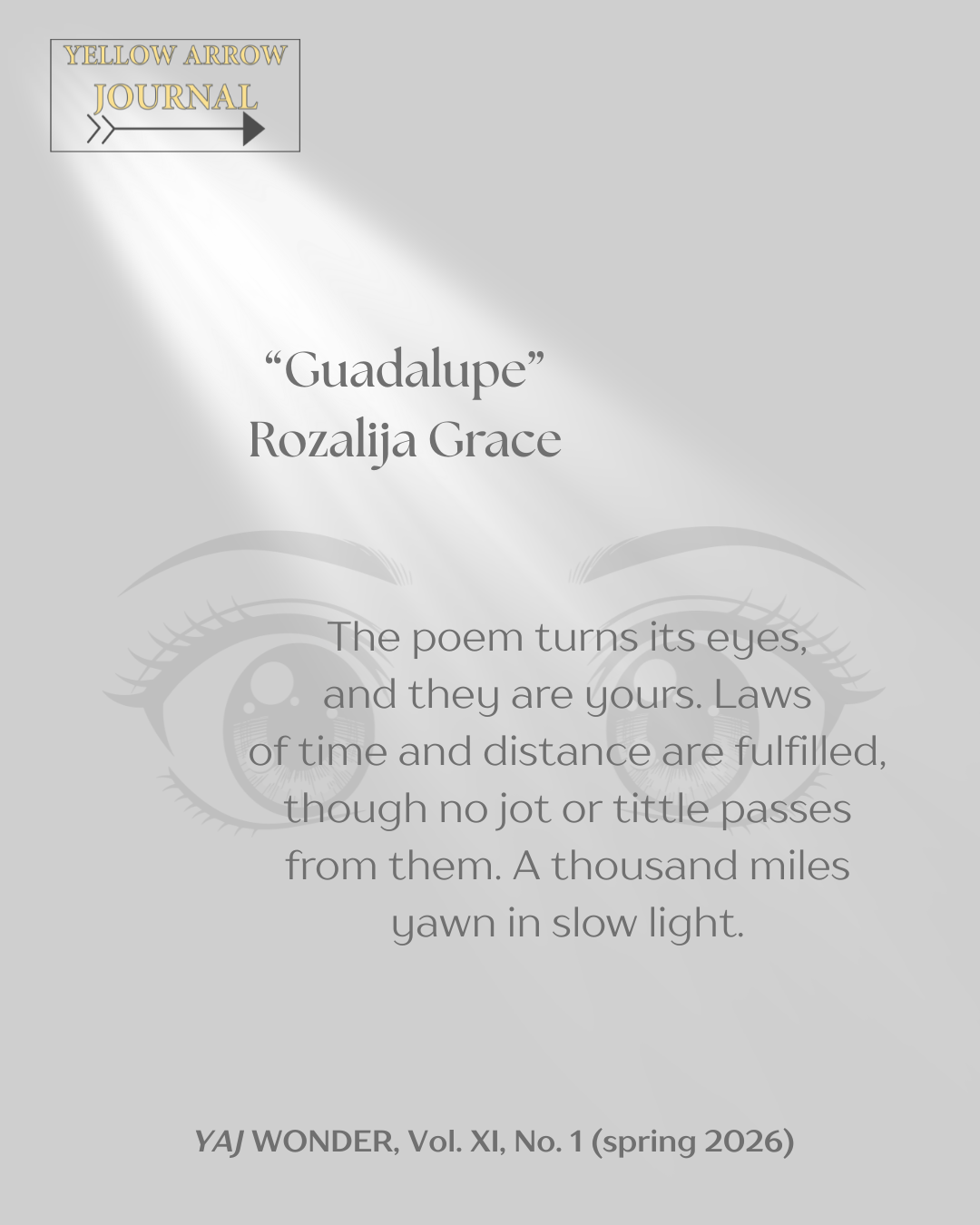
Rozalija Grace is a Russian and Armenian diasporic writer, translator, and cultural activist from southern Alaska. Her poems, short stories, and essays explore identity, language reclamation, and inclusive orthodoxy and have been nominated for the Pushcart Prize and featured in Dappled Things, Rust & Moth, Room, and other journals. Her translations of early Soviet poetry have been nominated for Best Literary Translations. She currently serves as a poetry editor for Psaltery & Lyre and lives in Minneapolis as the fiancée of a great American novelist.
Her poem, “Guadalupe,” was included in Yellow Arrow Journal WONDER, Vol. XI, No. 1, Spring 2026. You can find Rozalija on rozalijagrace.com and Bluesky @rozalijagrace.com.