.WRITERS.ON.WRITING..Writers.on.Writing.
Get to know our authors, the foundation and heart of Yellow Arrow Journal, and what writing means to them through our monthly series.

.W.o.W. #79
Rebecca Hart Olander
Why did you submit this piece to Yellow Arrow Journal? Why this piece at this time?
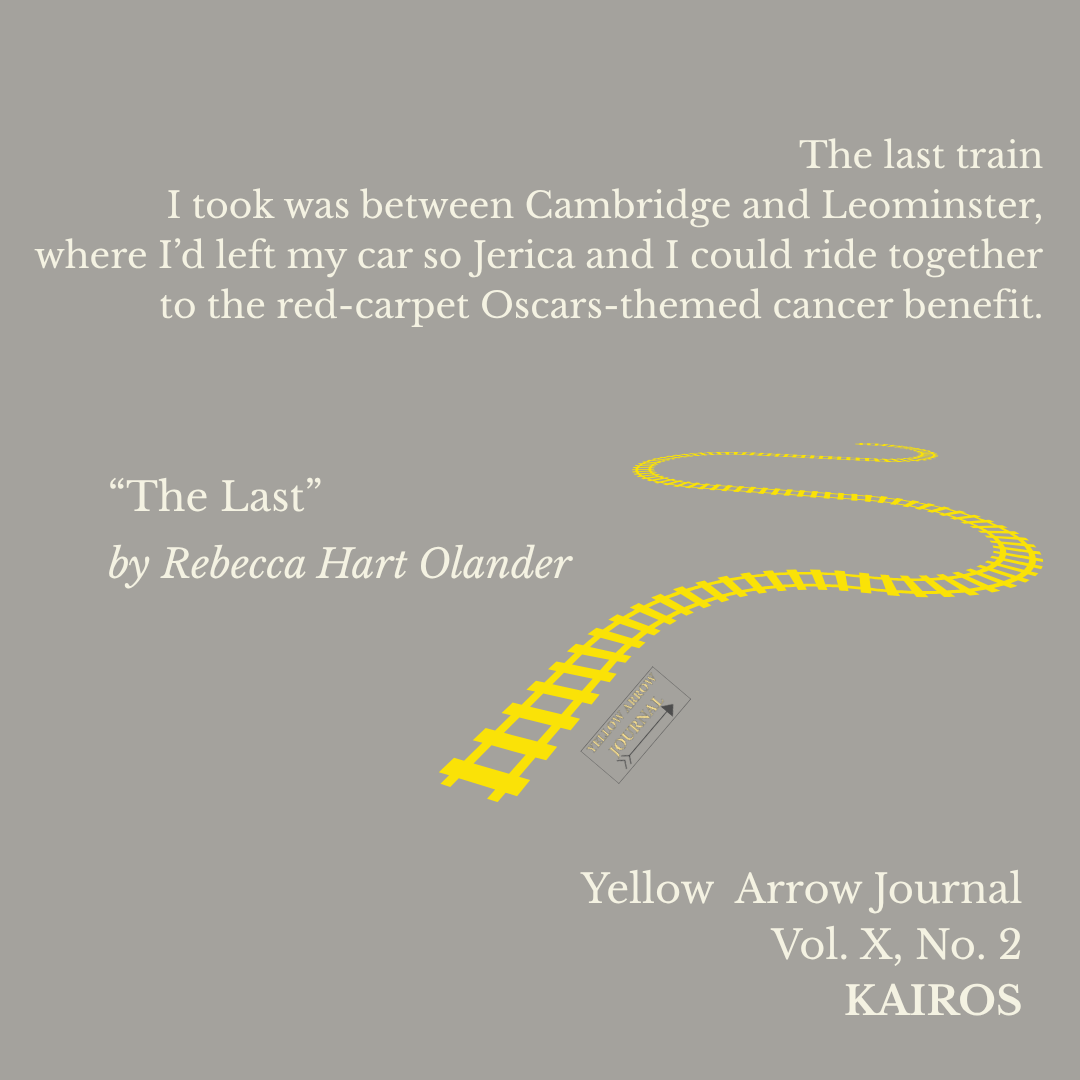
My poem “The Last” is for my dear friend Jerica, who died in 2020 of breast cancer. My second full-length collection, Singing from the Deep End, has a center section of poems written in honor of Jerica and our friendship. The book will be published in February 2026, so I had a small window in which to send unpublished poems from the book into the world. Yellow Arrow Publishing, with its focus on uplifting the work of women, is a journal I’ve admired and felt like the perfect home for a Jerica poem. Friendship with Jerica altered me, as did her passing. She shaped me, and the path I walk on is forever bordered by both her presence and absence, so the theme of KAIROS felt apt. I’m grateful the editors agreed!
Describe an early experience where you learned that language has power.
This question makes me think of the power of books and the magical way we get lost in them as young readers. Being transported as a reader is something I miss having as much as I once did, and I love those rare moments when I can reclaim that feeling. But I also think of my mother as storyteller, my stepmother as poet, and of music, the soundtrack of my childhood. Then there is the inverse power, the inability to put language to something, to name it, or being made to keep something silent. Or using language to judge. That whole “names can never hurt me” chant never rang true for me.
What does your inner writing voice tell you?
I don’t think I know! I’m so used to training myself not to listen, as in to reject the inner editor, that I’m not sure I’m listening to her! Hmm. . . Much of my work stems from childhood, so I guess she is my memory, and she’s telling me to remember, or what details to unearth and share.
If you could tell your younger writing self anything, what would it be?
Be patient, but also, go looking for the sparks! As for patience, my first full-length collection, Uncertain Acrobats, was published the month I turned 50, in November 2021, and I had sent it out about 60 times before it was accepted. Also, I haven’t always practiced writing on a regular schedule, but I have been steadfast in my attention to poetry over time. Regarding the sparks, I used to think some muse had to hit me over the head to grace me with an idea. Now I know it’s necessary to, as Emily Dickinson famously said in a letter, go “out with lanterns, looking for myself.” For me this means engaging in poetry community, spending time inartistic spaces or in nature, responding to prompts to get myself generating, and reading the work of others.
Rebecca Hart Olander is a Women’s National Book Association Poetry Award winner and the author of three poetry collections: Dressing the Wounds (dancing girl press, 2019), Uncertain Acrobats (CavanKerry Press, 2021), a finalist for the Eric Hoffer Book Award in Poetry and the Massachusetts Book Award in Poetry, and Singing from the Deep End (CavanKerry Press, 2026). Rebecca has taught writing at Amherst and Smith colleges, Westfield State University, and Pioneer Valley Writers’ Workshop, and she works with poets in the Maslow Family Graduate Program in Creative Writing. She is the editor/director of Perugia Press.
Rebecca’s poem “The Last” was included in Yellow Arrow Journal KAIROS, Vol. X, No. 2, Fall 2025. You can find her at rebeccahartolander.com, on Instagram @rholanderpoet, or on Facebook.
.Writers.on.Writing.
Get to know our authors, the foundation and heart of Yellow Arrow Journal, and what writing means to them through our monthly series.

.W.o.W. #78
Gloria Ogo
How did you first publish your writing and what was it?
My first published work is the novel While Men Slept. It was published in Nigeria and approved by the national education board for use in Nigerian universities, colleges of education, and high schools. Since then, I have never stopped writing.
Describe an early experience where you learned that language has power.
When I was in elementary school I remember standing in front of my classmates during a reading exercise. I had always been quiet, the kind of child who preferred observing to speaking, but that day I read aloud a short story I had written. The room grew unexpectedly still. The fact that words I had strung together could hold the attention of 30 restless children stunned me. Afterward, a teacher told me, “Your voice paints pictures,” and I realized that language could move people, not just carry information. It could silence noise, create images, even shift the way others looked at me. That moment taught me that language is not neutral, it has weight, rhythm, and power to shape how we are seen and how we see the world.
What is essential for good storytelling? What types of stories do you find yourself driving inspiration from and how do they manifest in your work?
For me, good storytelling requires honesty, tension, and resonance. A story must feel true on an emotional level even if it unfolds in imagined worlds. I believe what’s essential is the balance between voice, structure, and the deeper pulse of human experience; something that lingers beyond the page. I often draw inspiration from stories that sit at the intersection of reality and the surreal: folktales, speculative fiction, and narratives rooted in history but reimagined through myth or memory. I’m especially drawn to stories that carry the weight of displacement, identity, and transformation because they mirror the complexities of lived experience while also offering a way to dream beyond it. These influences manifest in my work through layered characters, blurred boundaries between the real and the unreal, and imagery that bends the ordinary into something luminous or unsettling.
What does your inner writing voice tell you?
Keep going. You will get there.
Gloria Ogo is an American-based Nigerian writer with several published novels and poetry collections. Her work has appeared in Eye to the Telescope, Brittle Paper, Spillwords Press, Metastellar, CON-SCIO Magazine, Kaleidoscope, The Easterner, Daily Trust, and more. With an MFA in creative writing, Gloria was a reader for Barely South Review. She is the winner of the Brigitte Poirson 2024 Literature Prize and a finalist for the Jerri Dickseski Fiction Prize 2024 and ODU 2025 Poetry Prize, both with honorable mentions. Her work was also longlisted for the 2025 American Short(er) Fiction Prize.
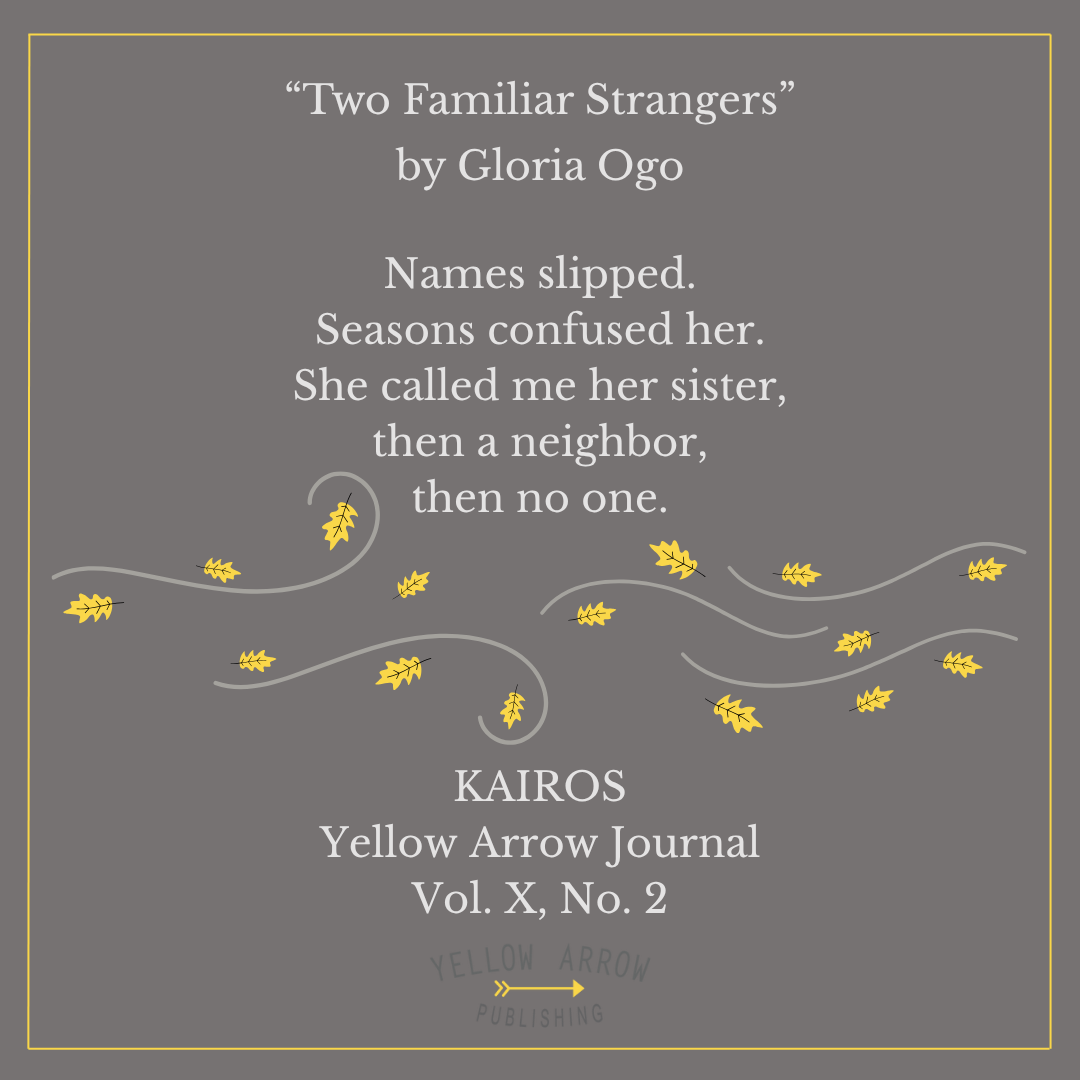
Yellow Arrow published Gloria’s piece “Two Familiar Strangers” as the foreword to Yellow Arrow Journal, Vol. X, No. 2, KAIROS. You can find her online on Facebook @gloria.ekedum and at glriaogo.wixsite.com/gloria-ogo.