.WRITERS.ON.WRITING..Writers.on.Writing.
Get to know our authors, the foundation and heart of Yellow Arrow Journal, and what writing means to them through our monthly series.
.W.o.W. #80
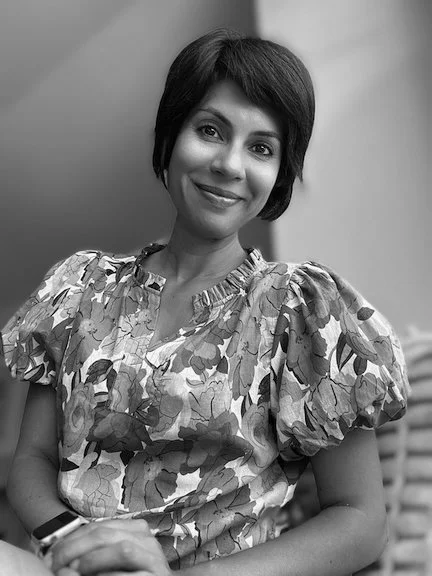
Mansi Bhatia
Why did you submit your piece to Yellow Arrow Journal? Why this piece at this time?
This piece emerged from a season of deep introspection—a reckoning with old narratives, inherited silences, and the ways we unbind ourselves from the past. “In the Dark: Unbound, Unafraid” is about stepping into one’s own light after years of living in the shadows of cultural expectations. For me this essay felt like shedding the weight of inherited trauma while making space for a new way of being—for both myself and my daughter. I submitted it to Yellow Arrow Journal because UNFURL is a perfect match for this essay’s exploration of transformation, inheritance, and the intentional unmaking of outdated narratives. This piece speaks to the unique journeys women take when reclaiming themselves from cultural, familial, and societal conditioning. It aligns with the journal’s mission to amplify underrepresented voices—particularly those navigating complex cultural and generational identities. We are in a moment where motherhood, identity, and autonomy are at the forefront of cultural conversations. Whether in discussions about reproductive rights, intergenerational trauma, or the shifting expectations of women across cultures, this piece speaks to a collective reckoning—one that asks:
What do we carry forward and what do we leave behind?
How do we unfurl into our truest selves while honoring where we came from?
How do we rewrite the stories we inherit without erasing them entirely?
This piece isn’t just personal—it’s a reflection of a larger, urgent conversation about women’s agency, lineage, and self-definition. It’s about choosing to mother differently, live differently, and tell new stories that make space for freedom.
What period of your life do you find you write about most often?
I return to the in-between spaces—adolescence, early motherhood, moments of transition. The times when identity is fluid, when belonging, feels both urgent and unattainable. The times when everything felt like it might break apart but somehow held together. These are the periods that shaped me, and I find myself revisiting them in different ways, through different lenses, in nearly everything I write.
What does your inner writing voice tell you?
To let the words fall out, without self-censorship or judgment; to embrace the ugliness and the broken parts just as much as the beauty.
What book is on the top of your to-be-read pile?
Making Time: A New Vision for Crafting a Life Beyond Productivity by Maria Bowler.
Mansi Bhatia (Mansi) is a writer and creativity facilitator exploring themes of identity, human connection, and the ripple effects of kindness. Her work examines the complexities of motherhood, cultural boundaries, and personal transformation. She is currently writing a book on the intersection of art, storytelling, and everyday generosity, forthcoming from Schiffer Craft in Spring 2027. Through her work, she encourages others to embrace creativity as an act of self-trust and presence. She lives in California with her family.
An essay, “The Field Between Us” was nominated for a Pushcart Prize by Chicago Story Press. Mansi also has two essays forthcoming: “An Unwanted Inheritance: A Fractured Love,” which will be published by Pangyrus Literary Magazine, and “Easier to Let You Win,” which will be published by ManifestStation.
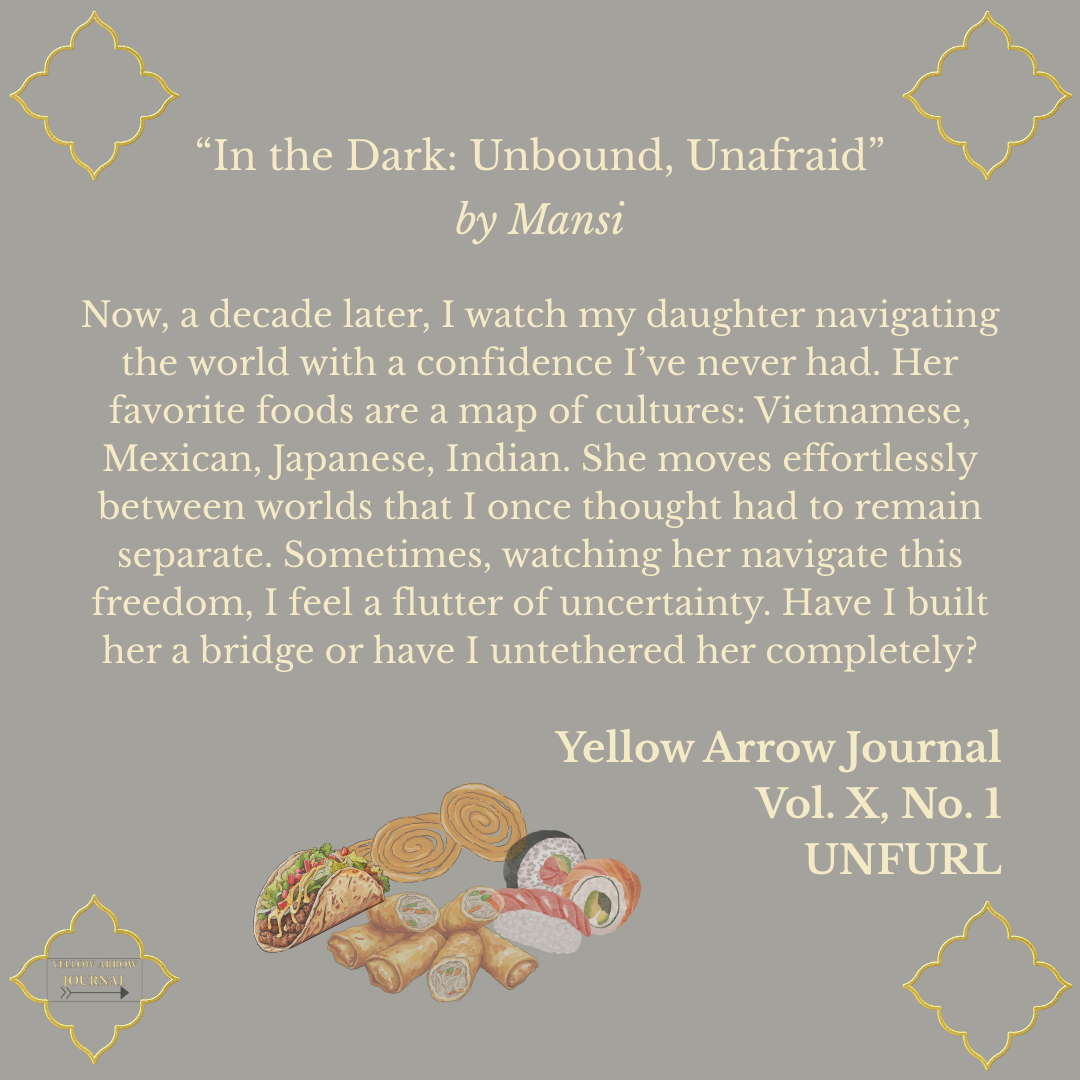
Yellow Arrow published Mansi’s essay “In the Dark: Unbound, Unafraid in Yellow Arrow Journal UNFURL, Vol. X, No. 1, Spring 2025. You can find Mansi at littletokensbigripples.com or on Instagram @littletokensbigripples.
.Writers.on.Writing.
Get to know our authors, the foundation and heart of Yellow Arrow Journal, and what writing means to them through our monthly series.
.W.o.W. #77
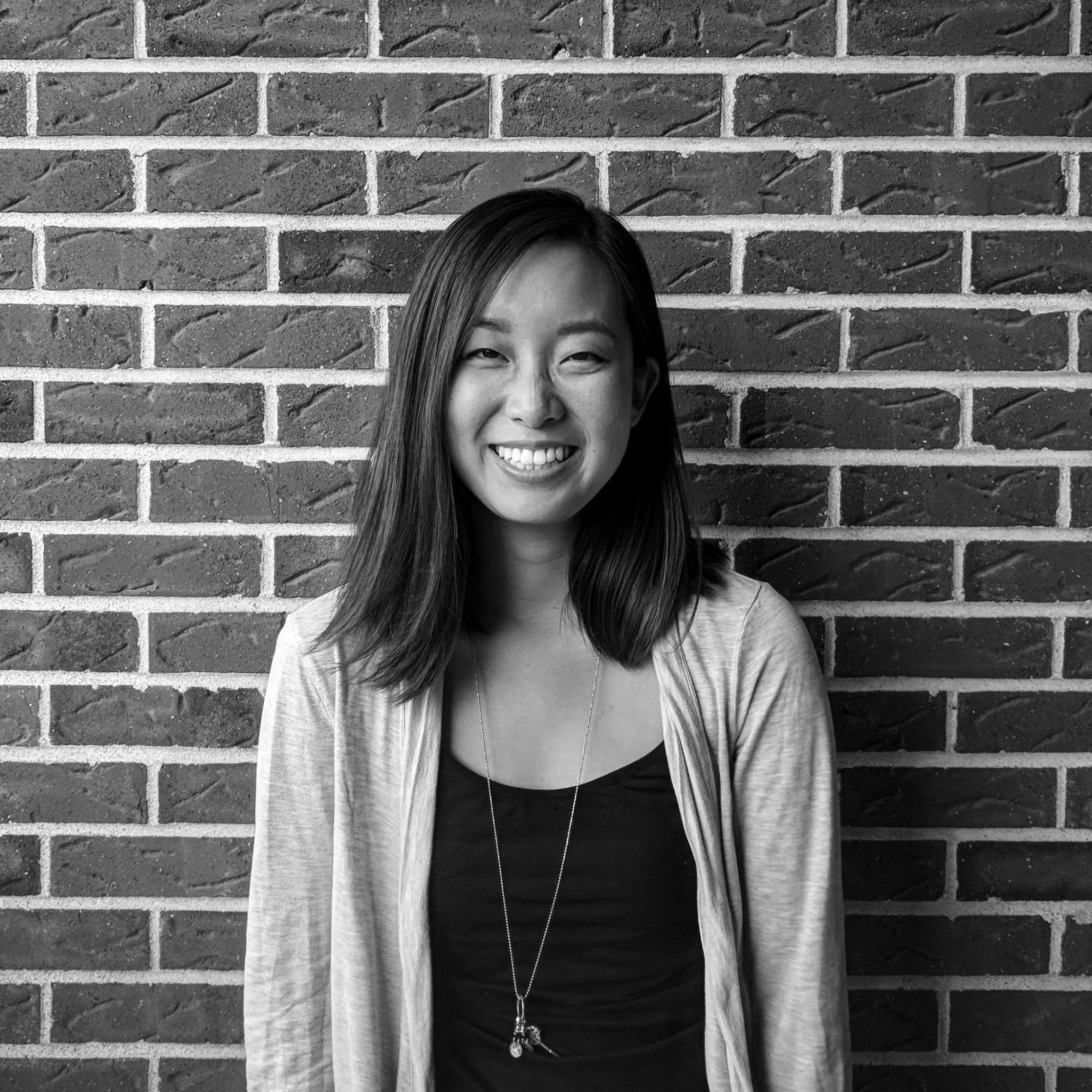
Melanie Hyo-In Han
What does your inner writing voice tell you?
Write so others who feel isolated can find a sense of home and belonging.
Describe an early experience where you learned that language has power.
I grew up in East Africa where I spoke Korean at home and Swahili in the community. When I was five years old, I started learning English for the first time at school and became frustrated by the fact that I couldn’t communicate effectively. I wanted to play with my classmates but could only point at things or smile, and that’s the first time I realized how much power language has. As a kid, I obviously picked English up really quickly, but it wasn’t until I was much older that there was a lot of resentment I’d felt not being able to express myself and then the eventual freedom that came with being able to talk to others.
What word do you find yourself using most often in your writing?
Probably the word “home” since, in my writing, it’s sometimes a tangible place, but most often, it’s a feeling or an abstract location that I seek to explore.
How did you last publish your writing (before Yellow Arrow) and what was it?
It was a chapbook of nature-related poetry titled Abecedarian: Banff, Canada by kith books. I was invited to participate in a writing residency last summer at Banff Centre for Arts in Creativity, and though nature poetry isn’t my usual forte, I was so inspired by the beauty of Banff that I decided to write some poems about the flora and fauna of the national park. I sent the chapbook manuscript out to several publishers and was lucky enough to have it picked up by kith books, and it was released just this past March, which is very exciting!
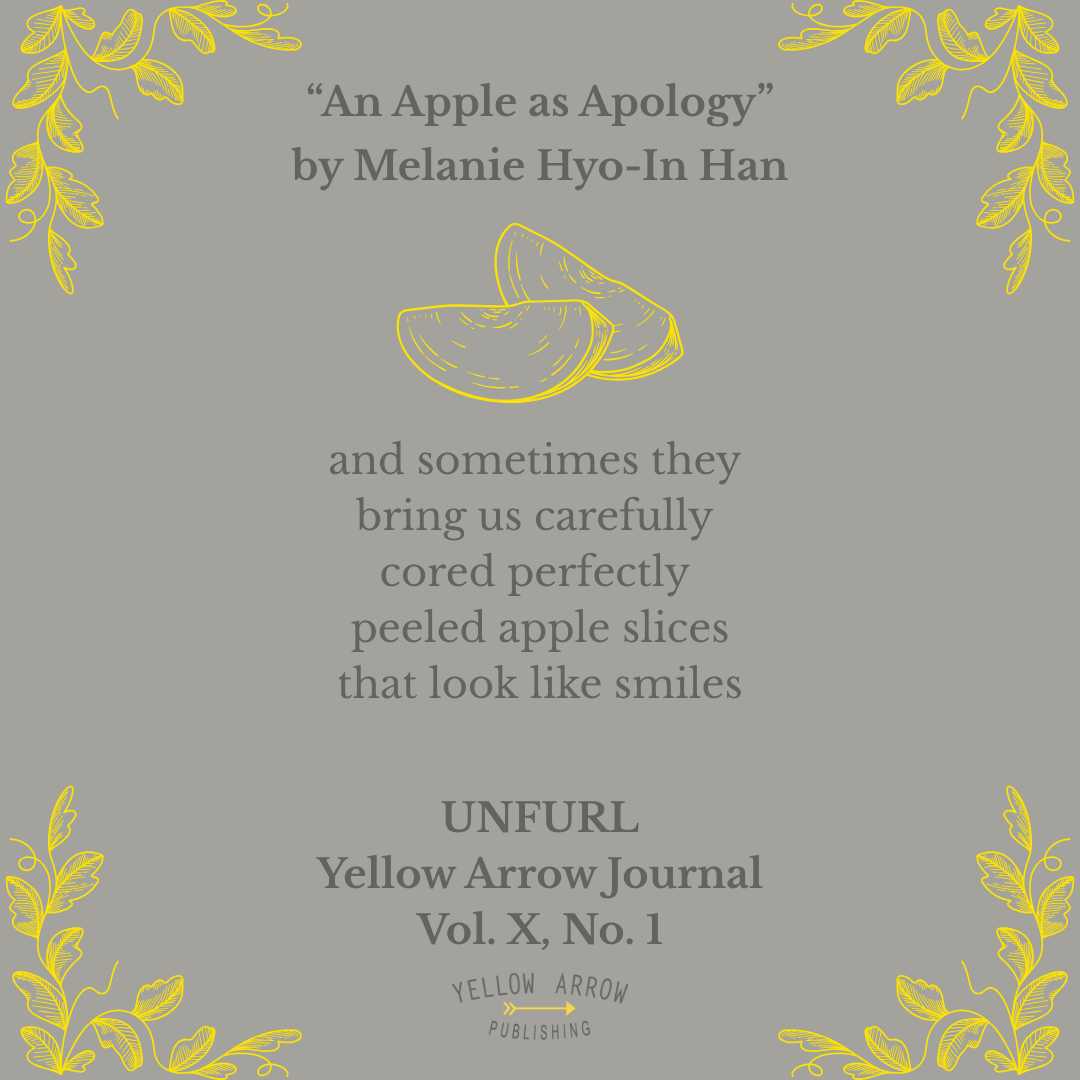
Born in Korea and raised in East Africa, Melanie Hyo-In Han recently moved from the U.S. to the U.K. She is the author of Abecedarian: Banff, Canada (kith books), My Dear Yeast (Milk & Cake Press), and Sandpaper Tongue, Parchment Lips (Finishing Line Press), as well as the translator of several collections of Spanish poetry (Hebel Ediciones). Melanie has been awarded fellowships from Gladstone’s Library, The Society of Authors, Sundress Academy, Banff Centre, and Casa Uno. She is the Coeditor-in-Chief of Flora Fiction and the Two Languages Prize Editor at Gasher Press.
Yellow Arrow published Melanie’s piece “An Apple as Apology” in Yellow Arrow Journal, Vol. X, No. 1, UNFURL. You can find her online on Instagram @melhan and at melaniehan.com.
Recently, Melanie published a chapbook with boats against the current entitled Passing Notes in Secret. We absolutely enjoyed reading the chapbook; make sure to get your copy at boatsagainstthecurrent.org. Congratulations Melanie!
.Writers.on.Writing.
Get to know our authors, the foundation and heart of Yellow Arrow Journal, and what writing means to them through our monthly series.

W.o.W. #74
Kalehua kim
Describe an early experience where you learned that language has power.
While taking hula classes as a young child, I felt a great connection to the chants and songs my teacher sang. It helped me find a specific rhythm in my body as I danced. I believe those rhythms are present in my writing as well.
How did you first publish your writing and what was it?
In high school I entered the Young Authors competition where we had to physically bind the stories we submitted. That meant I typed up each page, asked a friend to illustrate it, and then made a cover out of cardboard that my mother helped me cover with fabric and scraps of old shelf paper liner that we assembled around the pages. I don’t remember the name of the story, but there was a mythical element involved. I didn’t win, but it taught me a lot about storytelling and its packaging.
What does your inner writing voice tell you?
Stay open. Listen.
What is essential for good storytelling? What types of stories do you find yourself driving inspiration from and how do they manifest in your work?
I think good storytelling stems from some kind of truth, whether it’s a core value or experience. Having your speaker or character question that truth or work within the complications of that truth can draw in a reader. I like stories that push expectations. What might start as something simple often becomes fraught as the protagonist grapples with it, and then we, too, are confronted with how we might act in a similar situation. I am inspired by characters that question themselves with a true desire to gain greater understanding of themselves and the world. In my work, that usually calls into question how I relate to my culture and upbringing (I am mixed Native Hawaiian and grew up both in Hawai’i and California) as I try to understand the liminal space I exist in as an Indigenous person and woman from mixed cultures living away from my birth land.

Kalehua Kim is a Native Hawaiian poet living in the Pacific Northwest. Her poems have appeared in Poetry Northwest, Denver Quarterly, and ‘Ōiwi, A Native Hawaiian Journal. Her first poetry collection, Mele, will be released on July 1. It can be ordered through Trio House Press at triohousepress.myshopify.com/products/pre-order-mele-by-kalehua-kim.
Yellow Arrow published Kim’s piece “There’s a trick with a pen I’m learning to do” in Yellow Arrow Journal, Vol. X, No. 1, UNFURL. You can find her online on Instagram @kalehuakim, Facebook @kalekim, BlueSky @kalekim.bsky.social, and at kalehuakim.com.
.Writers.on.Writing.
Get to know our authors, the foundation and heart of Yellow Arrow Journal, and what writing means to them through our monthly series.

W.o.W. #73
Majiq Vu Mai
How did you first publish your writing and what was it?
The first piece of writing that I published was a short fiction piece that I wrote in middle school about a young girl who struggles to break free from the chains that other people put on her. I published it by handing out multiple handwritten copies of my story to my classmates in the back of English class.
What is essential for good storytelling? What types of stories do you find yourself driving inspiration from and how do they manifest in your work?
A willingness to be a bad storyteller is essential for good storytelling. Oftentimes, what kills a good piece is the fear that prevents us from writing it. The type of stories I find myself deriving inspiration from the most include protagonists who learn to love themselves through the bitterness of life. I find inspiration in these types of stories because I’m someone who holds a lot of bitterness myself. This inspiration shows up in my writing in how I elicit medicine out of the bitterness of my life, through the alchemizing process of storytelling. Powerful medicine often tastes bitter on the tongue. We swallow it anyway because we trust that swallowing the truth will make us better on the other side.
What word do you find yourself using most often in your writing?
I find myself using the word “possibility” the most in my writing. If I don’t know what word to put down, I put down “possibility” as a placeholder until I could find a better word to use. There are so many possibilities when it comes to using words—maybe we struggle to use them not because we have too few words but because we have too much. But I also think that’s the fun of words, there are an infinite number of arrangements to be made with them.
What does your inner writing voice tell you?
My inner writing voice tells me that my words matter, even when I feel like they don’t. Even if no one reads them. The worst thing that can happen is that I stop writing. How will I know what my heart has to say if I keep everything inside?
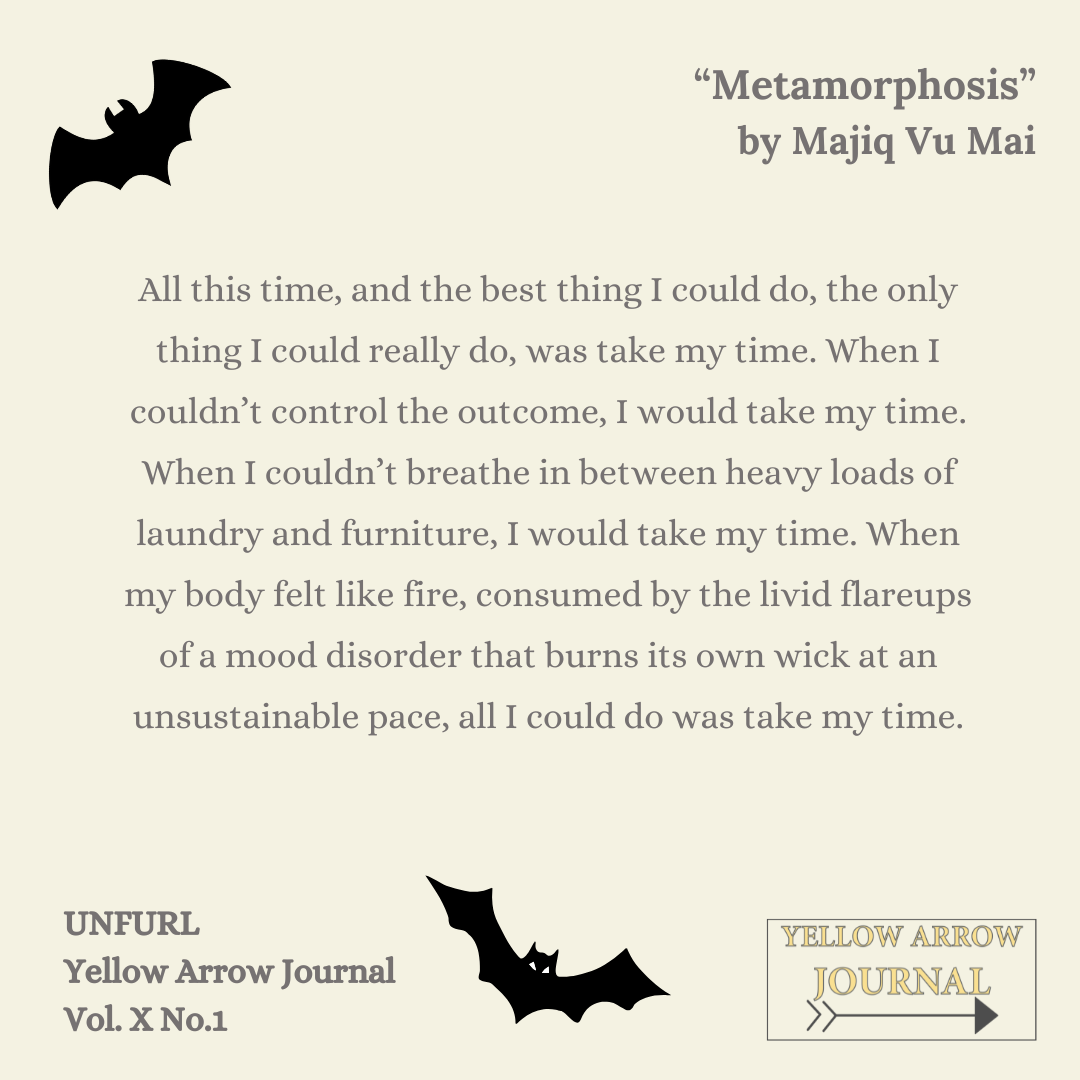
Majiq Vu Mai (they/we) is a multiplicity of madness, writing themselves alive with the words they have access to and the words they do not know yet. An alchemist of flesh and memory, Majiq writes whatever burns inside of them like a searing ache and finds relief in giving voice to the truths that no one else wants to hear. For Majiq, memoir is a form of self-constructed fiction—we write to recollect the pieces of ourselves we have lost along the way and remember our possibilities through the creative act of storytelling.
They are currently working on rebuilding the trust that they have with themselves again. They are working on finding the genuine in their voice. They are working on embracing love more than fear. They are working on completing their first collection of essays. They are working on their current reincarnation. They are working on their aliveness.
Yellow Arrow published Majiq’s piece “Metamorphosis” in Yellow Arrow Journal, Vol. X, No. 1, UNFURL. You can find them on Instagram @themajesticmaij.