.WRITERS.ON.WRITING..Writers.on.Writing.
Get to know our authors, the foundation and heart of Yellow Arrow Journal, and what writing means to them through our monthly series.
.W.o.W. #87
Johanna Elattar
Describe an early experience where you learned that language has power.
When I was eight, I wrote a story that made my teacher stop mid-class to praise my words. The power of language struck me then: a few sentences could demand attention, convey emotion, and leave a lasting impression. I realized that words could shape perception, spark empathy, and make invisible experiences visible.
What is essential for good storytelling? What types of stories do you find yourself drawing inspiration from and how do they manifest in your work?
Authenticity, attention to detail, and emotional resonance are essential. I draw inspiration from real human experiences—moments of resilience, trauma, or quiet triumph—and weave them into narratives that illuminate unseen perspectives. In my work, this manifests as stories rooted in history, memory, and personal truth.
How do you approach revising your own work? Do you enjoy the process?
I revise by reading aloud, cutting redundancies, and sharpening imagery and voice. It’s meticulous but rewarding; each round brings me closer to the clarity and impact I want. I enjoy the transformation, even when it’s painstaking.
What does your inner writing voice tell you?
It reminds me to be honest, observant, and brave in exploring both light and darkness. To trust the story, and trust myself.
Johanna Elattar is a journalist and writer of Arab and European heritage, currently based in Hornell, New York. Her work explores the human stories behind history, culture, and conflict, blending investigative insight with literary sensitivity. Her writing has been featured in the Hornell Sun and Wellsville Sun and by Oxford University Press, which selected an excerpt of her work on missing and murdered Indigenous women for a forthcoming textbook. Johanna is deeply engaged with storytelling that examines resilience, identity, and the intersections of personal and collective history. She lives with her pets and continues to write both fiction and nonfiction.
Recently, Johanna established a weekly series of “LinkedIn Exclusives,” which are original stories composed specifically for her professional network and are not pitched or submitted to other outlets. She also has other recent publishing news: “A Week in March” comes out in a forthcoming anthology called Words Left Unsaid, “Hunted” was published by Macabre Magazine in July 2026, and “Unicorn Summer” was recently featured as part of the inaugural Merion West fiction series, Theater of Belief.
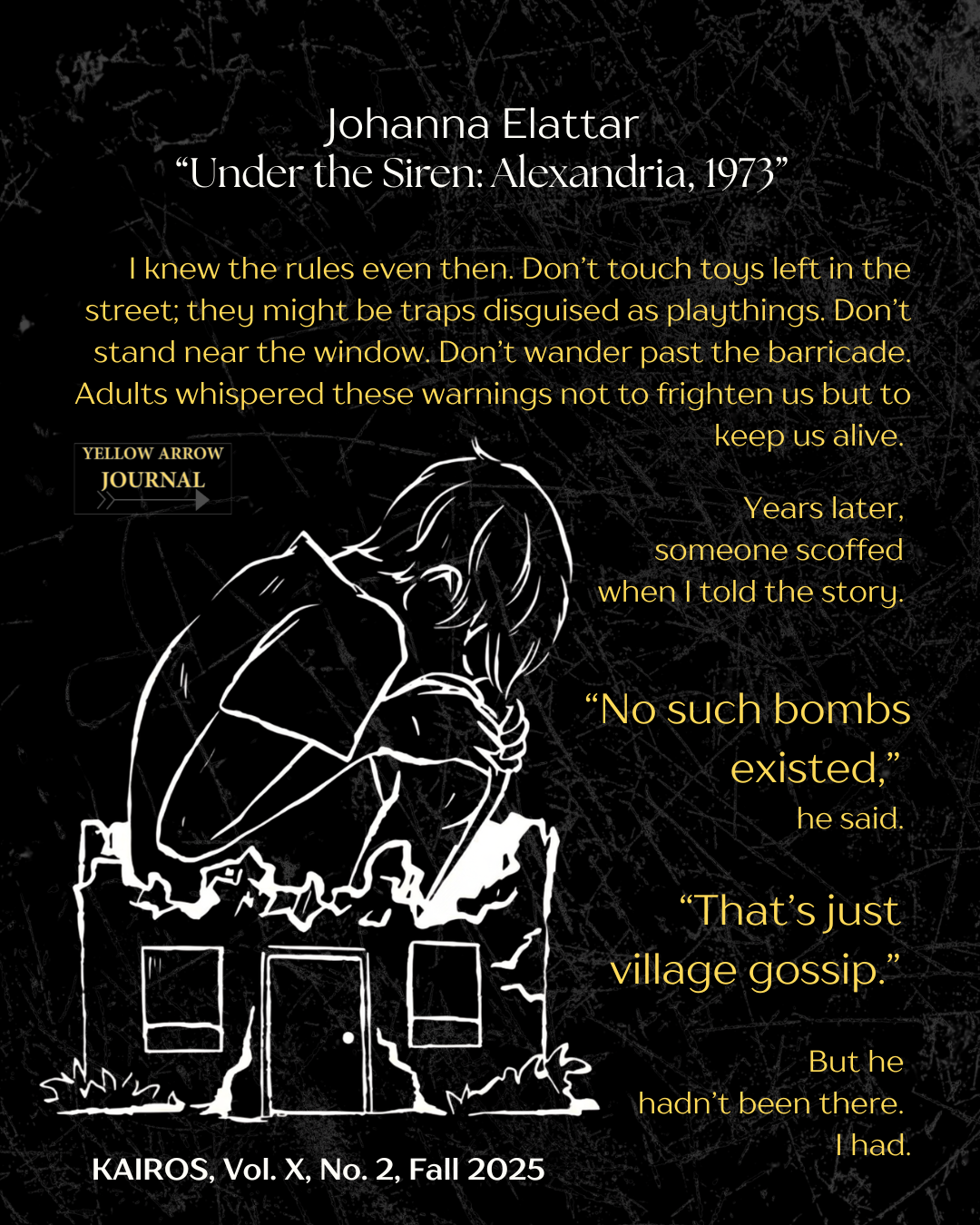
Her creative nonfiction piece, “Under the Siren: Alexandria, 1973,” was included in Yellow Arrow Journal KAIROS, Vol. X, No. 2, fall 2025, and “Waiting for the Moon” was included in WONDER, Vol. XI, No. 1, spring 2026. Yellow Arrow nominated “Under the Siren: Alexandria, 1973,” for the 2026 Puschcart Prize (find our announcement here).
You can find Johanna on Facebook @johanna.elattar3.
.Writers.on.Writing.
Get to know our authors, the foundation and heart of Yellow Arrow Journal, and what writing means to them through our monthly series.
.W.o.W. #86
Annie Rachele Lanzillotto
What do you hope readers take away from your work?
When a reader sits and holds and reads my writing, I hope they dive into the moments completely. Just south of Dublin there is a jump into the Irish Sea called “The Forty Foot.” Elders come out of the sea refreshed and invigorated and come back the next day. I’d want reading to feel like that. This is where [James Joyce’s] Ulysses begins at the Martello Tower. And for the writing to open up a cavern inside a reader, where the reader says, “That's how I feel. I didn’t even know I felt like that, but I do. I know myself better now.” This is how I feel when I read Joyce’s short story “Araby.” Sated. Known.
If you could tell your younger writing self anything, what would it be?
You can take off your shirt in the middle of the street like the boys if you want to. If they make fun of you, don’t listen. And all that Catholic stuff you’re hearing in school, it’s a lot of brainwashing. Think of it as a story, with characters. And . . . it’s not your fault that Jesus is bleeding and dying. . . . And . . . don’t worry about “Confession,” it’s just a man in the dark booth. Talk to him, but don’t worry about it.
How did you last publish your writing (before Yellow Arrow) and what was it?
Recent publication is the chapbook of sonnets Dyke Rubicons with Quelle Presse, a one-woman initiative out of Salt Lake City, by editor Rachel McKeen. A limited edition. Writing sonnets, the rhyme and scansion acted like a broom sweeping the moments of love I wrote about. Also I’ve recently published two poems with New Verse News. I love what editor James Penha does, a unique mission of poems on current events. It’s wonderful to process tragedy and other news through the voices of poets.
What does your inner writing voice tell you?
Keep writing. Every day. Finish the book on your father. Then take a break and enjoy yourself. Keep breathing deep.
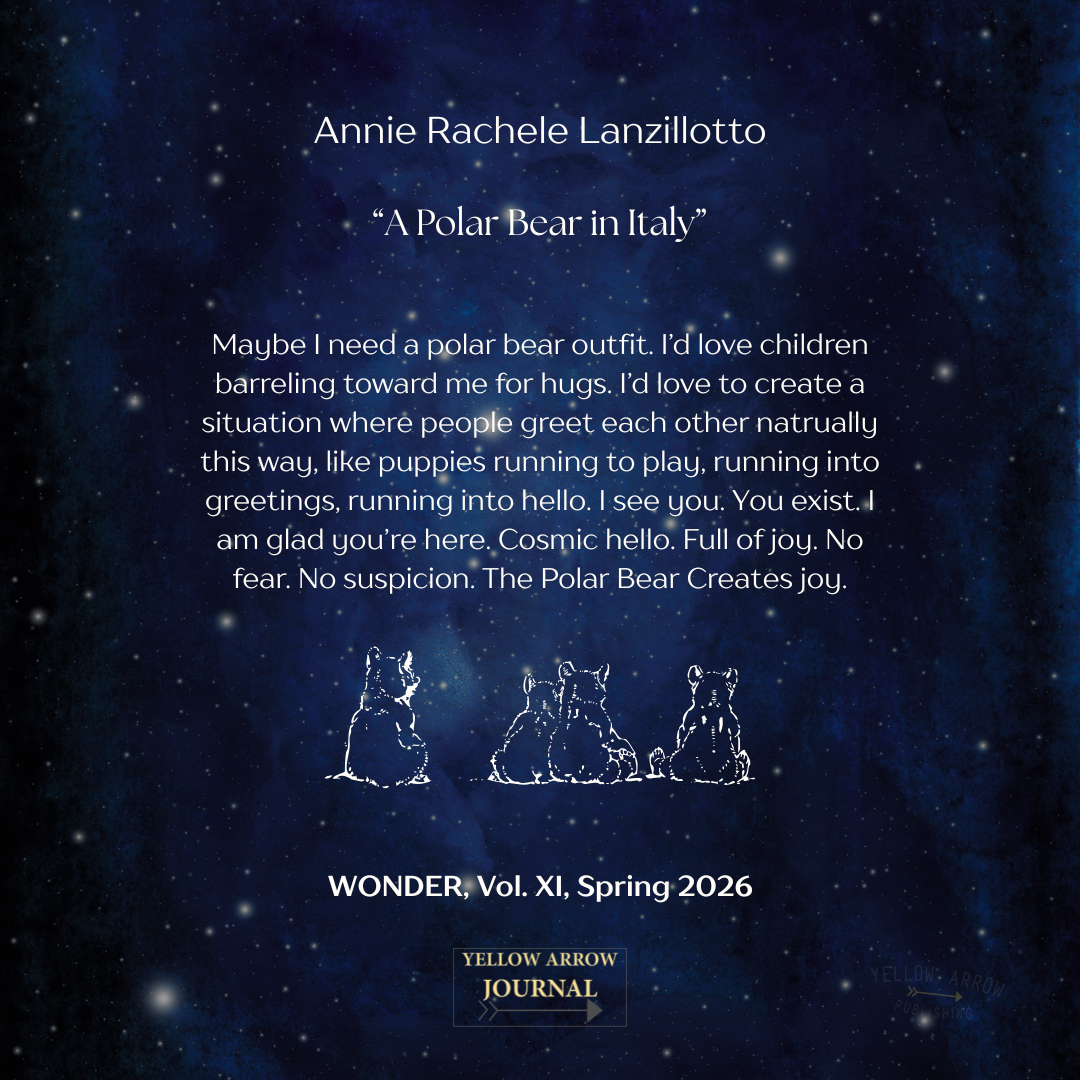
Annie Rachele Lanzillotto is a memoirist, poet, and performance-artist whose work has been called riveting and volcanic. Her books include Dyke Rubicons (Quelle Presse, chapbook of sonnets),Whaddyacall the Wind? (Bordighera Press), the double flip book Hard Candy: Caregiving, Mourning, and Stage Light; Pitch Roll Yaw (Guernica World Editions), L is for Lion: an italian bronx butch freedom memoir (SUNY Press; finalist LAMBDA Literary Award), and Schistsong (Bordighera Press). Albums include Never Argue With a Jackass; Swampjuice: Yankee with a Southern Peasant Soul.
Her creative nonfiction piece, “A Polar Bear in Italy,” was included in Yellow Arrow Journal WONDER, Vol. XI, No. 1, Spring 2026. You can find Annie online at AnnieLanzillotto.com.