.WRITERS.ON.WRITING..Writers.on.Writing.
Get to know our authors, the foundation and heart of Yellow Arrow Journal, and what writing means to them through our monthly series.
.W.o.W. #84
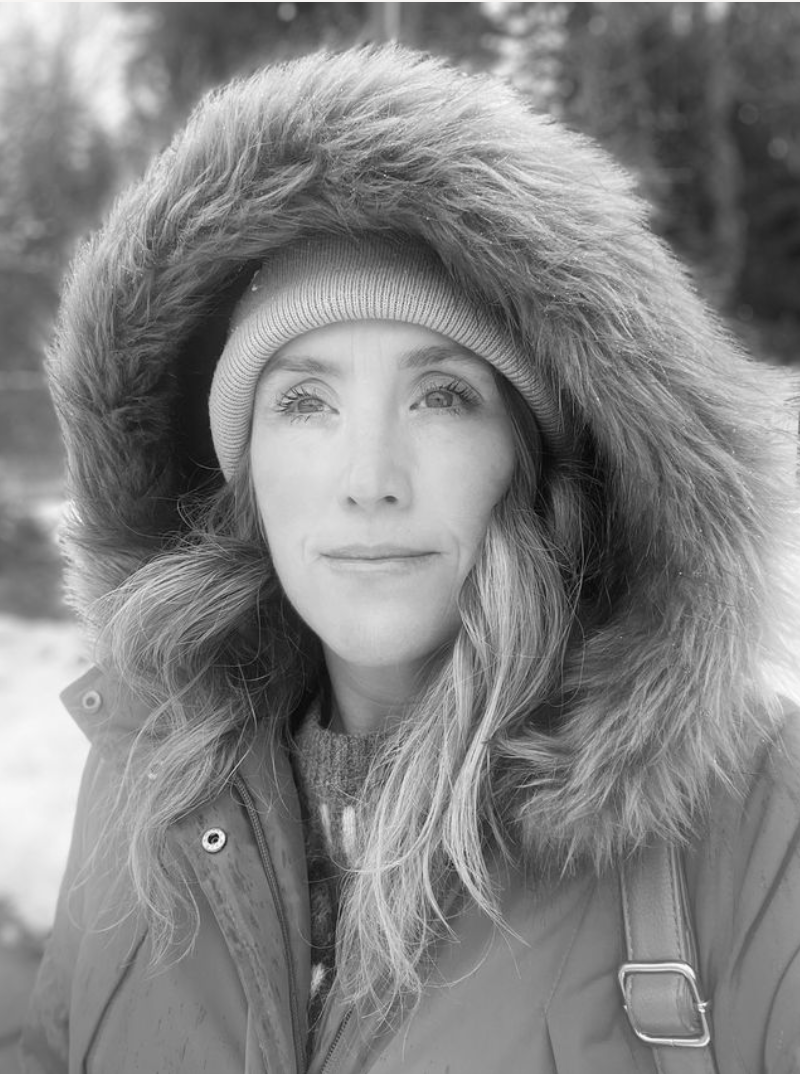
Lace LAwrence
Describe an early experience where you learned that language has power.
I think I have always understood that words held power but perhaps the best proof of this was found in one of my childhood journals when I was unpacking a few years ago. I found a contract I had written and made my older brother sign when he borrowed money from me. I was seven at the time because of course it was dated. I charged him with interest and had all of these legally binding clauses. I remember him trying not to pay me back and my mom making him pay me back with interest because of the contract. My parents were going through a nasty divorce at the time and legal language was everywhere. It really stuck with me in not just contracts but in everything.
If you could tell your younger writing self anything, what would it be?
The same thing I tell myself now “Keep writing. Keep sharing.” As a kid, I was lucky enough to be a part of the Young Author’s program, which was a program that had kids write stories, which were judged, and the best got to go to a multiday writers’ program at the local community college. I tried every year and failed all but two years. It was devastating every time I lost and yet I just kept at it. Sometimes I think I just wore the judges down but at the end of the day I got in twice and that planted the seed for everything I am doing now.
Why did you submit this piece to Yellow Arrow Journal? Why this piece at this time to this place?
This piece is a deeply personal piece that has struggled to find a home with other journals. When I saw the theme of kitalo I knew that this was a good fit for “Death and the Hawk.” Grief is a complicated thing, and I wanted to make sure I put that grief in caring hand. This is why I was excited to find a journal that was so supportive of women and the voice of the writer for this specific piece.
What does your inner writing voice tell you?
My inner writing voice can be so salty. I love her. She is definitely my biggest fan and gets pretty sassy when people can’t see my greatness. She believes that I have stories that need to be heard because for so long stories like mine haven’t been able to be told. I try to listen to her as much as possible although the world can get so loud at times I can’t hear her enough.
Lace Lawrence was raised on the Yakama Indian Reservation and is deeply influenced by her family’s tradition of oral history. She uses her story telling skills to craft compelling narratives for nonprofits, memoirs, and nature-based writing. Her work has been published in Sisu Magazine, Mountainflyer, and Mountaineers Books, and she was a finalist in the 2023 Barry Lopez Nonfiction Contest. Notably, Lace is the first known person to stand up paddle board the entire Willamette River Trail. When not working, Lace can be found out in nature with her two dogs,Trooper and Tokul, and her lime green camper van, Aurora.
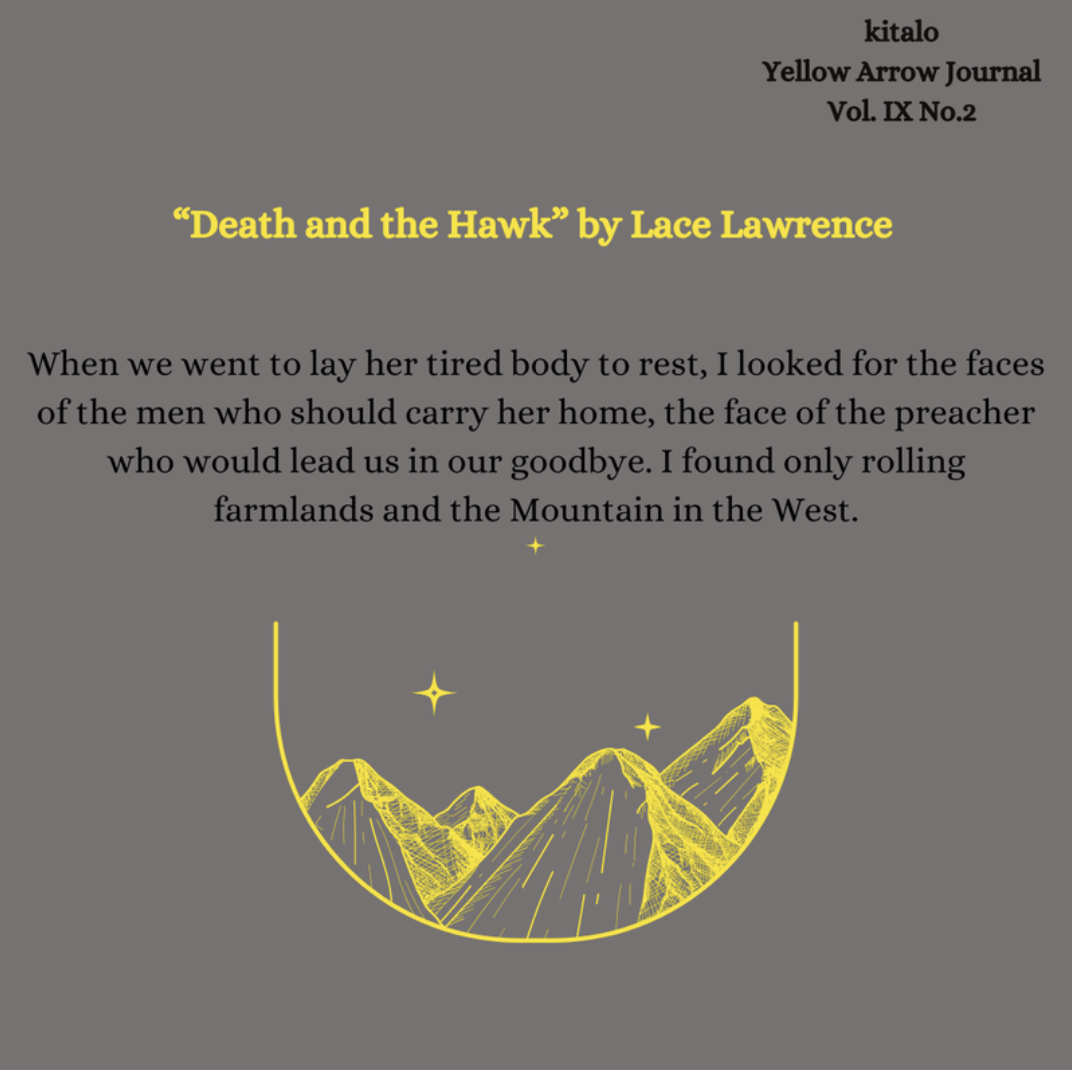
Her poem “Death and the Hawk” was included in Yellow Arrow Journal kitalo, Vol. IX, No. 2, Fall 2024. You can find Lace on Facebook and Instagram @lacelaya.
.Writers.on.Writing.
Get to know our authors, the foundation and heart of Yellow Arrow Journal, and what writing means to them through our monthly series.
.W.o.W. #83
Caroline Bock
What period of your life do you find you write about most often?
I’ve written a lot about my tumultuous childhood, however, these days I seem to be obsessed with the fiction and nonfiction versions of me in my 20s–40s.
What word do you find yourself using most often in your writing?
As a writer, I try to be conscious about overusing the same words, though my husband recently pointed out that I like “cacophony” quite a bit. It now appears only twice in my novel The Other Beautiful People!
What book is on the top of your to-be-read pile?
I have a lot of to-be-read piles these days! On top of my poetry pile, because I love reading poetry as a break from writing fiction, is Diane Seuss’ Modern Poetry and You Are Here: Poetry in the Natural World edited by Ada Limón.
What does your inner writing voice tell you?
Keep writing. You are not done yet. Your journey is far from over.
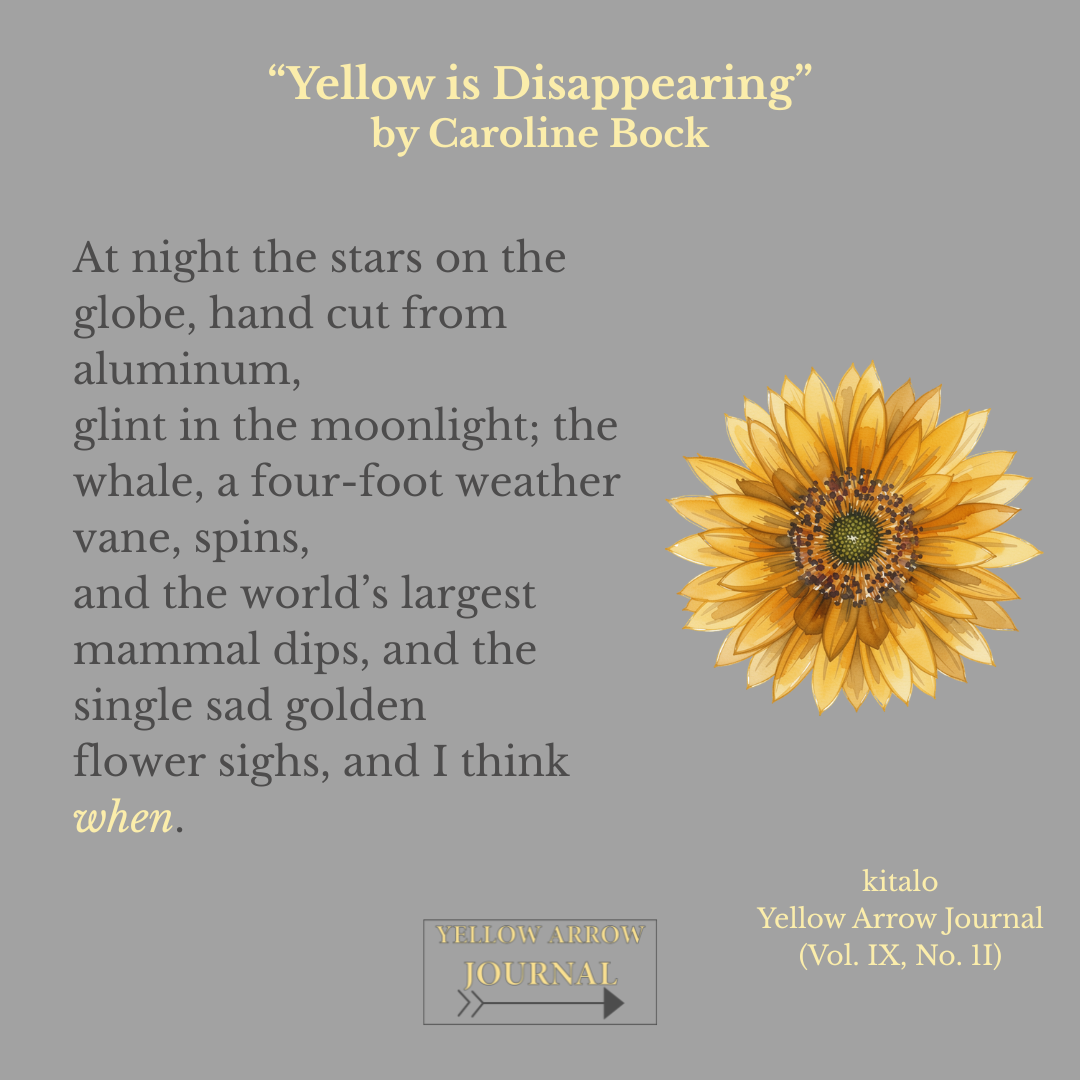
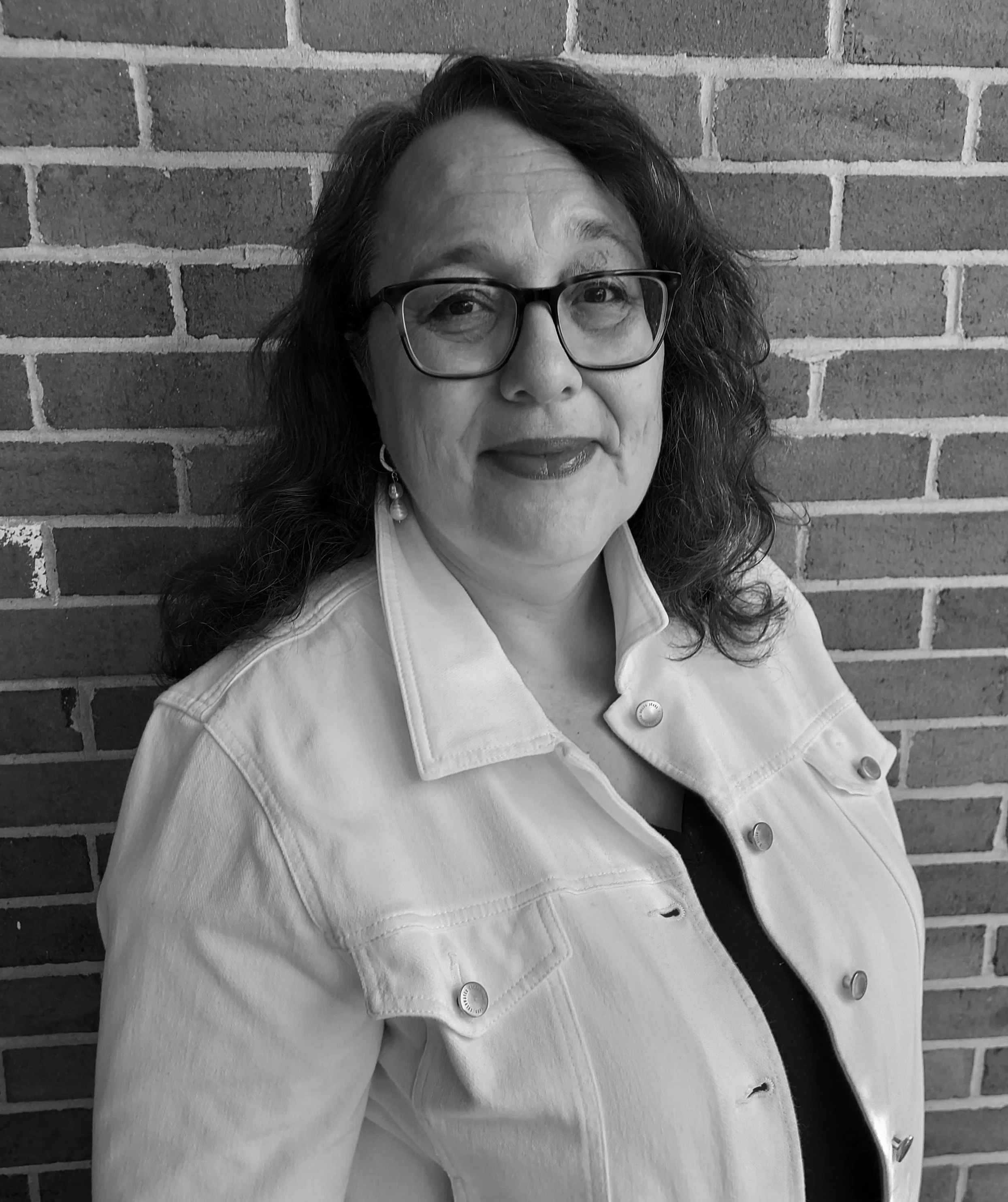
Caroline Bock writes micros to novels. She is the author of the short story collection Carry Her Home, winner of the fiction award from the Washington Writers’ Publishing House, and the critically acclaimed young adult novels, LIE and Before My Eyes (St. Martin’s Press). Her latest novel, The Other Beautiful People, a workplace love story about a movie-loving marketing executive, will be published in the summer of 2026 by Regal House Publishing. She is also the copresident and prose editor at the Washington Writers’ Publishing House.
Her poem “Yellow Is Disappearing” was included in Yellow Arrow Journal kitalo, Vol. IX, No. 2, Fall 2024, and is part of her work-in-progress, a hybrid collection, tentatively titled, I Should Have Slept With Them All. You can find Caroline online at carolinebockofficialauthorsite.wordpress.com, on Facebook and Instagram @CarolineBockAuthor, and on Twitter @cabockwrites.
The Other Beautiful People will be published June 2 and preorders are now available everywhere books are sold. Please join Caroline at her launch events at Politics & Prose (Connecticut Avenue, Washington D.C., store) on Tuesday, June 2 at 7:00 p.m. and at the Writer’s Center (Walsh Street, Bethesda, Maryland) on Sunday, June 7 at 4:00 p.m. Both events are free and open to all!
.Writers.on.Writing.
Get to know our authors, the foundation and heart of Yellow Arrow Journal, and what writing means to them through our monthly series.
.W.o.W. #81
Cherrie Woods (aka Cherrie Amour)
Describe an early experience where you learned that language has power.
It was in Toronto in the late ‘90s when a local poet, Dwayne Morgan, began to blow up as a poet with his Black conscious poetry. It was my first experience seeing a local poet become a celebrity.
What is a book you wish someone would write? That you want to write (or are writing).
A memoir about a double-woman immigrant from the Caribbean who fits in on the outside but feels awkward in two different countries—one that includes the pain and humor of not truly fitting in. Think of a book that combines Chimamanda Ngozi Adichie’s Americanah with Issa Rae’s Misadventures of Awkward Black Girl.
What does your inner writing voice tell you?
To keep working at my writing and take chances by submitting more.
What book is on the top of your to-be-read pile?
What Have We Here? by Billy Dee Williams (I met him at the Pratt Library after a lifetime of adoration).
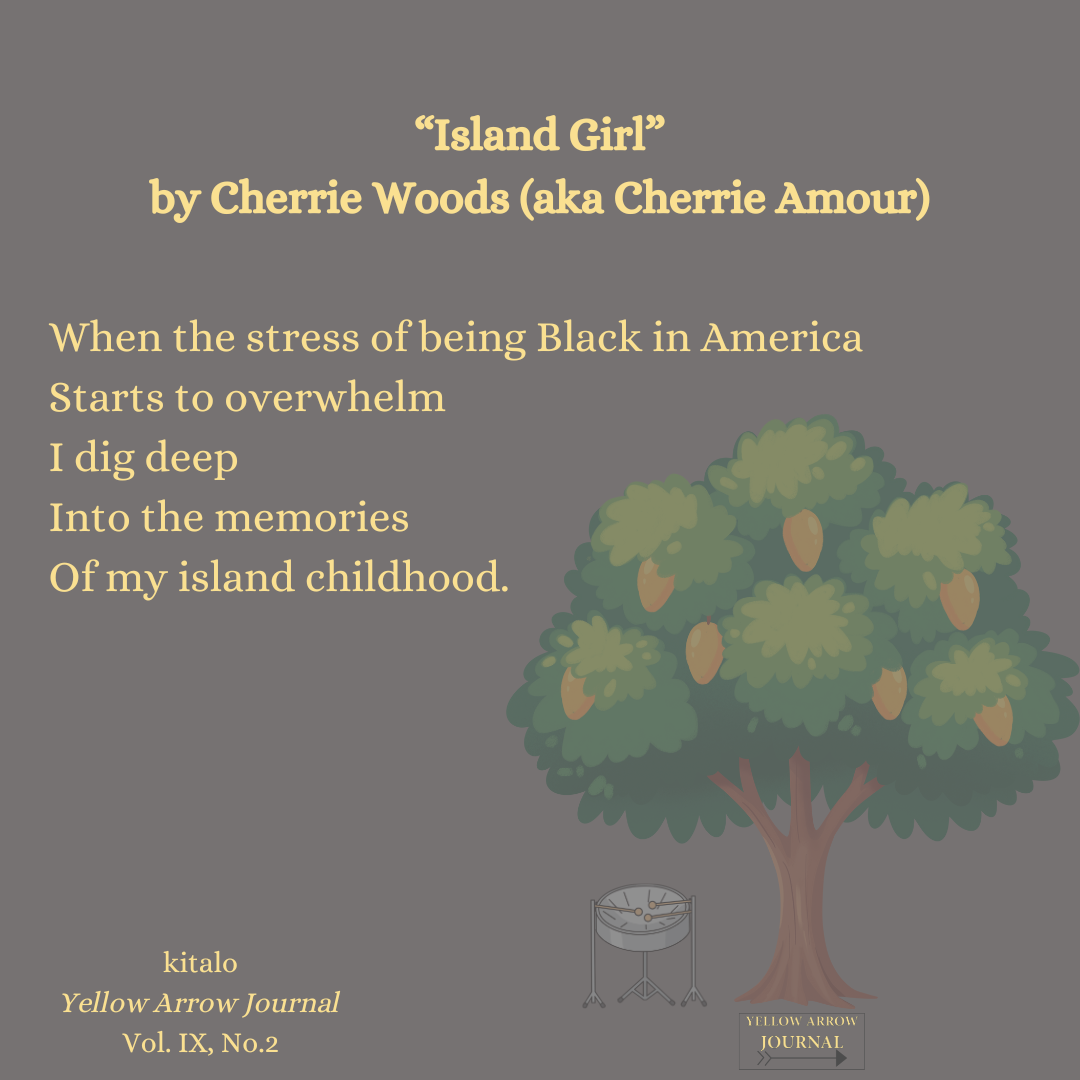
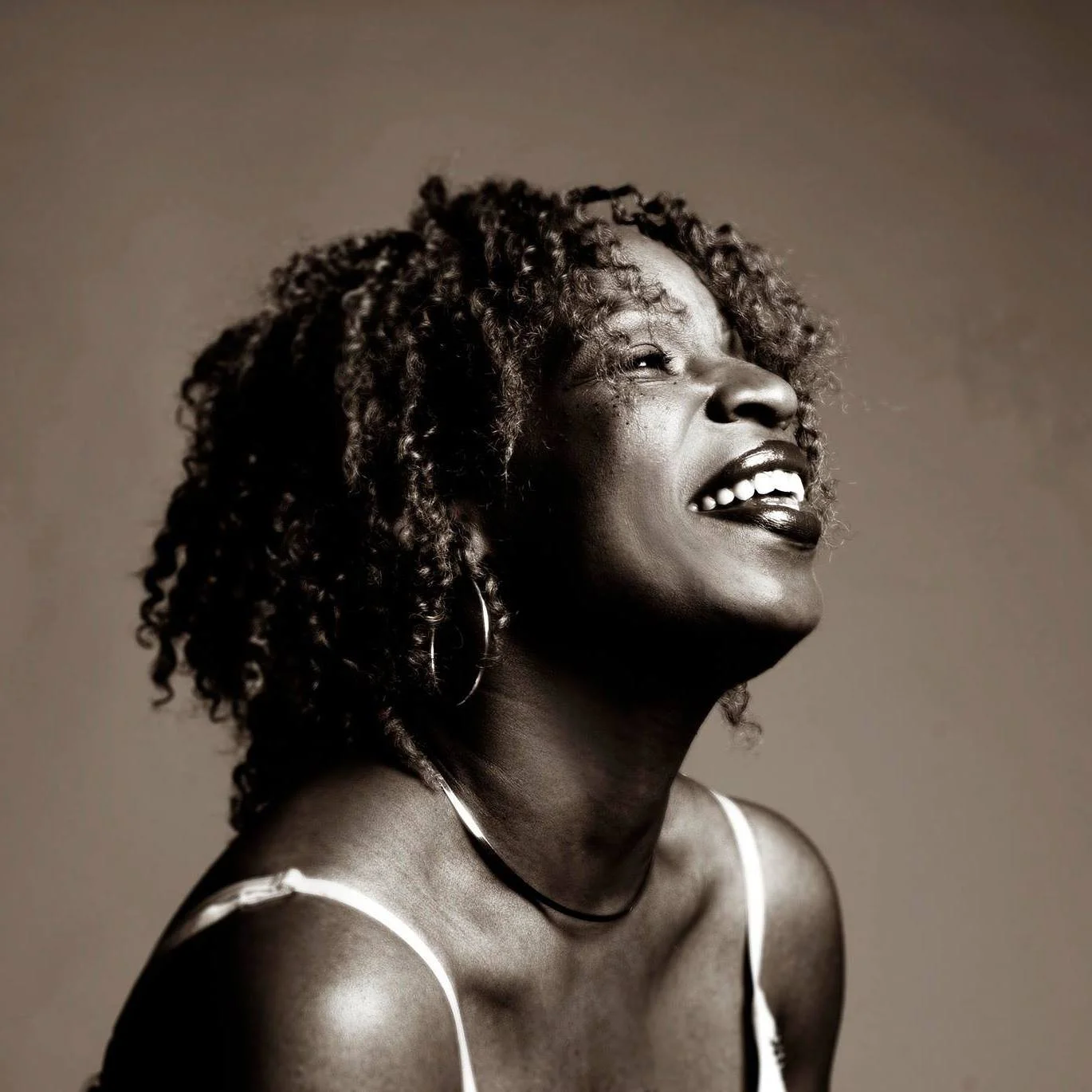
Cherrie Woods (aka Cherrie Amour) is a Baltimore-based award-winning poet whose candid, narrative style is shared in her book, Free to Be Me: Poems on Love, Life, and Relationships. Her poems have been published in the Paterson Literary Review, Understorey Magazine, Poet’s Ink, The Fire Inside: Collected Poems and Stories from Zora’s Den, The Pen Woman, Maryland in Poetry, and America’s Future: Poetry & Prose in Response to Tomorrow. She is currently seeking publication for her new poetry manuscript, Sit Comfortably Elsewhere.
Yellow Arrow published Cherrie’s “Island Girl” in Yellow Arrow Journal kitalo, Vol. IX, No. 2, fall 2024 and “Kid Bamboo” in Yellow Arrow Vignette AMPLIFY. You can find Cherrie online at cherrieamour.com and on Instagram @cherrie_amour_thepoet and @cherriewoods and Facebook @cherrie.amour and @cherrie.woods.
Cherrie is teaching a virtual workshop at the Baltimore County Public Library called “Public Relations for Authors with Cherrie Woods” on February 10 (Tuesday) from 7:00 p.m. to 8:30 p.m. Learn more and register at events.bcpl.info/event/15509927.
.Writers.on.Writing.
Get to know our authors, the foundation and heart of Yellow Arrow Journal, and what writing means to them through our monthly series.
W.o.W. #76
sarena tien
How did you first publish your writing and what was it?
During my sophomore year of college, I took an expository writing class. My professor had us write a cover letter for an assignment, and so I ended up submitting two of the personal essays I’d written for her class. While both ended up being published, “What It Means to be Chinese-American” was first.
Describe an early experience where you learned that language has power.
I remember when I learned that accents have power, even though they shouldn’t. Two Chinese American sisters were trying to get me to say “lion” because they thought it hilarious that my “l”s weren’t quite fully formed and so I’d say “nion” instead, and I think that’s when the cruelty of linguistic discrimination first crept into my world.
What does your inner writing voice tell you?
Finish one of the many pieces in progress that you have floating around your laptop.
Why did you submit this piece to Yellow Arrow Journal? Why this piece at this time to this place?
I’ve been subscribed to the Yellow Arrow newsletter for a while, but I never had pieces that fit the themes. Then I saw the call for kitalo, and the concept of grief resonated with me. Various forms of grief—linguistic, cultural, and familial—have shaped and unshaped my identity. I wrote “A Doctoral Education” during the winter break of my final year of graduate school, when I was struggling to figure out what I wanted to do after my PhD. Being the only first-generation, Chinese American student in my graduate program wasn’t easy, and my experience actually ended up playing a role in my decision to leave academia. However, I’m still grateful for the opportunity to write a dissertation on a topic I love, and my PhD helped me secure a job close to home with the kind of salary that my immigrant mother who never went to college always wanted me to have.
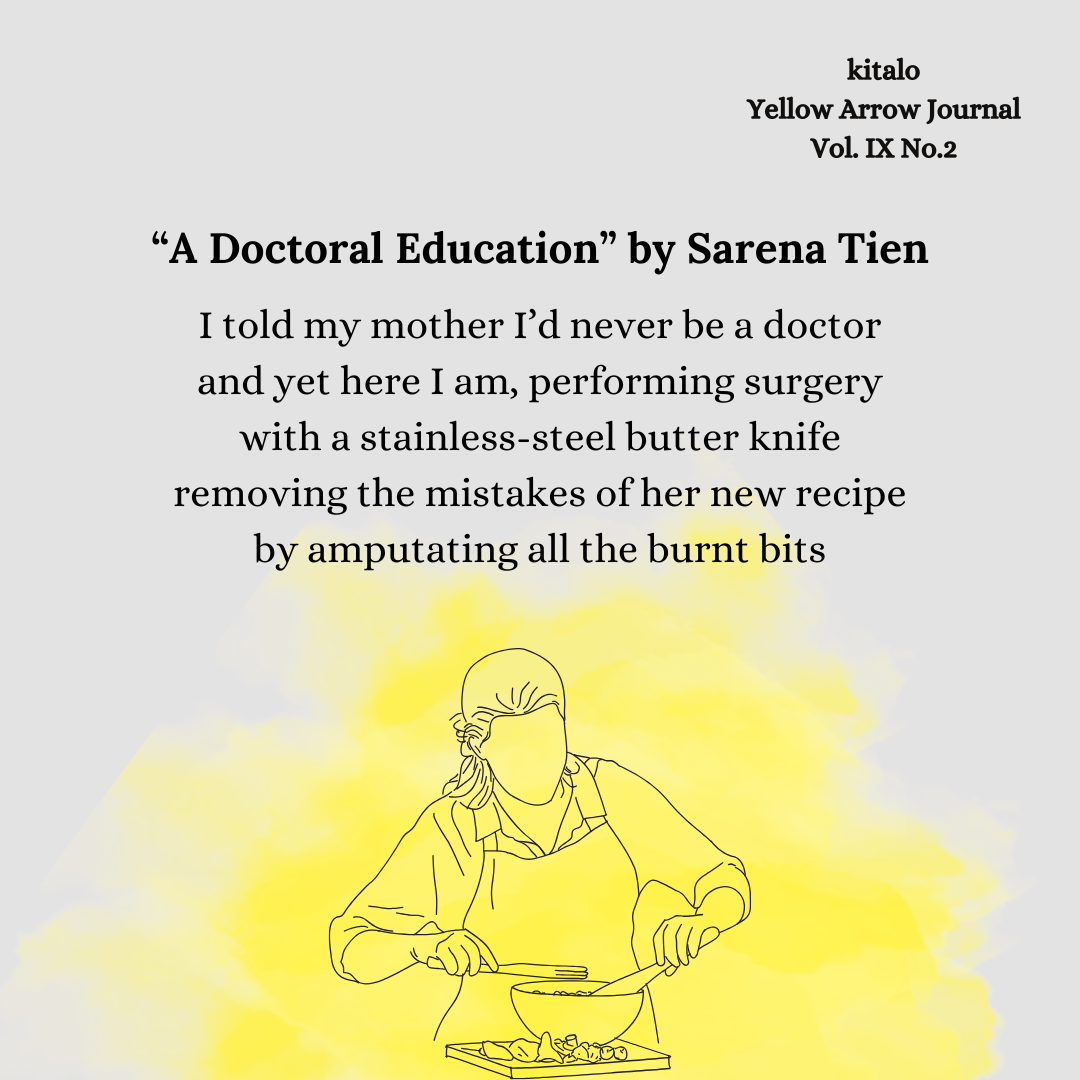
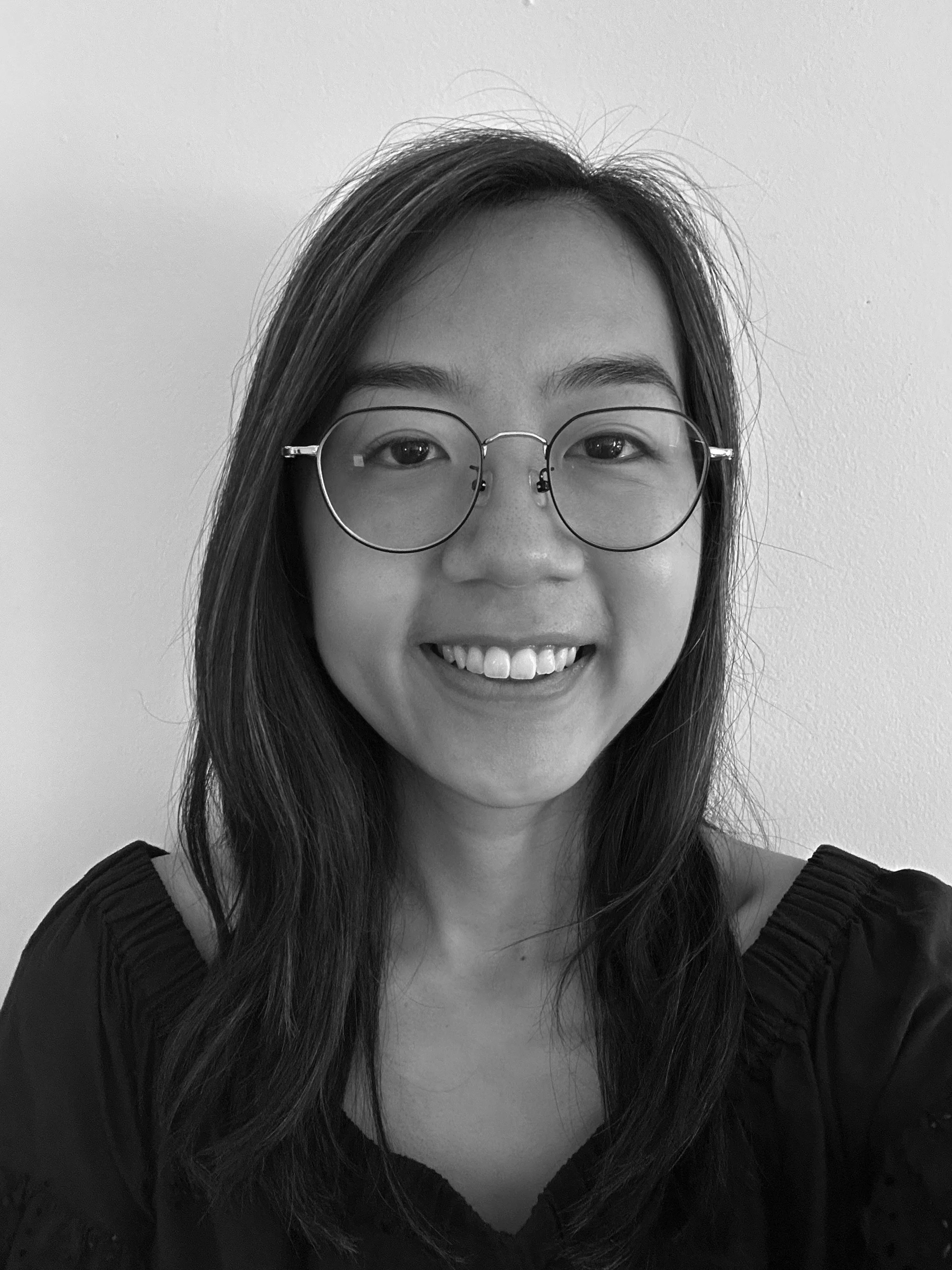
Sarena Tien (she/her) is a queer Chinese American writer and doctor (the PhD kind). Once upon a time, she used to be so shy that two teachers argued whether she was a “low talker” or “no talker,” but she’s since learned how to scream. Her poetry and prose have appeared in The Rumpus, Snarl, and Sylvia, as well as anthologies such as Decoded Pride, The Secrets We Keep, and Good for Her: An Anthology of Women’s Wrongs.
Yellow Arrow published Tien’s piece “A Doctoral Education” in Yellow Arrow Journal, Vol. IX, No. 2, kitalo. You can find her online on BlueSky @sarendipitous.bsky.social, and at sarenatien.com.
Recently, Sarena has published poems in Philly Chapbook Review and The Hellebore and a novelette, Definition: a Novelette, which will be published soon. Get your copy of Definition: a Novelette at elj-editions.com/definition. Congratulations Sarena!
.Writers.on.Writing.
Get to know our authors, the foundation and heart of Yellow Arrow Journal, and what writing means to them through our monthly series.

W.o.W. #69
Milan Harris
What period of your life do you find you write about most often?
I’m very interested in writing about the present. I often turn to my current situations, experiences, and interests to inform my writing. If it’s not about the present, it’s certainly about childhood. More than periods of life, I turn to a lot of similar themes, but they can also be molded by the situational and environmental contexts I exist in. I find myself writing a lot about death, grief, and liberation, but also about love and connection—I think all of those themes are constantly interacting with each other, and I’m constantly interacting with them.
What word do you find yourself using most often in your writing?
Oddly enough, I use a lot of words relating to the body like flesh, blood, and bone. Much of my writing tends to be visceral and imagery—heavy, and I usually connect the body and the physical realm to the ideas I write about.
Why did you submit “we been been immortal” to Yellow Arrow Journal? Why this piece at this time to this place?
I write a lot about grief because grief has followed me in many ways, for many years. In 2024, grief has been especially present, as over 200,000 Palestinians have been killed. For me, grieving death is both personal and communal, individualized and politicized. A lot of my writing recently has helped me to process the grief I’ve felt for loved ones passing, but, it’s also helped me to grieve communally—“we been been immortal” is a direct response to seeing the deaths of so many Black people in Baltimore and the world. Though I had a specific context of why I wrote this poem over a year and a half ago, I think it can connect to oppressed people all over the world. I think it says that we can grieve in the ways most authentic to us, love intimately and uniquely, and we will still be here. We will always be here, immortal, transcendent, and eternal.
What does your inner writing voice tell you?
Mostly to get off my butt and stop procrastinating.

Formerly the director of an after-school program, Milan Harris now works as a researcher inequity-based education practices in Maryland. Born and raised in Baltimore, Maryland, she has always been a lover of literature. She’s written for various online journals, but in 2020 she cofounded her own creative arts magazine, Amani Sol, with her best friend. They’re currently working on their third issue. When not writing, she can be found gardening, cooking, or doing yoga.
Yellow Arrow published Milan’s piece “we been been immortal” in Yellow Arrow Journal, Vol. IX, No. 2, kitalo. You can also find her on Instagram @milanrougee_ and at her magazine’s website amanisolmag.com.