.WRITERS.ON.WRITING..Writers.on.Writing.
Get to know our authors, the foundation and heart of Yellow Arrow Journal, and what writing means to them through our monthly series.
.W.o.W. #27
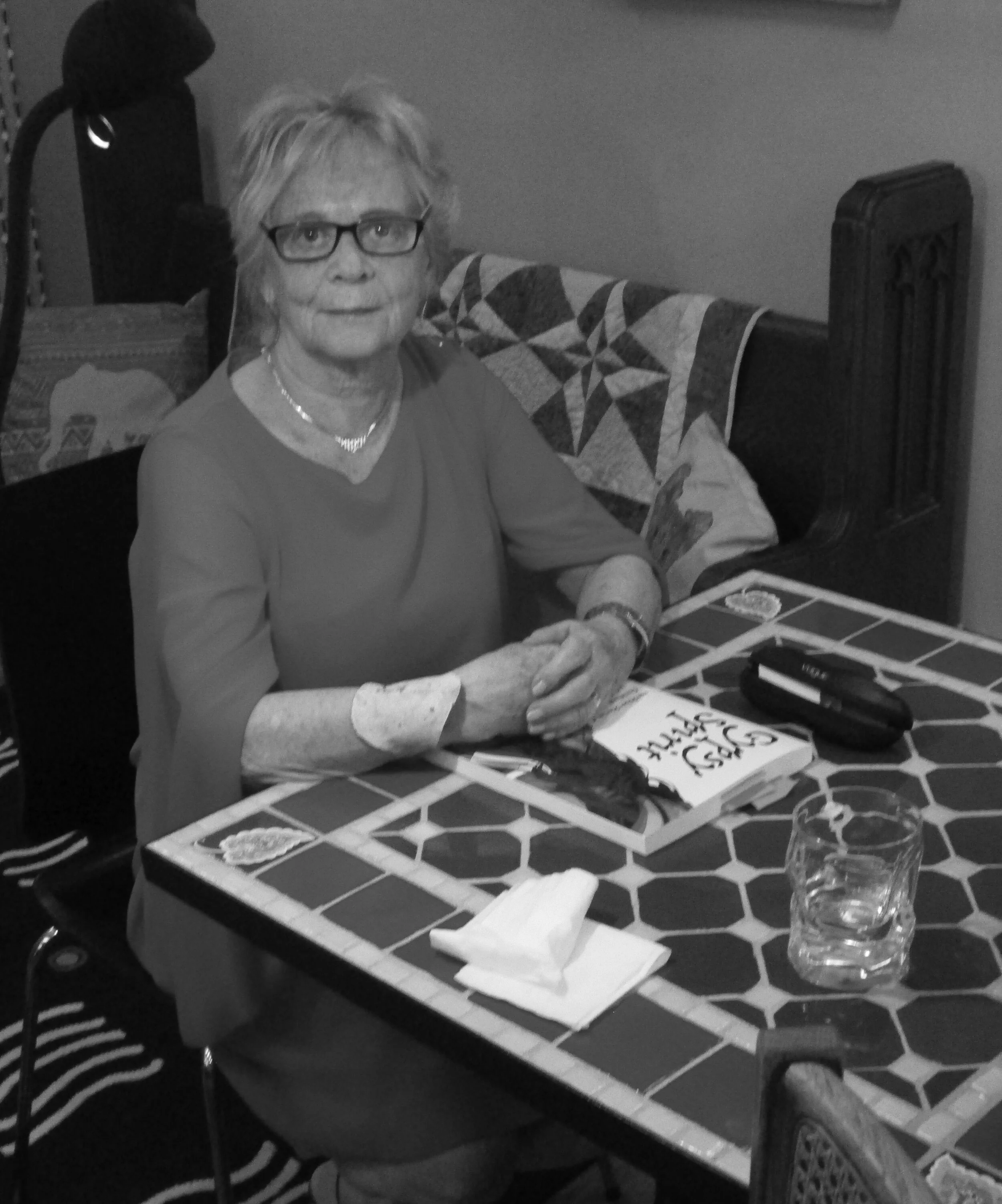
Ute Carson
Describe an early experience where you learned that language has power.
I have been writing all my life. Inspiration came from my mother and both grandmothers, who read, told stories, and recited poetry from my infancy on. In elementary school, I had an inspiring teacher who ended each school day with a brief story. I was immersed in poetic language and started my first notebook in second grade. In third grade, a story about my pet rabbit was published in a German nature magazine. From then on, I never stopped writing. Writing is a passion and, like all passions, it never ceases. I have never experienced writer’s block.
If you didn’t write, what would you do?
I enjoy many other activities, especially in relation to my family and animals. Because ideas stay safely in my memory until I can find the time to write them down, interruptions don’t bother me. I used to write in longhand, but now composing on a computer keyboard has become routine. I have so many stories just waiting to be written. But I also enjoy the work of other writers.
What does your inner writing voice tell you?
My inner voice fills me with gratitude for my writing career, and that I am never without a story to tell or an image for a new poem.
Ute Carson published her poem, “Risks Around Each Corner,” in Yellow Arrow Journal’s Vol. V, No. 3 issue (Re)Formation. She also joined other (Re)Formation authors in our A Reformative (Re)Formation Reading in November 2020.
And we are thrilled to have Ute release her chapbook, Listen (which will include “Risks Around Each Corner”), with Yellow Arrow Publishing in October 2021. Please show her some love in the Comments.
You can learn more at utecarson.com. Find her and our other incredible chapbook authors here.
.Writers.on.Writing.
Get to know our authors, the foundation and heart of Yellow Arrow Journal, and what writing means to them through our monthly series.

.W.o.W. #26
Leah Myers
Describe an early experience where you learned that language has power.
When I was in first grade, my teacher tried to shame the class into calming down by saying, “You’re all acting like a bunch of wild Indians!” I burst into tears almost instantly. It is the earliest, clearest memory of learning that words have power because of how I felt, even if the teacher never intended to insult me.
What word(s) do you find yourself using most often in your writing?
My latest project is centered around race and culture, so “Native,” “blood,” and “tribe” are all pretty high-frequency. Thematically, I write about teeth a lot, both in fiction and nonfiction; the primal qualities teeth can show are very interesting to me.
What does your inner writing voice tell you?
As a nonfiction writer, my inner voice tells me to write my truth, regardless of how others may judge me. I have written my story and the stories of my family members in how they connect to me and affect my life, and I know that I do not always look like the hero. I know I’m sometimes the coward or the villain. I know some family members would prefer I only tell half-truths, that I cover up the troubles that we have faced in our history. My inner writing voice knows that I can’t hold back. It has to be the entire truth, bare and unflinching, or it isn’t the best it can be.
Leah is a member of the Jamestown S’Klallam Tribe. Pick up a copy of RENASCENCE (Yellow Arrow Journal, Vol. VI, No. 1) today to learn more about Leah’s relationship with her tribe’s language in her creative nonfiction piece, “A Writer Who Can’t Read.” Leah recently graduated with an MFA in Creative Nonfiction from the University of New Orleans, where she was awarded the Mockbee Prize for Nonfiction two years in a row.
Connect with Leah at leahmyers.com or on Facebook, Twitter, and Instagram, or below in the Comments.
.Writers.on.Writing.
Get to know our authors, the foundation and heart of Yellow Arrow Journal, and what writing means to them through our monthly series.

.W.o.W. #25
Kathy Z. Price
Describe an early experience where you learned that language has power.
As a young child, my mother read The Owl and the Pussycat—and to this day I can hear
They dined on mince, and slices of quince,
Which they ate with a runcible spoon;
But as a youngster, maybe 10 years old, I was shaken to the very core with “Great Pax Whitie” by Nikki Giovanni (you can find a version on YouTube here). My aunt would go around the house declaring
Ain’t they got no shame—nah, they ain’t got no shame
What word do you find yourself using most often in your writing?
Black.
What does your inner writing voice tell you?
Trust yourself.
Kathy Z. Price is one of Yellow Arrow’s incredible RENASCENCE (Yellow Arrow Journal, Vol. VI, No. 1) authors. She has a picture book, Mardi Gras Almost Didn’t Come This Year, coming out in January 2022 and is currently working on a memoir. Find Kathy on Twitter (@KathyZPrice or k_obia) and Instagram.
And join us for Renascence: A Reading on June 4 at 7:00 pm EST. Kathy will read a portion of her RENASCENCE piece “For Keeps” along with several other issue contributors. Find out more here.
.Writers.on.Writing.
Get to know our authors, the foundation and heart of Yellow Arrow Journal, and what writing means to them through our monthly series.

.W.o.W. #24
Nikita Rimal Sharma
What is a book you wish someone would write?
If only my mother wrote a book. I would love to read about the pain and struggles that my mother has experienced, as a third person. I feel like I would understand her so much more.
How did you first publish your writing and what was it?
It was an essay on “Environmental Pollution in Kathmandu” when I was in grade 5. I submitted it to my local newspaper The Kathmandu Post, and it got published in the weekly kid’s section. I was elated.
What does your inner writing voice tell you?
You can heal.
Nikita was born and raised in Kathmandu, Nepal and moved to the U.S. about seven years ago. She currently lives in Baltimore, Maryland. You can learn more about her in Yellow Arrow Journal’s Vol. V, No. 3 issue (Re)Formation, with “Be You, Beautiful,” and find her in our A Reformative (Re)Formation Reading of (Re)Formation from November 2020.
.Writers.on.Writing.
Get to know our authors, the foundation and heart of Yellow Arrow Journal, and what writing means to them through our monthly series.
.W.o.W. #23
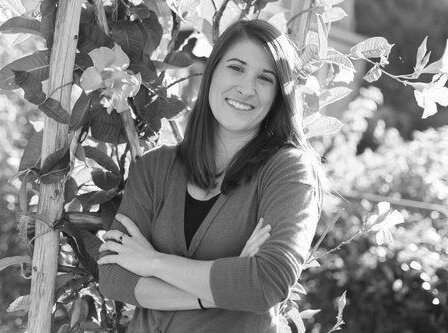
Claire Taylor
What is your writing Kryptonite?
The amount of patience it requires. There’s so much waiting in writing. Waiting for the piece to take shape, waiting to get it just right. Waiting to hear back about submissions. With social media it can often feel like everyone else around you is getting published and it can be hard to stick to your work and not rush your own process.
What does your inner writing voice tell you?
To keep going.
What period of your life do you find you write about most often?
Lately, I write a lot about motherhood and that transition. My writing most frequently focuses on episodes of sorrow and depression, which is more of a throughline connecting all stages of my life rather than one specific period.
Claire’s poem “Again, Begin” was included in Yellow Arrow Journal’s Vol. V, No. 1 RESILIENCE. Last year, she participated in our 2020 Earth Day Reading. And this year, she will be one of our featured poets in our April Poetry Series. You can find her on Twitter or Instagram.