.WRITERS.ON.WRITING..Writers.on.Writing.
Get to know our authors, the foundation and heart of Yellow Arrow Journal, and what writing means to them through our monthly series.
.W.o.W. #77
Melanie Hyo-In Han
What does your inner writing voice tell you?
Write so others who feel isolated can find a sense of home and belonging.
Describe an early experience where you learned that language has power.
I grew up in East Africa where I spoke Korean at home and Swahili in the community. When I was five years old, I started learning English for the first time at school and became frustrated by the fact that I couldn’t communicate effectively. I wanted to play with my classmates but could only point at things or smile, and that’s the first time I realized how much power language has. As a kid, I obviously picked English up really quickly, but it wasn’t until I was much older that there was a lot of resentment I’d felt not being able to express myself and then the eventual freedom that came with being able to talk to others.
What word do you find yourself using most often in your writing?
Probably the word “home” since, in my writing, it’s sometimes a tangible place, but most often, it’s a feeling or an abstract location that I seek to explore.
How did you last publish your writing (before Yellow Arrow) and what was it?
It was a chapbook of nature-related poetry titled Abecedarian: Banff, Canada by kith books. I was invited to participate in a writing residency last summer at Banff Centre for Arts in Creativity, and though nature poetry isn’t my usual forte, I was so inspired by the beauty of Banff that I decided to write some poems about the flora and fauna of the national park. I sent the chapbook manuscript out to several publishers and was lucky enough to have it picked up by kith books, and it was released just this past March, which is very exciting!
Born in Korea and raised in East Africa, Melanie Hyo-In Han recently moved from the U.S. to the U.K. She is the author of Abecedarian: Banff, Canada (kith books), My Dear Yeast (Milk & Cake Press), and Sandpaper Tongue, Parchment Lips (Finishing Line Press), as well as the translator of several collections of Spanish poetry (Hebel Ediciones). Melanie has been awarded fellowships from Gladstone’s Library, The Society of Authors, Sundress Academy, Banff Centre, and Casa Uno. She is the Coeditor-in-Chief of Flora Fiction and the Two Languages Prize Editor at Gasher Press.
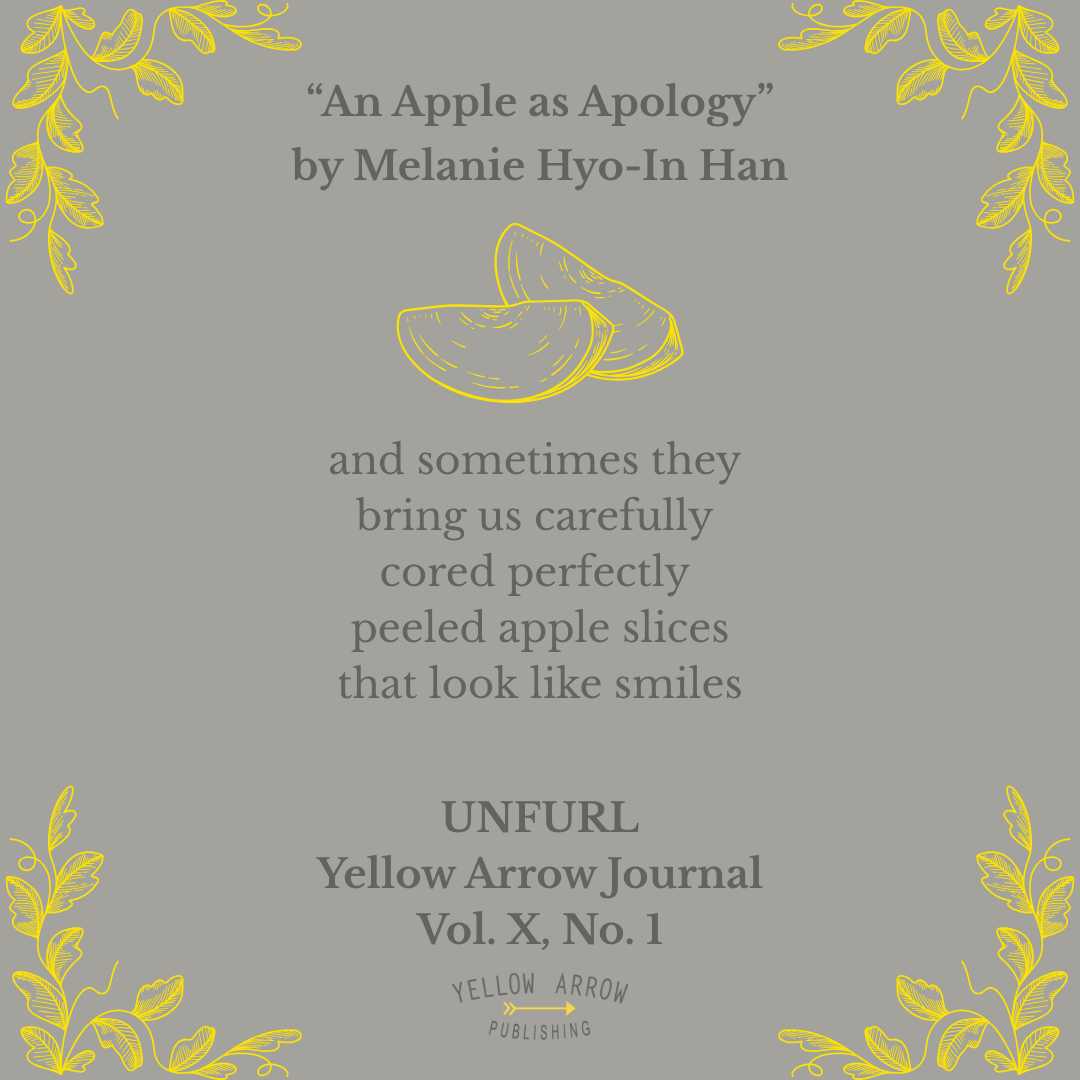
Yellow Arrow published Melanie’s piece “An Apple as Apology” in Yellow Arrow Journal, Vol. X, No. 1, UNFURL. You can find her online on Instagram @melhan and at melaniehan.com.
Recently, Melanie published a chapbook with boats against the current entitled Passing Notes in Secret. We absolutely enjoyed reading the chapbook; make sure to get your copy at boatsagainstthecurrent.org. Congratulations Melanie!
.Writers.on.Writing.
Get to know our authors, the foundation and heart of Yellow Arrow Journal, and what writing means to them through our monthly series.
W.o.W. #76
sarena tien
How did you first publish your writing and what was it?
During my sophomore year of college, I took an expository writing class. My professor had us write a cover letter for an assignment, and so I ended up submitting two of the personal essays I’d written for her class. While both ended up being published, “What It Means to be Chinese-American” was first.
Describe an early experience where you learned that language has power.
I remember when I learned that accents have power, even though they shouldn’t. Two Chinese American sisters were trying to get me to say “lion” because they thought it hilarious that my “l”s weren’t quite fully formed and so I’d say “nion” instead, and I think that’s when the cruelty of linguistic discrimination first crept into my world.
What does your inner writing voice tell you?
Finish one of the many pieces in progress that you have floating around your laptop.
Why did you submit this piece to Yellow Arrow Journal? Why this piece at this time to this place?
I’ve been subscribed to the Yellow Arrow newsletter for a while, but I never had pieces that fit the themes. Then I saw the call for kitalo, and the concept of grief resonated with me. Various forms of grief—linguistic, cultural, and familial—have shaped and unshaped my identity. I wrote “A Doctoral Education” during the winter break of my final year of graduate school, when I was struggling to figure out what I wanted to do after my PhD. Being the only first-generation, Chinese American student in my graduate program wasn’t easy, and my experience actually ended up playing a role in my decision to leave academia. However, I’m still grateful for the opportunity to write a dissertation on a topic I love, and my PhD helped me secure a job close to home with the kind of salary that my immigrant mother who never went to college always wanted me to have.
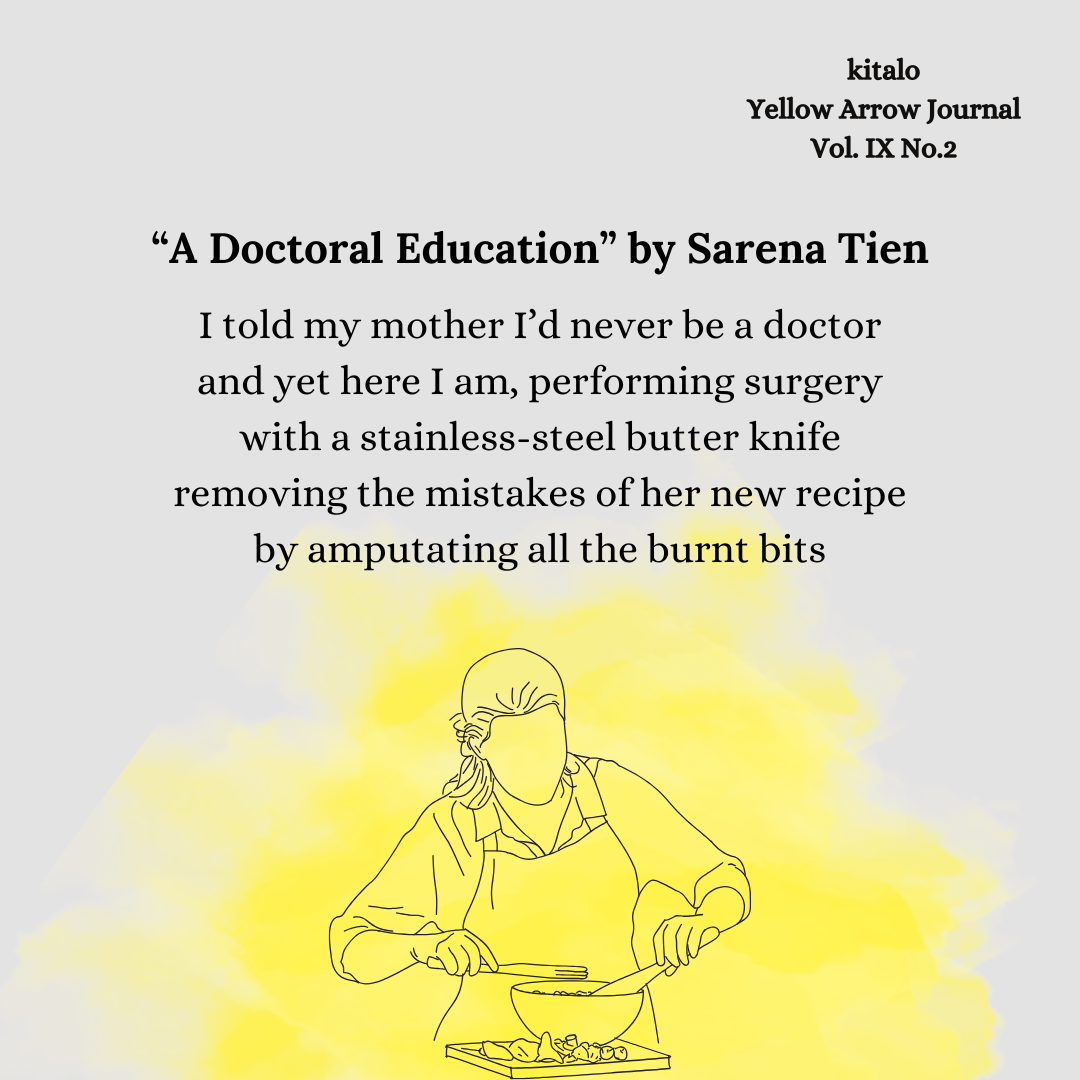
Sarena Tien (she/her) is a queer Chinese American writer and doctor (the PhD kind). Once upon a time, she used to be so shy that two teachers argued whether she was a “low talker” or “no talker,” but she’s since learned how to scream. Her poetry and prose have appeared in The Rumpus, Snarl, and Sylvia, as well as anthologies such as Decoded Pride, The Secrets We Keep, and Good for Her: An Anthology of Women’s Wrongs.
Yellow Arrow published Tien’s piece “A Doctoral Education” in Yellow Arrow Journal, Vol. IX, No. 2, kitalo. You can find her online on BlueSky @sarendipitous.bsky.social, and at sarenatien.com.
Recently, Sarena has published poems in Philly Chapbook Review and The Hellebore and a novelette, Definition: a Novelette, which will be published soon. Get your copy of Definition: a Novelette at elj-editions.com/definition. Congratulations Sarena!
.Writers.on.Writing.
Get to know our authors, the foundation and heart of Yellow Arrow Journal, and what writing means to them through our monthly series.
W.o.W. #75
mandy shunnarah
How did you first publish your writing and what was it?
When I was 19, I started writing for my hometown newspaper, The North Jefferson News, in Gardendale, Alabama. I covered a city council meeting where I took meticulous notes on things like stop signs needing to be replaced and deer eating people’s gardens, and turned in 4,000 words of the most boring news writing in the history of journalism. Thankfully, I’ve gotten better since then.
What word do you find yourself using most often in your writing?
I love to throw in “unmoored” when I can. I’m drawn to the idea of not merely being adrift but being set apart in a way that’s confusing and attempting to make sense of your surroundings in relation to your past life. That’s the connotation, at least for me, and it’s a theme in a lot of my work, so “unmoored” makes some nice appearances.
What is a book you wish someone would write?
I want a reverse Indiana Jones swashbuckler! A literary adventure novel full of shipwrecks, museum art heists, and the kind of weird, delightful characters that stick with you for years to come.
What does your inner writing voice tell you?
Whether the idea I want to write needs to be a poem, essay, or short story, I write across all three genres and know pretty quickly which medium the idea would be best served by. I don’t think too hard about it; it’s more running on vibes and intuition.

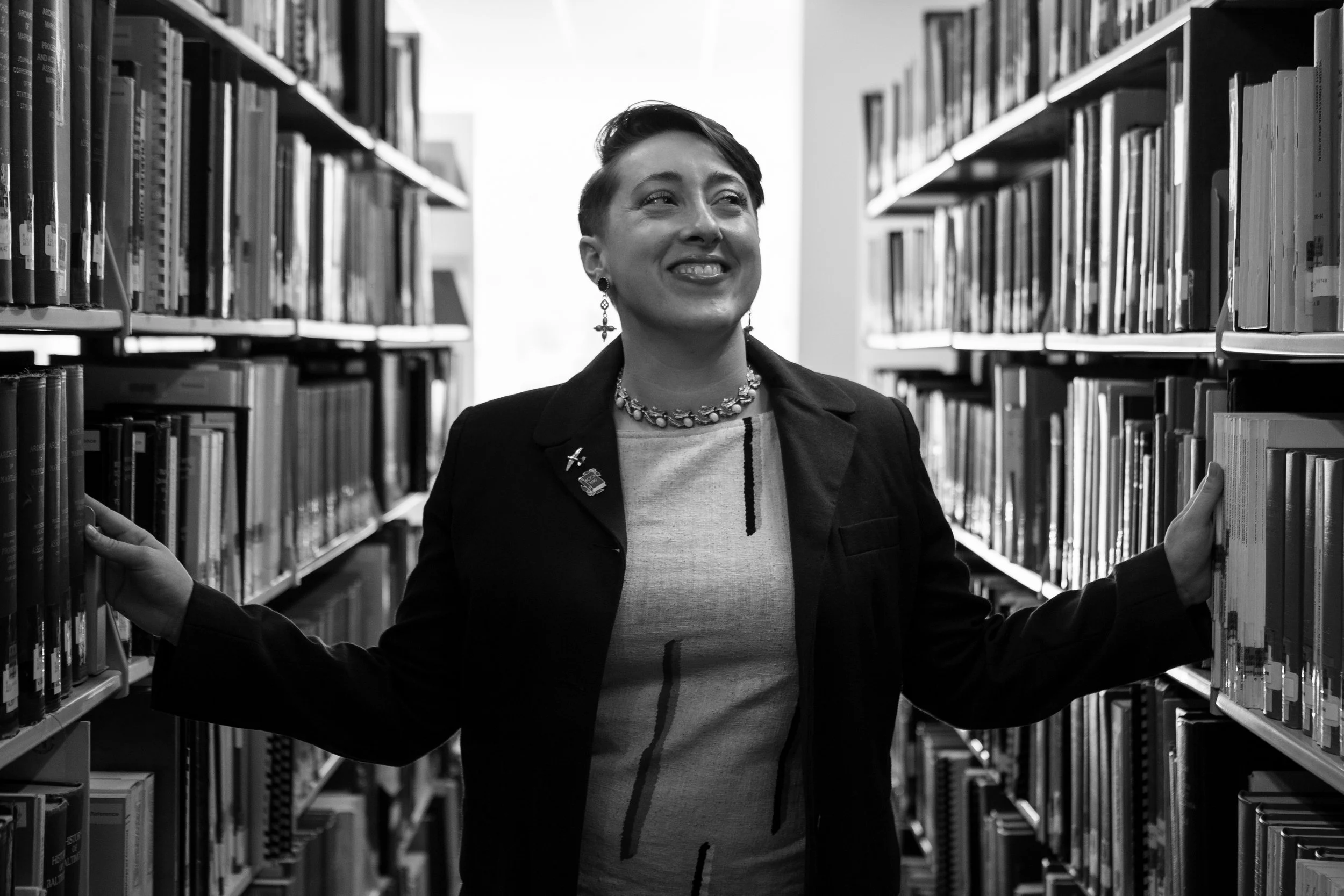
Mandy Shunnarah (they/them) is an Alabama-born Appalachian and Palestinian-American writer in Columbus, Ohio. Their essays, poetry, and short stories have been published in The New York Times, Electric Literature, The Rumpus, and others. Their first book, Midwest Shreds: Skating Through America’s Heartland, was released in 2024 from Belt Publishing.
Yellow Arrow published Shunnarah’s piece “a train derails in ohio & they still won’t say the name of my country” in Yellow Arrow Journal, Vol. VIII, No. 1, KINDLING. You can find her online on Instagram @offthebeatenshelf, Facebook @Mandy Shunnarah, X @fixedbaroque, and at mandyshunnarah.com.
Mandy would like to share that their poetry collection We Had Mansions is out in the world! You can get your copy at diodeeditions.com/product-page/we-had-mansions. Congratulations Mandy!
.Writers.on.Writing.
Get to know our authors, the foundation and heart of Yellow Arrow Journal, and what writing means to them through our monthly series.

W.o.W. #74
Kalehua kim
Describe an early experience where you learned that language has power.
While taking hula classes as a young child, I felt a great connection to the chants and songs my teacher sang. It helped me find a specific rhythm in my body as I danced. I believe those rhythms are present in my writing as well.
How did you first publish your writing and what was it?
In high school I entered the Young Authors competition where we had to physically bind the stories we submitted. That meant I typed up each page, asked a friend to illustrate it, and then made a cover out of cardboard that my mother helped me cover with fabric and scraps of old shelf paper liner that we assembled around the pages. I don’t remember the name of the story, but there was a mythical element involved. I didn’t win, but it taught me a lot about storytelling and its packaging.
What does your inner writing voice tell you?
Stay open. Listen.
What is essential for good storytelling? What types of stories do you find yourself driving inspiration from and how do they manifest in your work?
I think good storytelling stems from some kind of truth, whether it’s a core value or experience. Having your speaker or character question that truth or work within the complications of that truth can draw in a reader. I like stories that push expectations. What might start as something simple often becomes fraught as the protagonist grapples with it, and then we, too, are confronted with how we might act in a similar situation. I am inspired by characters that question themselves with a true desire to gain greater understanding of themselves and the world. In my work, that usually calls into question how I relate to my culture and upbringing (I am mixed Native Hawaiian and grew up both in Hawai’i and California) as I try to understand the liminal space I exist in as an Indigenous person and woman from mixed cultures living away from my birth land.

Kalehua Kim is a Native Hawaiian poet living in the Pacific Northwest. Her poems have appeared in Poetry Northwest, Denver Quarterly, and ‘Ōiwi, A Native Hawaiian Journal. Her first poetry collection, Mele, will be released on July 1. It can be ordered through Trio House Press at triohousepress.myshopify.com/products/pre-order-mele-by-kalehua-kim.
Yellow Arrow published Kim’s piece “There’s a trick with a pen I’m learning to do” in Yellow Arrow Journal, Vol. X, No. 1, UNFURL. You can find her online on Instagram @kalehuakim, Facebook @kalekim, BlueSky @kalekim.bsky.social, and at kalehuakim.com.
.Writers.on.Writing.
Get to know our authors, the foundation and heart of Yellow Arrow Journal, and what writing means to them through our monthly series.

W.o.W. #73
Majiq Vu Mai
How did you first publish your writing and what was it?
The first piece of writing that I published was a short fiction piece that I wrote in middle school about a young girl who struggles to break free from the chains that other people put on her. I published it by handing out multiple handwritten copies of my story to my classmates in the back of English class.
What is essential for good storytelling? What types of stories do you find yourself driving inspiration from and how do they manifest in your work?
A willingness to be a bad storyteller is essential for good storytelling. Oftentimes, what kills a good piece is the fear that prevents us from writing it. The type of stories I find myself deriving inspiration from the most include protagonists who learn to love themselves through the bitterness of life. I find inspiration in these types of stories because I’m someone who holds a lot of bitterness myself. This inspiration shows up in my writing in how I elicit medicine out of the bitterness of my life, through the alchemizing process of storytelling. Powerful medicine often tastes bitter on the tongue. We swallow it anyway because we trust that swallowing the truth will make us better on the other side.
What word do you find yourself using most often in your writing?
I find myself using the word “possibility” the most in my writing. If I don’t know what word to put down, I put down “possibility” as a placeholder until I could find a better word to use. There are so many possibilities when it comes to using words—maybe we struggle to use them not because we have too few words but because we have too much. But I also think that’s the fun of words, there are an infinite number of arrangements to be made with them.
What does your inner writing voice tell you?
My inner writing voice tells me that my words matter, even when I feel like they don’t. Even if no one reads them. The worst thing that can happen is that I stop writing. How will I know what my heart has to say if I keep everything inside?
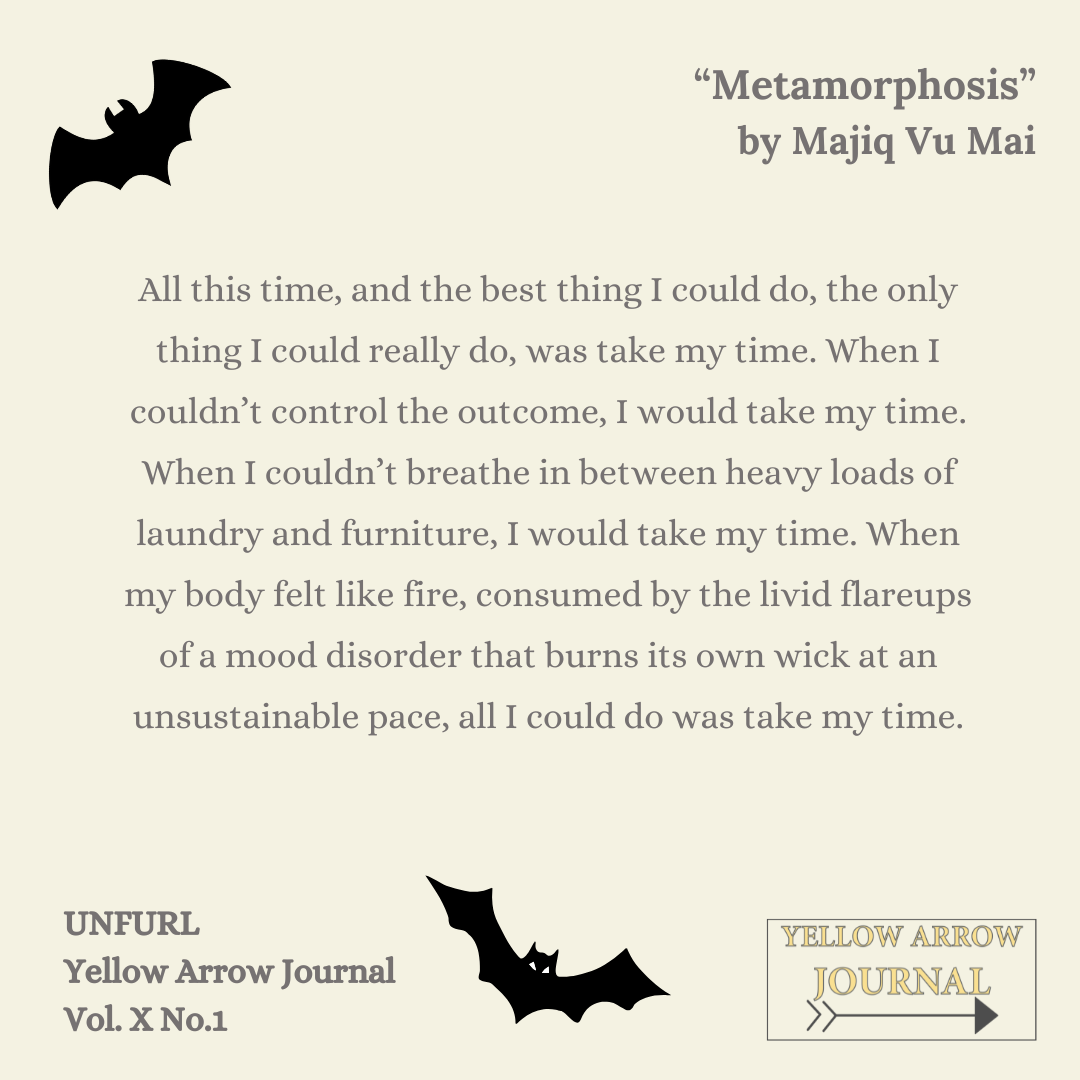
Majiq Vu Mai (they/we) is a multiplicity of madness, writing themselves alive with the words they have access to and the words they do not know yet. An alchemist of flesh and memory, Majiq writes whatever burns inside of them like a searing ache and finds relief in giving voice to the truths that no one else wants to hear. For Majiq, memoir is a form of self-constructed fiction—we write to recollect the pieces of ourselves we have lost along the way and remember our possibilities through the creative act of storytelling.
They are currently working on rebuilding the trust that they have with themselves again. They are working on finding the genuine in their voice. They are working on embracing love more than fear. They are working on completing their first collection of essays. They are working on their current reincarnation. They are working on their aliveness.
Yellow Arrow published Majiq’s piece “Metamorphosis” in Yellow Arrow Journal, Vol. X, No. 1, UNFURL. You can find them on Instagram @themajesticmaij.