“The everyday is our portion of eternity”: Of Devotion and the Notebook
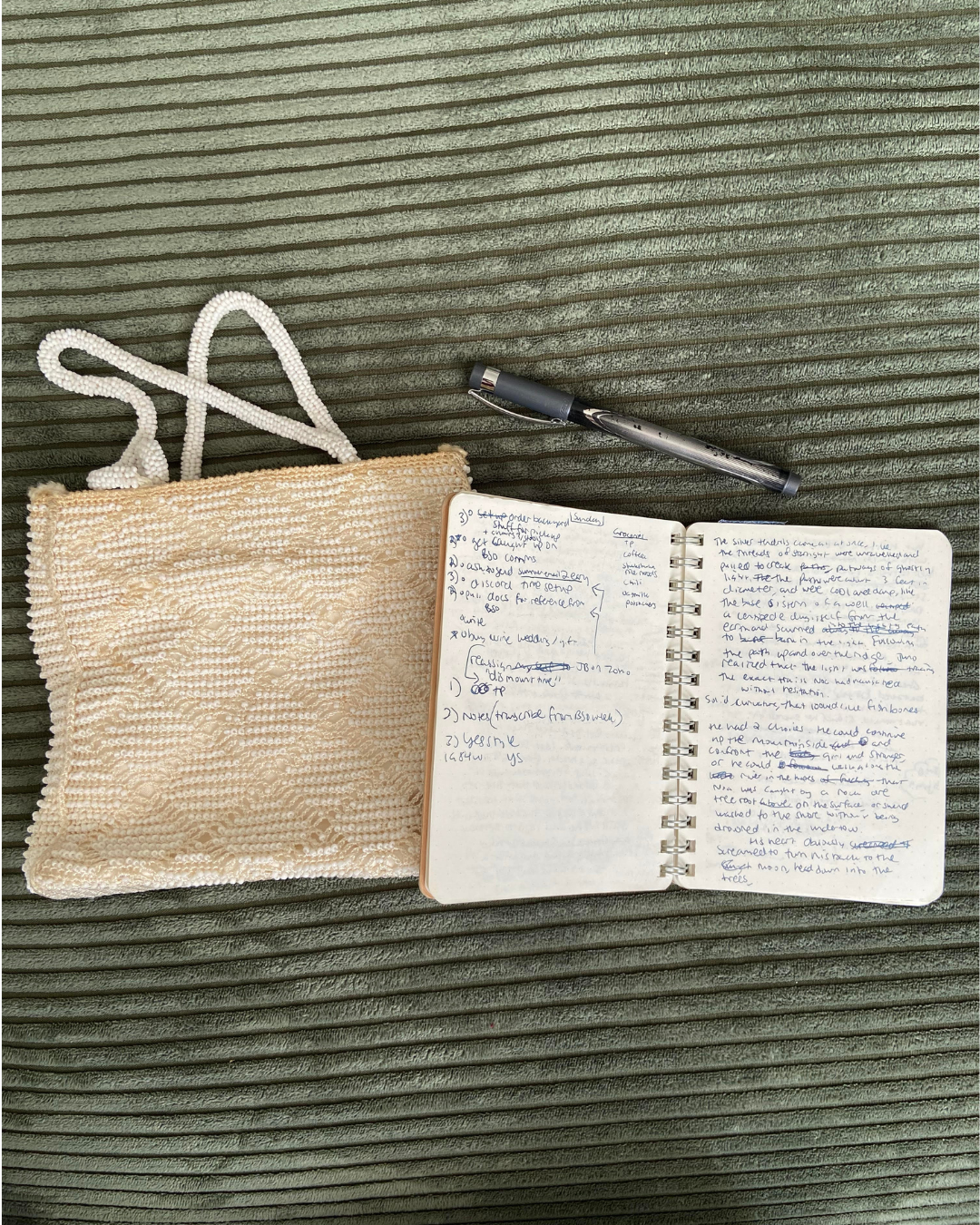
By Lillian Deja Snortland, written February 2026
I was at first absorbed entirely by the mystique of “the author”—beginning with Beatrix Potter’s fables and peaceful watercolors of the English countryside. Eventually, my voracious reading introduced me to many other avatars of authorship, including the grave, troubled artist, wandering the proverbial (or literal) woods, shepherding the truth about nature and the human condition, and so forth.
They made anything real—how could there be any greater power?
When I was a toddler, I wanted to one day own a tea shop with my mother and become an author myself. For a long time, my north star was Christopher Paolini, the young author of the Eragon series; with talent and drive, he wrote the first book when he was only 15 and published it officially only a few years after.
I will publish a fantasy novel by the time I’m 18, too, I promised myself.
On clunky computers, I spelled stories about fairies and demons. Fanciful and unserious, maybe, but my imagination was my domain, a place to formulate, resolve, and release reality’s constraints at will. No matter how the world saw me, with my brown skin and messy hair and curiosity, there was dignity I felt with every word I recorded. Children innately flex these muscles of self-actualization, and if they’re lucky, they are encouraged by others to strengthen them.
With 16 candles on my cake, I had ideas swirling around and around, scenes written, and accompanying doodles. However, no book was born by the time I was a legal adult. Eighteen came and went, and 20, 24—now, nearly with my 30th birthday in April, there is still no novel with my name on anyone’s bookshelf.
Yet I have created more than I ever thought possible through commitment to the core of my practice: keep observing, keep absorbing, and keep processing on the page. As it turned out, creation came easiest when I removed authorship from its lofty pedestal, and my writing became a simple part of daily living, my “every day,” as necessary and commonplace as taking a breath.
At one time, as part of my job at the Baltimore Symphony Orchestra, I sat at a podium and checked donors into a lounge. Throughout those nights, my notebook, which I carried in a tiny white beaded purse, was surreptitiously tucked away, whipped open, and then hidden away, over and over again.
The dotted notebook contained guest demands to pass along to my bosses the next day. It was also a space for schedules. For hurt feelings that I wasn’t sure how to say aloud. Dinner shopping lists. Pros and cons. Travel lists and strategic plans. Questions. The names of songs with swells that felt akin to my characters’ journeys. Words I needed to look up. Descriptions of people and their behavior.
My notebook is perhaps what might be called a commonplace journal, perfect for someone whose brain is tantamount to spinning plates.
There’s no limit to what one might include. For example, while traveling in a bus, my handwriting nearly illegible from the bouncing, I copied a few sentences from James Baldwin’s Notes of a Native Son,which imbued my writing with a new rhythm. Lines from video essays and colors I really want to wear in fall (chocolate brown, if you’re curious). Academic-style presentations and YouTube videos might be synthesized in equal merit. If I’ve enjoyed a movie or book, I consider why, be that the pacing, weaving of descriptions, length of sentences, overall chapter structure, and keep my observations like a treasure map—though I don’t always have the “X” marked yet.
The tiny notebook was my companion as I processed myself, not as a diary but as a grounding tool. The pen in my hand flitted about with no aim, but with the utmost attention to what was immediate in my life.
After the musicians’ scattered warmups melded into a single tuning note, and the lights dimmed, I took a temporary seat in the hall myself. Once I could no longer see the page in the darkness, I wrote in diagonals, with black ink looping back over itself. This was a time for poetry. Static, random lines, pops of a color, doodling blindly.
At intermission, I would return to the podium and write some more. In between pleasantries, closets of coats, refilled Keurig cups, and boxes of white wine, I drafted scenes of a fantasy world, made of character types I’d tended to as a child, and incorporating elements of media I loved.
Whatever world my imagination had once lived in developed over the decade. In my vignettes, there grew the vision of a character with thick brown hair and oxblood-colored eyes. An island. A festival. Magical systems and transformations. Countries bearing suffering and moral conflicts that resembled present-day horrors.
At this job, my time was often traded in for a paycheck, but I was lucky it afforded me spans of boredom and an empty page. Novelist Henry Miller wrote (then later published along with other “commandments” in Henry Miller on Writing (1964)), “Don’t be nervous. Work calmly, joyously, recklessly on whatever is in hand”—and so I did, between taking orders, in the dark, always learning and watching, remaining humbly faithful to my creative practice.
Interspersed amongst commentary about my work, house, and community, nothing shiny and literary linked together in an obvious way. There were no chapter titles, nor logical order. Nothing particularly resembled a noble lightning strike of brilliance I’d always imagined, naively, that Paolini might have felt while writing Eragon. Yet quietly, the scenes, brightened and shaped by the music around me, sequenced together. I transcribed the notes onto my laptop and found I had over 50,000 words: a first imperfect draft of exactly the sort of novel I’d been chasing for years.
Sharing a novel with the public was my dream, but it was this commonplace journaling, this scattered meditation, that provided me an unexpected ladder to reach it.
French author and activist Simone de Beauvoir went to see her friends often, and this social treat was part of her creative world. Writing at the symphony amidst the white noise of strangers allowed for a calm sense of momentum without the immense crushing pressure of isolation. I often take notes after meetings with friends where we sit and gab about life, or create stories, scripts, and tabletop role-playing games together. I attend local poetry and fiction readings or find cheap tickets to the symphony on occasion.
During a recent girls’ trip to New York, I purchased a tiny notebook with a blue-and-yellow watercolor tree on the cover. Containing no more than 30 milky pages, I asked my friends to fill the emptiness with whatever they wanted. Over the course of our trip, they left me with stickers and sketches of a bagel shop, a scruffy dog, and Stonewall.
As our trip drew to a close, I took a page at the end and drew the chevron pattern from a woman’s coat who stood near me at New York Moynihan Train Hall at Penn Station. In spite of its meaninglessness, the pattern was part of a story just waiting to be written. Once my eyes opened, and even while at times I felt far adrift from my novel’s success, I found my writing growing richer as my relationship with the world shifted endlessly between my internal landscape and that of the external.
Concepts from truncated notes often return like a north wind and drive some part of my creative work. Rather than by divine inspiration, I can trace my mind’s connections directly back to something I took notice of in commonplace musing. Disparate thoughts and observations are not without meaning, but a form of meditation and mesmerization.
Take, for example, this fragmentary passage from author Julian Barnes’ novel The Sense of an Ending, which stirs the heart and queries the passage of time with everyday things:
I remember, in no particular order:
—a shiny inner wrist;
—steam rising from a wet sink as a hot frying pan is laughingly tossed into it;
—gouts of sperm circling a plughole, before being sluiced down the full length of a tall house;
—a river rushing nonsensically upstream, its wave and wash lit by half a dozen chasing torchbeams;
—another river, broad and grey, the direction of its flow disguised by a stiff wind exciting the surface;
—bathwater long gone cold behind a locked door.
This last isn’t something I actually saw, but what you end up remembering isn’t always the same as what you have witnessed.
We live in time—it holds us and molds us—but I’ve never felt I understood it very well. And I’m not referring to theories about how it bends and doubles back or may exist elsewhere in parallel versions. No, I mean ordinary, everyday time, which clocks and watches assure us passes regularly: tick-tock, click-clock. Is there anything more plausible than a second hand? And yet it takes only the smallest pleasure or pain to teach us time’s malleability. Some emotions speed it up, others slow it down; occasionally, it seems to go missing—until the eventual point when it really does go missing, never to return.
I recently viewed the Ruth Asawa retrospective at the MoMA, labeled Ruth Asawa: A Retrospective exhibition. Though I was familiar with her commercially successful works, I was most inspired by her textile and meditative practice. She was patient in her pursuit of quiet beauty, with works spanning repeated, unpolished graphite gestures of an elementary sunflower, to her powerfully modern paintings and wire sculptures.
Her sketches were not a rudimentary means to a grandiose end. They were part of her fundamental daily practice of living. “Doing is living. That is all that matters,” Ruth Asawa is quoted on a panel in the exhibit. As she walked, through the concentric expansion and contraction of her thoughts, the path was created beneath her. In his book What I Talk About When I Talk About Running (2007), Haruki Murakami speaks of routine habits as follows: “The repetition itself becomes the important thing; it’s a form of mesmerism. I mesmerize myself to reach a deeper state of mind.”
Commonplace journaling was one such way I mesmerized myself. This professor shared a series of anchors to consider when observing the world, including, but not limited to: readings, watching, sketching, eating, praying, quoting, needing, eating, buying, thinking, considering, debating, owing, avoiding, looking at, wondering about, checking in, gratitude, planting, harvesting, nurturing, weaning, creating, listening to, ignoring, cooking, wearing, planning, releasing, tasting, touching, smelling, noticing, embracing, rejecting, waiting for, allowing, learning, dreaming, becoming, embodying, giving, appreciating, resisting, hard truths, delights, small wins, inside/outside, architecting, sound, sidewalks, streets, traffic, stores, trash, sticker, graffiti, energy, sounds, a color, a shape, an accessory, dynamics, attention/distraction, and so forth.
It was only after years and years that I discovered delight in dry observations, arranging sights and sounds which, if I described them alone, would mean very little. In director Guillermo Del Toro’s film Frankenstein, Lady Elizabeth countermanded scientific voracity in favor of wonder towards God’s smallest creatures. Lady Elizabeth’s faith was tenacious, and I think of her faith as something akin to my own. French writer Maurice Blanchot writes, in a translation of his piece “Everyday Speech,” “The every day is our potion of eternity.” My habits are a trellis for my dreams, including my desire to see my name on the spine of a book. But by the same token, my habits are in attendance of the awe-inspiring every day.
I write, therefore I am, and therefore I am also in this eternity with you.
Though I have no religion, journaling has become a sort of ritual, a grounding procedure based on mechanical habit. I believe one’s craft has very little to do with talent and much more to do with devotion. Writing and paying attention are ways of life, and anyone can do it.
Writing in the dark of the orchestra hall, there was nothing splendid in my routine or my view of myself. It was then that I sensed my sweet spot—when I wrote from within a paradox. I was both dedicated and casual. My writing could be everything, but most importantly, it was nothing at all—I observed simple things and trained myself to say simple things, too. When writing became so commonplace, it allowed me to detect, within the swirling chaos of time, compelling patterns worth sharing.
As a creative, it behooves you to open doors around you rather than closing them. Start wherever and however you can, today: take life in. After all, consciousness is a matter of attention.
And what is any life made of, if not infinite stories?
Lillian Deja Snortland’s poetry, essays, features, creative nonfiction, and short stories have appeared in Postscript Magazine, OUCH! Magazine, Goucher Magazine, Yellow Arrow Vignette BLAZE, and Amplify Arts publications, been performed at Voxel Theater, and exhibited at the Temporary Arts Centre in Eindhoven, The Netherlands. Her essay “The Tragedies of Ecstasy” was nominated for a 2025 Pushcart Prize through After the Art literary magazine. She will be leading a Yellow Arrow workshop called Bear Fragments in May; registration is at yellowarrowpublishing.com/workshop-sign-up/bearfragments.
Her work explores metamorphosis (physical and metaphorical) and precipice. She loves collaborating with teams in any creative medium, including film writing/production (having participated in the Baltimore 48 Hour Film Project and the Maryland 72 Film Fest), tabletop role-play, and musical jams.
Originally from Eugene, Oregon, Lillian graduated from Carleton College with a BA in Classical studies and a minor in French/Francophone studies, and has an MFA in nonfiction from Goucher College. She enjoys lounging in parks, zooming via public transit to Baltimore cultural events, and hosting thematic parties in her apartment.
*****
Yellow Arrow Publishing is a nonprofit supporting women-identifying writers through publication and access to the literary arts. You can support us as we LUMINATE a path for women-identifying creatives this year by purchasing one of our publications or a workshop from the Yellow Arrow bookstore, for yourself or as a gift, joining our newsletter, following us on Facebook and Instagram, or subscribing to our YouTube channel. Donations are appreciated via PayPal (staff@yellowarrowpublishing.com), Venmo (@yellowarrowpublishing), or US mail (PO Box 65185, Baltimore, Maryland 21209). More than anything, messages of support through any one of our channels are greatly appreciated.