A Young Woman’s First AWP: On Nerves, Community, and Finding Your Voice
By Camille Leah Barrón, written March 2026
I taught myself to read twice.
The first time was like everyone else. The second time was harder—that was in middle school, newly diagnosed with dyslexia, learning to reorganize letters in their proper order to form a sentence that actually made sense. It was slow. It was frustrating. I liked the idea of reading—of dreaming up new worlds and sharing stories—but for some reason, I was never good enough at it to take advantage of the enjoyment everyone else experienced. And then I found the books that made the effort worth it. Young adult fantasy. Dystopian fiction. Stories about girls who had no business surviving the situations they were dropped into, and who survived them anyway. I read every one I could get my hands on. I decided then: If they could fight their way through impossible worlds, I could fight my way through a page.
Reading became an escape at first. Then a passion. Then I started writing stories of my own. I made a decision somewhere in those pages: one day, I would work in publishing.
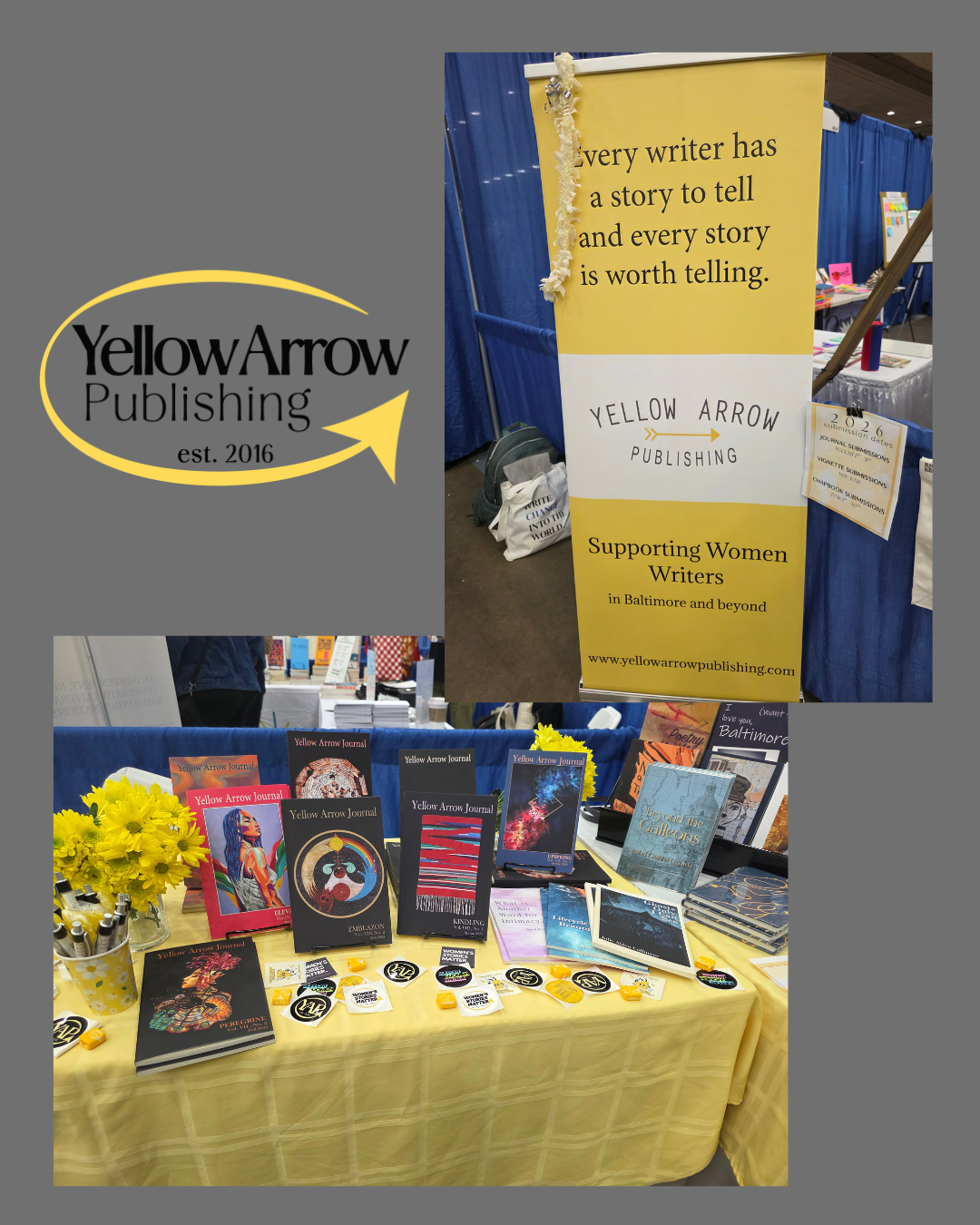
That day looked like this: spring break, junior year of college. My classmates were on their own vacations with their friends or families. My little brother was backpacking across Iberia. I was at the Baltimore Convention Center in the professional clothes I bought specifically for the occasion, about to walk into AWP—11,000 writers, editors, publishers, and me—for the very first time.
The AWP—the Association of Writers and Writing Programs—conference is one of the largest literary gatherings in the country, spanning several days of panels, craft talks, readings, and a book fair. Yellow Arrow Publishing, a Baltimore-based press, had only attended a handful of times before. This year, AWP came to Baltimore, and we kicked things off the night before the conference opened by celebrating Yellow Arrow’s 10th anniversary with a reading from 10 of our incredible authors.
The last time I had been inside the Baltimore Convention Center was for a Comic Con when I was in middle school. The differences were obvious—one had thousands of people dressed in elaborate costumes of their favorite comic book characters, and the other had thousands of people carrying tote bags overflowing with literary magazines and dog-eared chapbooks—but the energy was surprisingly similar. Both were thousands of people converging in one place to celebrate and learn within a shared passion. Both were overwhelming in the best possible way.
This time, though, I wasn’t a middle schooler tagging along with my best friend’s dad as a chaperone. I was there professionally, as an intern, with “Yellow Arrow Publishing” on my badge.
The book fair alone had hundreds of booths, small presses, journals, and publishing houses stretching across the floor in every direction. Panels were happening simultaneously upstairs across multiple rooms, with lines of people snaking out into the hallways waiting to get in.
I stood at the Charles Street entrance for a moment and genuinely did not know where to go first.
Walking into a new experience without knowing a single person, without knowing the unwritten rules of how things work—it’s disorienting in a way that’s hard to explain. You look around and assume that everyone else knows exactly what they’re doing, that they’ve done this before, that they belong here in some way you don’t yet. You think: I’m just an intern, these people are real adults.
But then I started noticing the people around me more. And what I saw was this: so many women. Women presenting at panels, women running booths, women standing in the hallways mid-conversation, animated and engaged. Women who looked like they had been coming to AWP for 20 years and women who looked like they were figuring it out in real time, just like me. In a split second, I felt less nervous. I wasn’t alone in that room. Not even close.
The connections came slowly at first, then all at once.
Through Yellow Arrow, I had the chance to meet other interns along with people interning at other small presses. What I didn’t expect was how quickly a shared admission of nervousness could dissolve the tension of meeting someone new. Within the first few minutes of almost every conversation with another intern, someone would say some version of “I wasn’t sure what to expect or I’m still figuring this out or I have no idea what I’m supposed to be doing,” and suddenly we were just people talking, not professionals performing professionalism at each other.
That’s something nobody tells you about networking: Most people aren’t as confident as they look, and most people are genuinely happy to talk to you. About their writing. About the press they’re working for. About where they’re from, what brought them to publishing, what they’re excited about right now. The conversations didn’t feel like transactions. They felt like people just sharing their love of reading and writing.
The community at AWP was more welcoming than I had any right to expect as a first timer. People offered advice freely—not in a condescending way, but in the way that people share things they wish someone had told them earlier. I absorbed as much as I could.
And the representation in that convention center was incredible to see. So many women. So many people of color. So many voices that publishing has historically struggled to center, now showing up and claiming space with full force. It wasn’t just visually affirming—it was a reminder of why small, independent presses like Yellow Arrow exist in the first place. The industry has room for more voices; it needs them. Walking through that book fair, I saw what it looks like when the door gets held open a little wider.
I started my internship in January not knowing what publishing actually looked like from the inside. I left AWP with a slightly clearer picture, and it was bigger and stranger and more interesting than I had imagined.
There are independent presses and literary magazines operating on shoestring budgets with enormous amounts of heart. There are editors who specialize in poetry and editors who work exclusively in literary fiction. There are authors at every stage—debut writers with their first book, seasoned writers reinventing their practice, writers who also teach, also edit, also run presses of their own. The publishing world isn’t a single ladder you climb. It’s more like a web with a hundred different points of entry and a hundred different ways to build a life inside it.
The panels reinforced this. Conversation after conversation made clear how deeply collaborative writing is—how much writers rely on each other, how communities form around journals and workshops and readings and, yes, conferences like this one. Writers supporting other writers isn’t a nice sentiment. It’s structural. It’s how the work survives.
I also learned something more practical: Networking doesn’t have to feel like performing a version of yourself that’s more polished and less real. The most meaningful conversations I had at AWP happened when I stopped trying to say the right thing and just talked honestly about what I was learning and what I cared about. Professionalism, it turns out, isn’t a costume. It’s just showing up and being present and treating people like they’re worthy of your full attention.
What made that easier than I expected was how freely people offered up their knowledge—especially women. There was no sense of guarding hard-earned wisdom or doling out advice strategically. If anything, it felt the opposite. The women I met seemed genuinely invested in watching another young woman find her footing. Like they remembered exactly what it felt like to be new and had decided that the best thing they could do with everything they’d learned was to hand it forward.
The advice was surprisingly simple.
Be yourself in your writing. Don’t soften your voice to make it easier to swallow. Your work has a place, especially when it doesn’t fit cleanly into a box. Women’s voices matter and need to be heard, not as a gesture, but as a genuine correction to a long history of erasure.
I’m a junior in college. I’m a poet and a rhetorician. I’m an intern. I am, by most measures, at the very beginning of whatever this is. AWP didn’t change that. But it did something more useful—it reminded me that everyone starts somewhere. The writer signing books at her publisher’s booth was once a student who didn’t know what AWP was. The editor presenting a panel on queer ekphrasis once stood at the entrance of a convention center feeling exactly the kind of overwhelmed that I felt on day one. The conference exists, at least in part, because the literary community understands that the people coming up behind them need to see what’s possible.
Sometimes the hardest part is walking into the room. The sheer act of showing up when you’re uncertain, when you don’t yet know the language, when the imposter syndrome is loud takes courage. But once you’re inside, you realize that the room is full of people who want you there. People ready to hand you a piece of advice, strike up a conversation, or simply exist alongside you as proof that this world is bigger and more open than it might have seemed from the outside.
I walked into AWP not knowing what to expect.
I walked out knowing that little girl who struggled to read was now a part of the conversation.
Camille Leah (Cam) Barrón (she/her) is a junior at Loyola University Maryland majoring in writing with a minor in gender and sexuality studies. She grew up devoting much of her time to reading, writing, and playing lacrosse and has since developed a deep commitment to women’s empowerment and language as a tool for connection, argumentation, and social change. Her academic and creative work centers on rhetoric and poetry with a particular focus on conversations surrounding her Méxican heritage, mental health, gender-based violence, and feminist thought.
*****
Yellow Arrow Publishing is a nonprofit supporting women-identifying writers through publication and access to the literary arts. You can support us as we LUMINATE a path for women-identifying creatives this year by purchasing one of our publications or a workshop from the Yellow Arrow bookstore, for yourself or as a gift, joining our newsletter, following us on Facebook and Instagram, or subscribing to our YouTube channel. Donations are appreciated via PayPal (staff@yellowarrowpublishing.com), Venmo (@yellowarrowpublishing), or US mail (PO Box 65185, Baltimore, Maryland 21209). More than anything, messages of support through any one of our channels are greatly appreciated.