Andromeda & Anglerfish: A Conversation with Andi Myles
I dream of smoking cigarettes
but I am pregnant with the new earth
bloated with possibility
aching for my final transformation
“Transfigured”
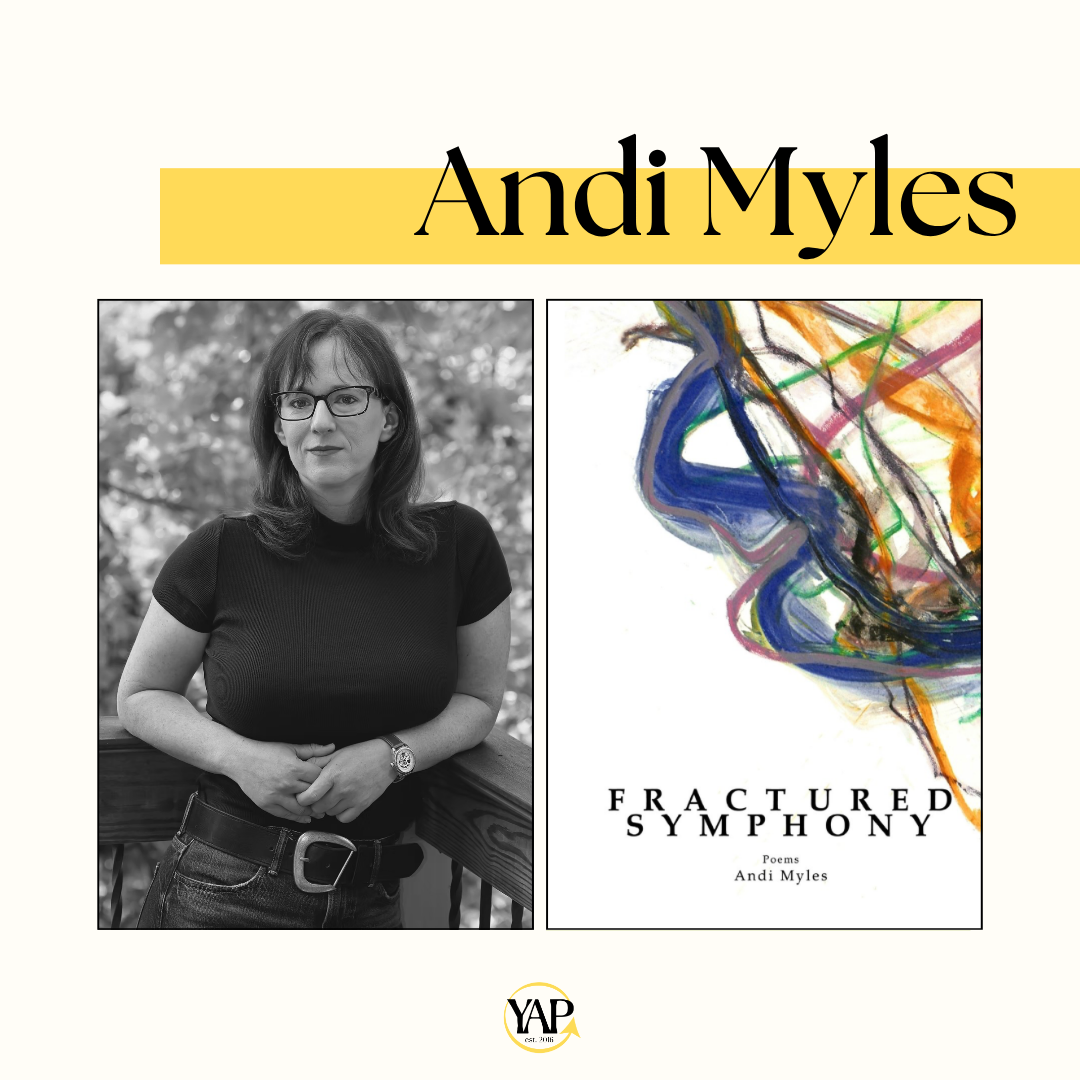
Andi Myles has worked as a science writer in the Washington, D.C., area for 14 years. She recently embarked on the adventure of relocating with her family to a new country. She is the author of the chapbook Fractured Symphony (Cathexis Northwest Press, 2025), and her lyric essay collection God Haunted is forthcoming from Ohio State University Press in 2027. Her essays and poetry often use the natural world—science, math, and the environment—as a lens to illuminate and explore human experiences.
Yellow Arrow interviewer Melissa Nunez and Myles connected over email to discuss Myles’ writing philosophy, current publications, and upcoming projects.
Who are some women-identified writers who inspire you?
Maggie Nelson and Anne Carson were the first two writers that changed my understanding of what an essay and a lyric essay could be. They gave me permission to stop trying to turn my voice into something that sounded like everything else I had read and taught me that I could lean into all the quirks that made my writing style unique.
Can you speak to the convergence of science and art in your life and your writing?
I feel like at this point, I couldn’t stop it even if I wanted to. After almost 15 years of writing about science, I have collected so many factoids and interesting ideas that I cannot stop seeing the connections and metaphors to daily life. It truly is a case of writing what I know. When I reach for a metaphor, the first thing I find is science. Because I know the reason that shadows on the moon are darker than shadows on earth, I can’t help but want to use it to explain that sometimes disruption makes things clearer.
Can you address the theme of longing in your poetry? Even in pieces that lean more positive, this theme remains a strong presence.
That old adage about life being about the journey and not the destination is a concept that I am obsessed with and so it comes out in my writing over and over [again]. The minute you have “the thing” you wanted so badly, it loses so much of its power.
I find it is uncomfortable to always be striving but intolerable not to have something to long for.
I will not tell you that
you are cold hands on a
warm mug pulling heat from
the depths of me. What I
mean is that you are stars at noon.
“a love story in three parts”
How do you come to the different forms of your poetry?
I feel like a lot of times, the form the poem takes on the page provides a different physical experience for the reader, and I try to use that to my advantage. So if the speaker of the poem is holding back, is constraining themselves, I might use short, clipped sentences in clean, regular stanzas. Panic, frustration, anger often tend to look like longer run-on sentences with fewer stanza breaks.
And occasionally, a poem just needs to reflect the concept. I have a poem about atoms wanting to break apart, and I kept it in stanzas for a long time before I realized that the words themselves needed to spread out all over the page. It completely changed the feel of the poem and worked so much better. So sometimes the answer is just, “It feels better this way.”
Can you discuss the differences, if any, in the writing process for poetry vs. creative nonfiction?
Well, first off, the biggest difference is that I can lie in poetry! I can make up details or people or events as needed. I can bring in the absurd—the day my mother turned into a parrot and flew out the window—or speak with certainty about how black holes talk to each other. That gives a writer enormous freedom, which is not to say that there aren’t benefits to working within the constraints of experienced reality.
Other than that, the difference in my writing is context. Because I so often write lyric essays, I feel like they are just long poems and my poems are tiny lyric essays. In my [creative nonfiction work], I get to give the reader a little more detail, context, or history. But ultimately when I write, I want the reader to feel something that they recognize and if I can do it in 100 words, it usually looks like a poem. If it needs more, I turn it into an essay.
How did this poetry collection (Fractured Symphony) come together? I am especially curious about the musical element in the title and structure.
I don’t have a particularly exciting answer to this question. I knew I wanted the title to contain an element of brokenness, and I felt strongly that the manuscript consisted of three distinct movements: two more turbulent sections separated by a brief moment of relative calm.
Once I thought of the word rest or cesura to describe the poems in the middle, I started thinking in terms of music. Then it was just a matter of experimenting and trying out different pairs of adjectives and musical nouns until I found one that seemed to fit.
There is an abundance of rich and elegant imagery in this collection, from the celestial to the mundane. Can you expand on how a dented can and the god Zeus can take up the same space on the page, command the same attention from the reader?
I think because it’s never really about the dented can or Zeus for that matter. I’m always looking to find the universal, to say, “Look here is a thing,” and have someone say, “Yes, I understand. I have felt that, too.”
That’s why it is possible to tear up over the description of the destruction of a spider web, because we have all felt the sudden loss of something we spent a portion of our lives building. And so, when you can find the words that give a shape to an experience or a feeling that allows someone else to recognize themselves in it, it doesn’t matter what shape it happens to be.
What advice do you have for fellow women-identified writers?
Don’t worry about being a woman-identified writer. Especially in the poetry world, there is sometimes the idea that men write the poetry that is to be taken “seriously” and women write the accessible poetry for regular people. I think it’s changing. I hope it’s changing. But worrying about writing seriously or being taken seriously will only constrain your voice and make you question your lines before they ever even get a chance on the page.
Other than that, the advice I give to all writers: practice and revise.
All writing makes you a better writer—journalism, science writing, academic writing, book reviews, letters (or emails) to friends.
The first draft doesn’t have any inherent magic. Revision is not something to fear. Save old drafts—you can always go backwards—but experimenting, moving things around, will give you freedom to see the connections that your mind already made, and you can go back and make it clearer, more intentional and more effective.
Listen to feedback that is specific, ignore feedback that is broad. For both the good and the bad, generalized feedback (“This is not ‘poetic’ enough/I don’t like the voice” vs. “I think a concrete image here would help anchor the idea”) means either the person didn't read carefully enough to be worth listening to or isn’t skilled enough to be giving feedback in the first place.
Most importantly, if you are getting bored, your reader will, too. That’s how you know it’s a place that needs a little kicking to get it into shape.
Daughter, lift weights, run fast, live with apprehension
the last woman to be burned at the stake has yet to be born.
“Fallen”
What symbol represents you as a woman or writer?
A phoenix. I have one tattooed on my wrist. It is cliché, but for a very good reason. The phoenix is a metaphor that contains so much of my worldview. None of us gets only one life, we get a long string of connected ones. And my goal in life is not to avoid pain, it’s to make the pain worthwhile and to come out of difficulty stronger.
And if you want to be a writer, I think it is helpful to be ok with sometimes burning it all down and starting over.
Do you have any future projects in the works you would like to share with the Yellow Arrow audience?
I have [my] book of lyric essays, God Haunted, coming out with Ohio State University Press in 2027. I’m also finishing up a poetry manuscript about the connection and relationship between the body and the mind, and I’m excited to begin looking for the right home for it.
The poems quoted throughout the blog are from Fractured Symphony. You can follow Myles on Instagram @andimyleswriter and find more information about her and her publications on her website andimyles.com.
Melissa Nunez makes her home in the Rio Grande Valley region of south Texas, where she enjoys exploring and photographing the local wild with her homeschooling family. She writes an anime column at The Daily Drunk Mag and is a prose reader for Moss Puppy Mag. She is also a staff writer for Alebrijes Review and interviewer for Yellow Arrow Publishing. You can find her work on her website at melissaknunez.com/publications and follow her on Twitter @MelissaKNunez and Instagram @melissa.king.nunez.
*****
Yellow Arrow Publishing is a nonprofit supporting women-identifying writers through publication and access to the literary arts. You can support us as we LUMINATE a path for women-identifying creatives this year by purchasing one of our publications or a workshop from the Yellow Arrow bookstore, for yourself or as a gift, joining our newsletter, following us on Facebook or Instagram, or subscribing to our YouTube channel. Donations are appreciated via PayPal (staff@yellowarrowpublishing.com), Venmo (@yellowarrowpublishing), or US mail (PO Box 65185, Baltimore, Maryland 21209). More than anything, messages of support through any one of our channels are greatly appreciated.