Spotlighting Indigenous Independent Press
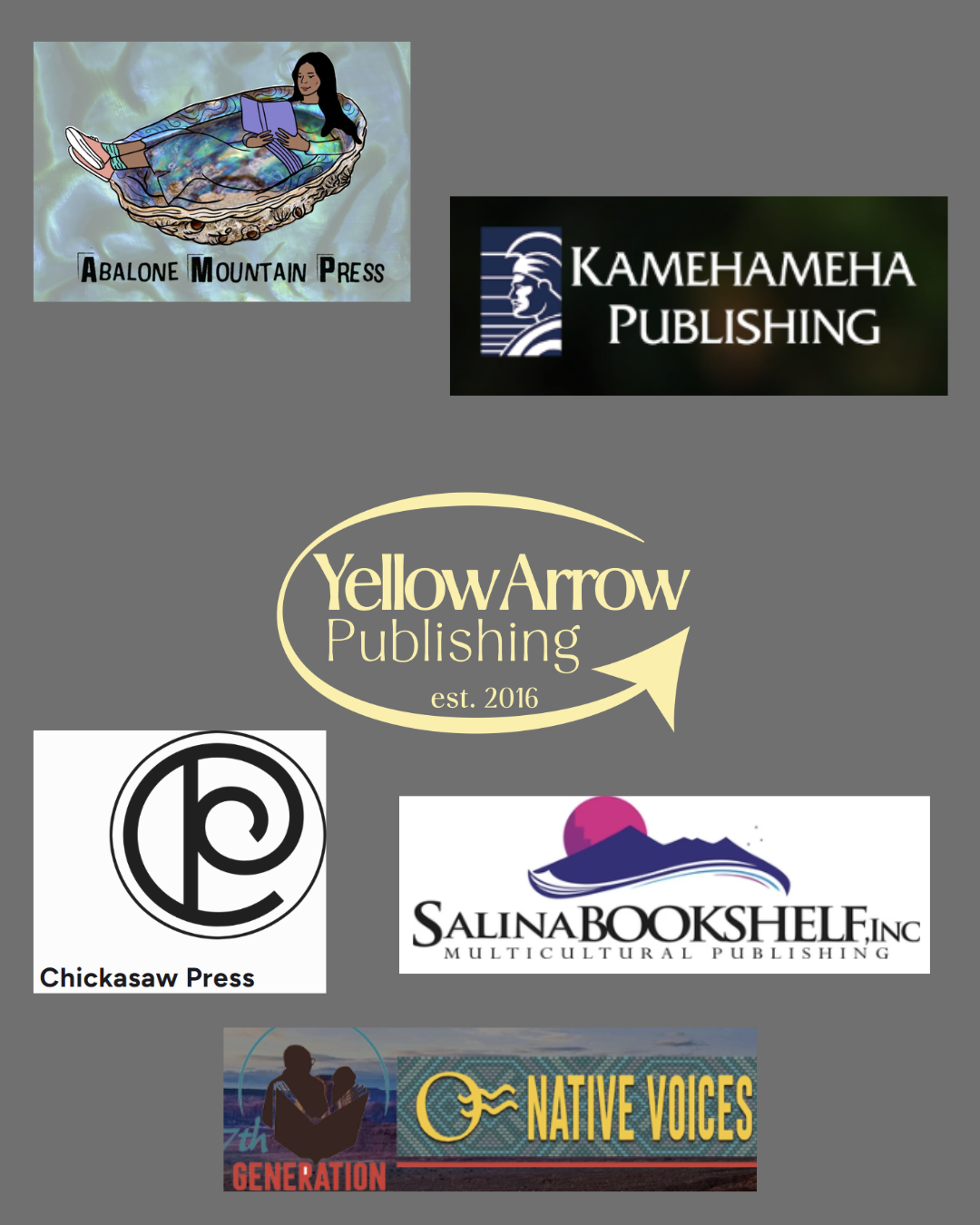
By Avery Wood, written December 2025
At Yellow Arrow, we believe in uplifting marginalized voices and supporting the intersection of womanhood. In this blog, I focus on giving a spotlight to independent presses and publishers that support or are run by Indigenous peoples, with a focus on poetry and prose, as well as history, heritage, and children’s books. As an organization dedicated to womanhood in all its forms, Yellow Arrow wants to use its platform to highlight incredible Indigenous-led presses whose work we admire.
Abalone Mountain Press
In a recent blog, I spotlighted Abalone Mountain Press, a women-owned independent publishing house created by Amber McCrary, a Diné woman. McCrary is a Red House Clan born for Mexican people who was originally from Shonto, Arizona and raised in Flagstaff, Arizona. Through various multimedia works such as chapbooks, zines, anthologies, coloring books, their blog and podcast, and their Abalone Writing Circle, Abalone Mountain Press supports and uplifts Indigenous voices in the Phoenix area and beyond. Their work includes themes like Indigenous culture, mental health, queerness, spirituality, the natural world, Native masculinity, and more. Find Abalone Mountain Press at abalonemountainpress.com or on Instagram and Facebook @abalonemountainpress.
Chickasaw Press
If you are interested in more history and heritage nonfiction, you can support Chickasaw Press, operated by Chickasaw natives. Housed in Ada, Oklahoma, it publishes about Chickasaw history, culture, and language. Their imprint, White Dog Press, established in 2013, explores popular genres and creative projects and includes children’s literature, historical fiction, young adult, poetry, and other creative works. In 2023, they further expanded with another imprint, Leaning Pole Press, that acts as an outlet for Chickasaw authors and scholars in a variety of genres and subjects beyond the Chickasaw historical and cultural experience. You can find countless Chickasaw Press resources available on their website at aachompa.com/pages/chickasawpress, including an app (Choctaw Hymns App), a Chickasaw dictionary, a national curriculum, a Chickasaw Nation Culture and Humanities YouTube, and a language learning software called Rosetta Stone. You can also find them on Instagram and Facebook @chicksawpress.
Kamehameha Publishing
Another nonfiction and education-focused Indigenous publishing company is Kamehameha Publishing, a Hawaiian-owned and operated publisher setting out to amplify ʻōlelo Hawaiʻi, ʻike Hawaiʻi, and kuanaʻike Hawaiʻi and deliver engaging content on Hawaiian culture for all ages. Originally known as Kamehameha School Press, established in 1888, Kamehameha Publishing currently works to publish and distribute Hawaiian language, culture, and community-based materials. One noteworthy title is Lurline Wailana McGregor’s Between the Deep Blue Sea, winner of the American Indian Library Association’s 2010 American Indian Youth Literature Award for Best Young Adult Book. Find and support them at kamehamehapublishing.org or on Facebook and Instagram @kamehamehapublishing.
Native Voices Books
Native Voices Books from Tennessee is dedicated to celebrating and promoting Indigenous cultures, publishing children’s books, craft books, coloring books, and both Cherokee and Iroquois history and cultural books. One notable title is Sisters in Spirit by Sally Roesch Wagner about the Haudenosaunee (Iroquois) influence on early American feminists, an example of their mission to illuminate intersectionality and Native feminism in the Indigenous community. Other powerful themes in their publications include health and wellness, spirituality, warrior culture, and family. You can find Native Voices at their website, bookpubco.com/native-voices, or on Instagram and Facebook @nativevoicesbooks.
Salina Bookshelf, Inc.
Independent publisher Salina Bookshelf, Inc., founded in 1994 in Arizona, specifically focuses on publishing Navajo (Diné) and southwest tribal content. They publish textbooks, children’s picture books, children’s chapter books, informational texts, reference books, audio books, and language learning materials, and they specialize in dual Navajo-/English- and Hopi-/English-language books along with textbooks used to teach Navajo language in schools. Saad Lá Tah Hózhóón: A Collection of Diné Poetry is a collection they published in 2019 about author Rex Lee Jim’s relationship to his land, his people, and his language, Diné Bizaad (Navajo Language), translated into English. You can find Salina Bookshelf, Inc., at their website, salinabookshelf.com, or follow them on Instagram and Facebook @salinabookshelf.
Honorary Mention: Milkweed Editions
Milkweed Editions, although not Indigenous owned, is another independent press I want to highlight. They are one of the most prestigious independent publishers in the U.S., and one of the most successful at amplifying voices of Indigenous peoples and other marginalized communities. Some of their world-renowned titles include Braiding Sweetgrass by Robin Wall Kimmerer and You Are Here: Poetry in the Natural World by Ada Limón. They are a beautiful organization that prides itself on taking risks on debut and experimental writers, and they operate entirely as a nonprofit. Founded in 1980 in Minneapolis, Minnesota, they’ve successfully published over 350 books of literary fiction, nonfiction, and poetry. Their slogan is “Because reading should be life-changing,” which is perfectly encapsulated by their revolutionary works that encompass themes like love, mental health, intersectionality, childhood, climate change, kinship, music, time, and more. They continue to support authors from a variety of backgrounds: Indigenous, LGBTQ+, Asian American, Pacific Islander, African American, Palestinian, Hispanic, Latinx, the climate activist community, and those writing in non-English languages. You can find and support them on their website at milkweed.org, at book and poetry readings around the world, through their Minnesota book clubs, membership opportunities, and on Instagram @milkweed_books and Facebook @milkweed.books.
In researching all the presses I mention, I was moved by the sheer breadth of stories being told, whether through language preservation apps or online zine poetry projects. All these unique forms of storytelling work to challenge the status quo and bring both positivity and perspective to Indigenous culture. Join me in celebrating all these amazing publications as they continue to amplify the voices of Indigenous peoples across the United States and work to preserve their vibrant and essential cultures. Indigenous stories are vital, and those who work to publish these incredible authors are truly doing fantastic work.
Avery Wood (she/her) is a rising senior at North Carolina State University, pursuing a BA in English with a focus on creative writing and a BS in business administration. Born and raised in Raleigh, North Carolina, Avery’s love for literature began with her work as lead editor for her high school literary magazine and continues to be a central part of her life through her involvement with her college’s literary journals. Following graduation, she intends to bring her passion for business and creative writing to the publishing industry.
*****
Yellow Arrow Publishing is a nonprofit supporting women-identifying writers through publication and access to the literary arts. You can support us as we LUMINATE a path for women-identifying creatives this year by purchasing one of our publications or a workshop from the Yellow Arrow bookstore, for yourself or as a gift, joining our newsletter, following us on Facebook and Instagram, or subscribing to our YouTube channel. Donations are appreciated via PayPal (staff@yellowarrowpublishing.com), Venmo (@yellowarrowpublishing), or US mail (PO Box 65185, Baltimore, Maryland 21209). More than anything, messages of support through any one of our channels are greatly appreciated.