Spotlighting Clara Garza: Yellow Arrow Journal X/02 KAIROS Cover Artist
By Darah Schillinger
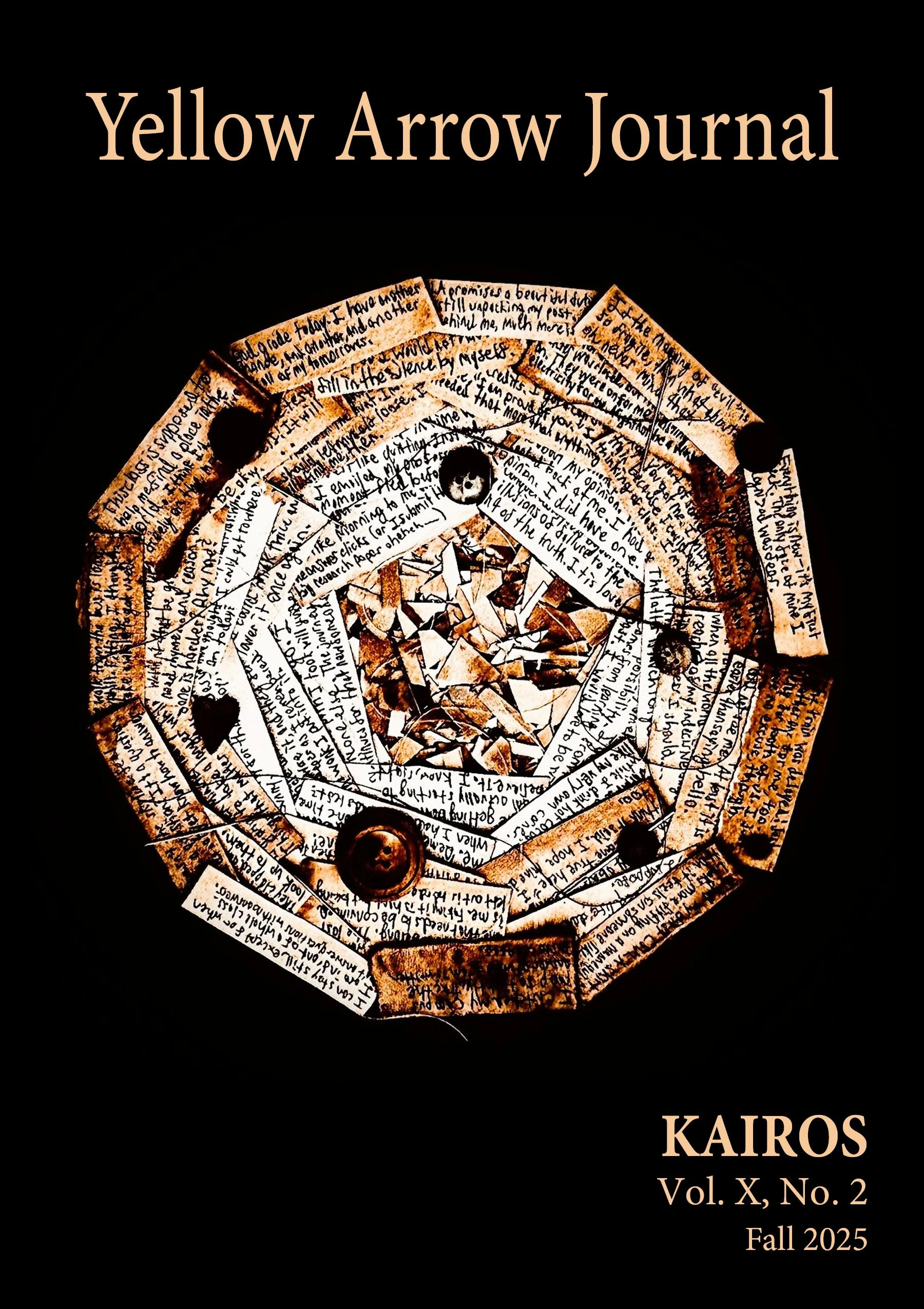
Clara Garza is a 16-year-old writer and senior at California State University, Los Angeles. She serves as a politics and world health journalist with The Borgen Project and contributes editorially to numerous journals. Her creative and critical work has earned recognition across essay, photography, performance, and visual arts contests, including in statewide and national outlets like the NOAA and KCACTF. Clara is also the cover artist for the second issue of Yellow Arrow Journal, Vol. X, on KAIROS, guest edited by Darah Schillinger. The issue comes out on November 11 and is currently available for preorder at yellowarrowpublishing.com/store/yellow-arrow-journal-kairos-paperback. KAIROS explores the aftermath and aftereffects of catalytic moments, forged from either small flash fires or conflagration, and is a Greek word meaning an opportune and decisive moment.
Make sure to take your time exploring Clara’s beautiful mixed-media collage, “The Awakening Aperture,” on the cover of KAIROS. According to Clara, “The circle (inspired by the aperture of a camera, or the lens that captures a fleeting fragment of time) is composed of pieces of the diary of a fictional college student experiencing college life, from the day she is accepted to the school to her graduation. Her initial doubt is reflected by the moody outer rim of the circle, and as she opens herself to the brightness of college, she starts to appreciate her life more fully.” Thank you, Clara, for sending us your artwork and for letting us showcase it to our community.
Recently, Clara answered some questions about herself and her aspirations from Darah.
“The Awakening Aperture” beautifully captures a decisive moment through both concept and form. What first inspired this piece, and how did it evolve from idea to execution?
This piece originated from a college art project prompt that focused on empowering dreams and transforming lives. Since the deadline was the following day when I first received it, I found myself feeling like I could make it—especially since I did not want to take the easy option of painting a college graduate with outstretched arms looking toward the sky. The ending of that story felt too static for me. That evening, I stood just outside my house, pondering how I could incorporate my major (English) into the work of art. A few minutes passed, and the visual of a collage made of literary quotes flashed in my mind. Had I continued with that idea, the paper would have been white, and the camera would have been positioned so that the edges of the collage were not visible. “How would that be empowering dreams or transforming lives?” I thought. Shortly after, I conceived the idea of transforming the quotes into diary entries, and the author into a student who undertook the task of creating an aperture into one of the most transformative experiences of her life. The construction of the piece involved collage, aging techniques, and a sense of symmetry. Each diary strip was individually written, cut, and placed to follow the aperture’s form. The aperture is the symbol of zooming in on one’s own potential more clearly.
As a writer, journalist, and visual artist—is there a particular medium that feels most like home to you? Or is it freeing to switch between them?
I feel nomadic in my eclecticism: The entire world of expression feels like home to me; it is just a matter of circumstances and my personal sense of desire to identify where I will be residing for the night. In that way, I could not imagine, not switching between them—and quite a few more!
What most often inspires your visual work? Are there specific artists, places, or experiences that consistently fuel your imagination?
Funnily enough, I do not know. The most consistent fuel for my imagination is being alone, especially when standing right outside my house in the evening. I can never quite predict when the next idea will come.
This journal issue explores KAIROS—an opportune or decisive moment. How does your piece engage with this idea, especially in the context of memory, self-discovery, or growth?
I believe in the poise of the littlest moments in great endeavors. It is up to the individual to find the kairos in what they remember, do, and desire for the future. There will never be a “perfect” moment to do something, and time is always of the essence, so being opportune and decisive converts ordinary time into meaning.
Your use of mixed media—sewing supplies, suede, torn paper—adds a tactile and almost archival feel to the work. What role do material textures play in conveying the emotional landscape of the diary entries?
Textures create a feeling. Mixed media pop out of an image. These domestic items feel like home to me and hopefully to many others. In monetary value, they might not be worth more than a few cents. In this sense, the diary entries could be from anyone. Through arrangement, these feelings become more immediate to observers.
The circle in your piece acts as both a literal and metaphorical aperture. Why did you choose this symbol and what does it reveal about how you perceive time or change?
Pictures are still, but apertures see all even when the camera is not on. They understand the shift between shadow and light that forms every act of creation. In that space between what is captured and what is lost the still becomes living and perception becomes creative awareness.
There’s a quiet optimism in how the college student character moves from doubt to belonging. What message or emotion do you hope viewers take away when they first encounter “The Awakening Aperture” on the cover of Yellow Arrow Journal?
I hope the viewer feels drawn into the light of the future and acknowledges the beauty in darkness. I hope they see that fragments make up a meaningful whole and that the past continues to grow with you as a reflection, since it will never be quite over, and that they strive to foster the continuation of many awakening apertures of their own.
As a politics and world health journalist with The Borgen Project, how does global advocacy influence your art, if at all?
I often think about how the number of successful individuals with a fortunate upbringing reflects the number of those with unanswered potential who lack the resources to pursue their passions. In that sense, I plan to continue using my platform, which combines artistic and journalistic voices, to draw attention to and advocate for action on behalf of many individuals facing unfair circumstances. This is a continuing cause we must recognize as long as it persists.
Given your editorial contributions and contest success, what advice would you give to other young creators trying to find their voice?
Random thoughts are artistic superpowers. Never dismiss them—listen to them. They are prompts in themselves. How might two intertwine? There is no such thing as not belonging in a particular realm of thought, nor is the lack of specialization a valid excuse for not finding one’s voice somewhere new. Your career(s) should be your passion, and your passion is invaluable to the world. You are not just another child with a dream. You have potential. You can pursue many things deeply if they move you. Take a step back from life and look at yourself like the protagonist in a fantasy story. Analyze the decisions the protagonist makes; the reality is that every decision has strengths and flaws. Do not stop at saying that you could have done something different, better, or worse. Take action and stay unpretentious throughout the process. Have fun sharing what you have done. It is never too early or too late to rethink the direction you are going in because 360° of possibilities will always be around you.
What’s next for you—creatively, academically, or professionally? Are there any upcoming projects you’re especially excited about?
I am applying to pursue a master’s degree in screenwriting. Since film requires a mastery of artistic awareness, I am excited to leverage my eclecticism to write impactful movies. Film feels like a natural extension because it combines story, picture, and emotion within a single medium. An upcoming project I look forward to is my thesis on the subtle presence of ideological reinforcement and dismantling in children’s literature. I am also excited about my visual and literary works being accepted into more journals.
Thank you Clara for finding the time to answer our questions and for being a part of KAIROS. And thank you to everyone for supporting the creatives involved in the issue. You can preorder your copy of KAIROS at yellowarrowpublishing.com/store/yellow-arrow-journal-kairos-paperback. If you want to reserve a copy of both issues of 2025, make sure to pick up a discounted journal bundle at yellowarrowpublishing.com/store/yellow-arrow-journal-bundle, for yourself or as a gift.
Darah Schillinger (she/her) is a writer based in Lexington Park, Maryland. Her poems have appeared in AVATAR Literary Magazine, Yellow Arrow Journal, Maryland Bards Poetry Review, Empyrean Literary Magazine, Grub Street Magazine, and Eunoia Review and on the Spillwords Press website. In October 2024, her poem “An elegy for the Pompeii woman the Internet wants to fuck” was named a finalist for the Montreal International Poetry Prize. Her first poetry chapbook, when the daffodils die, was released in July 2022 by Yellow Arrow Publishing. Her second collection, Still Warm, is a work in progress.
*****
Yellow Arrow Publishing is a nonprofit supporting women-identifying writers through publication and access to the literary arts. You can support us as we BLAZE a path for women-identifying creatives this year by purchasing one of our publications or a workshop from the Yellow Arrow bookstore, for yourself or as a gift, joining our newsletter, following us on Facebook or Instagram, or subscribing to our YouTube channel. Donations are appreciated via PayPal (staff@yellowarrowpublishing.com), Venmo (@yellowarrowpublishing), or US mail (PO Box 65185, Baltimore, Maryland 21209). More than anything, messages of support through any one of our channels are greatly appreciated.