Spotlighting Lori L. Tharps’ Podcast Your BIPOC Writing Coach
By Avery Wood, written November 2025
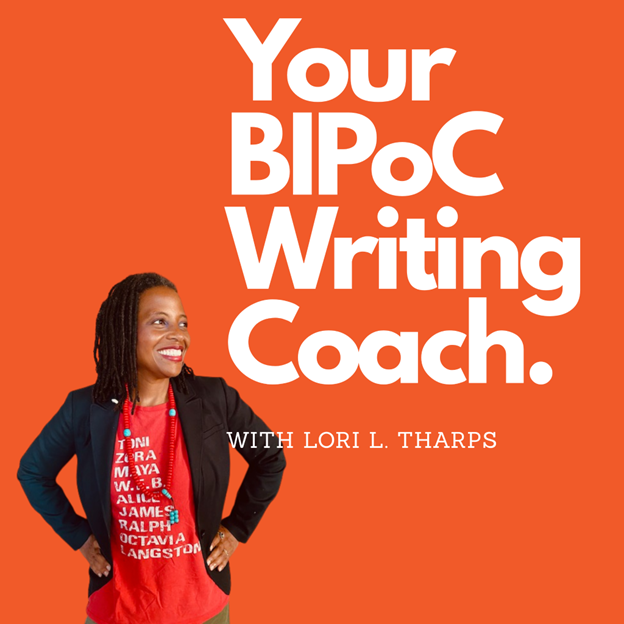
Lori L. Tharps is an award-winning author of both fiction and nonfiction, as well as a writing coach, journalist, former college professor, and podcast host. Tharps attended Smith College for her undergraduate degree, then attended Columbia University’s Graduate School of Journalism. Afterward, she went on to work as a journalist for Entertainment Weekly, The New York Times, The Washington Post, and several other publications, as both a writer and editor. She has written three nonfiction books: Hair Story: Untangling the Roots of Black Hair in America (2001), Kinky Gazpacho: Life, Love & Spain (2008), and Same Family, Different Colors: Confronting Colorism in America’s Diverse Families (2016), as well as a fiction novel, Substitute Me (2010). She “lives a proud global literary lifestyle,” having moved to Spain in 2021, where she then launched her first podcast in 2020. Called My American Melting Pot, the podcast evolved into Your BIPOC Writing Coach. You can find the podcast at podcasts.apple.com/us/podcast/your-bipoc-writing-coach/id1442662387.
Tharps also leads a private writing community for BIPOC women called The Reed, Write, and Create Sanctuary and launched a YouTube channel called Literary Lori. She lives her life in support of BIPOC writing and writers, advocating for social change through writing, guiding, and teaching new and experienced writers, carving a space for BIPOC voices to grow and thrive.
The podcast itself has grown in the last five years, where Tharps’ initial focus was on “being a Black woman married to a Spanish man, raising three bilingual, biracial, bicultural children,” The first podcast ran for a single season in 2020 before it transformed into the Reed, Write, and Create Podcast. Then, Tharps began to focus more on “bite-size sessions of creative writing coaching.” She believes in the power of stories and the need for more of them from marginalized voices—specifically BIPOC, female-identifying, and nonbinary individuals—a mission much like our own work at Yellow Arrow Publishing.
By 2025, the podcast will be known as Your BIPOC Writing Coach. Tharps revitalized her commitment to helping Black, Indigenous, Latinx, Asian American, and all other writers of color, promoting underrepresented voices and guiding their work into excellence. She understands the fiery passion of budding writers, and her goal is to create a space for them to get tangible writing advice that will guide them throughout the writing process.
I personally listened to more than a few of her podcasts in preparation for this blog post, and her tone throughout is cheery, supportive, and insightful. A pep talk. I personally found lots of inspiration and countless helpful tips, some of which I will endeavor to share here. But, if you are a BIPOC writer looking for a little motivation or seeking a space that shares the stories and advice of other accomplished craftspeople, you’ll have to go check out the brilliant podcast for yourself. Some intriguing episode titles include: “Why Smart Authors Aim for the Backlist,” “Behind the Book with David Ruggles: The First Black Man in America to Open a Bookstore,” and “Behind the Book with Literary Agent Regina Brooks: On a Mission to Bring More Asian American Stories into the World.” There are more than 100 other amazing and insightful episodes, with more to come. Some focus on advocacy, some on promotion and craft, and some simply on the state of the world for writers and, really, all individuals.
It was hard to choose which episodes to listen to first—all the different featured perspectives are fascinating and insightful. I listened to her very first podcast sharing her experience and story as a mother in a multicultural American family that moved to Spain, and I loved it because it gave me an introduction into Tharps and her story, as well as served as a kind of cultural criticism for the world as it was back in 2020. I listened to her June 2025 episode “Writers: Do You Have a Reading Habit or a Reading Hobby?” that talked all about how curated and intentional reading can vastly help a writer grow and discussed the tools and mechanics for reading with intention. This was a solo episode for Tharps without a guest accompaniment. Some tricks of note were using a receptacle for tracking reading notes and adding an index to the end of that receptacle for easy note reviewing. She talks about being thoughtful in selecting books, not purely for quantity but for quality, and having a purpose for reading a book as a writer, clearly in your mind throughout your read. She wants writers to avoid mindless “dirty reading” as she calls it. With Tharps’ episode, “How to Strategize, Plan, and Execute a Book Tour that Guarantees Success,” I found both inspiring as well as truly informative, as a budding writer myself. If you are a BIPOC writer and have any specific questions about publishing, publicity, writing in multiple genres, or simply want to know how to get started, I guarantee you there is, or will be, an episode for you on Your BIPOC Writing Coach.
Tharps’ podcast is special not only because she’s an amazing creative writing coach but also because she often learns with the listeners as she speaks with inspiring and noteworthy guests, both BIPOC authors and publishing professionals, all eager to embolden and raise the voices of their communities. As Rebecca Caroll, author of acclaimed titles Surviving the White Gaze: A Memoir (2021) and I Know What the Red Clay Looks Like: The Voice and Vision of Black Women Writers (1994) said in the episode “Telling Black Women’s Stories Across Platforms with Rebecca Caroll”: “Black women showing up for each other is timeless and regenerative.” In this particular episode, Tharps and Caroll discuss journalism, apathy, and cynicism, the effects of politics and violence on writing, the art and complications of writing a memoir, and so much more.
I think it’s absolutely brilliant the way that Tharps has seamlessly integrated activism into a writing coach podcast, featuring professionals from all identities and walks of life, supporting and raising their voices as well as those of her listeners. She gives a spotlight to the topics of activism themselves—race, gender, society, the changing world—while simultaneously balancing practical and tangible writing tools and advice to support all her listeners of any identity or background.
(All quotes came from Lori L. Tharps’ podcast Your BIPOC Writing Coach and her website at loriltharps.com.)
Avery Wood (she/her) was the fall 2025 program management intern at Yellow Arrow. She lives in Raleigh, North Carolina, and attends North Carolina State University, studying English and business administration. Following graduation, she intends to bring her passion for business and creative writing to the publishing industry. She was thrilled to be a part of the wonderful Yellow Arrow team, making a difference and amplifying female voices.
*****
Yellow Arrow Publishing is a nonprofit supporting women-identifying writers through publication and access to the literary arts. You can support us as we LUMINATE a path for women-identifying creatives this year by purchasing one of our publications or a workshop from the Yellow Arrow bookstore, for yourself or as a gift, joining our newsletter, following us on Facebook and Instagram, or subscribing to our YouTube channel. Donations are appreciated via PayPal (staff@yellowarrowpublishing.com), Venmo (@yellowarrowpublishing), or US mail (PO Box 65185, Baltimore, Maryland 21209). More than anything, messages of support through any one of our channels are greatly appreciated.