Yellow Arrow Publishing Blog
Poetry as it is, as I love it
By Elizabeth Ottenritter, written November 2024
“If I read a book and it makes my whole body so cold no fire can ever warm me,
I know that is poetry.”
– Emily Dickinson
They say poetry is the only form of literary art that is for no one but the poet themself. This undeniable notion is what had drawn me to poetry in late high school. At first, I thought that poetry always had to rhyme, skipping stanzas to accomplish a consistent sound above all else. I would open my notes app and type something candid, and vaguely lyrical. My first poem was written on March 8, 2020, ironically titled “Thanksgiving.” I won’t expose my young self just yet, but the content was centered around my first love, who I never dated. The repetitiveness of this in my mind was surprisingly easy to put into words. Then, I was slowly able to move into free-verse after discovering poetry doesn’t owe a rhyme—it doesn’t owe anything at all.
I didn’t tell anyone about my sudden interest in the genre nor did I show anyone what I had been writing in fear it would go misunderstood. At the time, I had been trudging through a brutal senior year of high school that had been entirely online due to COVID. I often felt lonely, confused, and undeserving, which reflected in the subjects I’d write about as a subconscious form of consolation. In no way does poetry always come from such circumstances. Some of my favorite poems are about very pleasant things. I found comfort in writing my feelings, which allowed me to better understand myself in return.
I was admitted to Loyola University Maryland that spring and chose to major in writing. While the writing major is an uncommon track at most universities, I felt a sudden surge of confidence during my first semester of college. Writing had been the only thing I never minded looking at or putting time into. In December of that year, I saw that our literary art magazine at Loyola, Corridors, was accepting submissions for their spring issue. I nervously submitted two poems, thinking neither would be taken to publication, but I had nothing to lose anyway. That March, I received an email that changed my life, reading Congratulations! and We would like to accept “Dear Sun” and “No Nutrition.” I waited until I got to hold the publication in my hands and saw my printed work. I even read my poem “Dear Sun” at the release party, my shyness slowly dissipating for good. I was finally in the right place.
Three years later, I am still in love with poetry and language. I am enamored with those who have the talent to create, what I like to call “portrait poems” with words that depict how something appears visually. A good example of this would come from poet Jane Hirschfield and her book The October Palace. Hirschfield’s language is transparent as though you were looking at the hidden wonders of the world through clear glass. Her poetry is a homage to what is around her; there is a physicality to everything she writes. I enjoy Hirschfield’s poem “Page” for how particular and hard-hitting the lines are:
It waits for the old
to grow young, fed and unfearful,
for freighters to carry their hold-held oil
back into unfractured ground,
for fires to return
their shoeboxes of photos and risen homes
Poems such as these are easy to be inspired by and difficult to write. I admire U.S. poet laureate Ada Limón for this reason. Her ability to bend structure to her will is compelling, as is her way of redefining what poetry may look like within her forms. Limón’s poems “Calling Things What They Are” and “The Hurting Kind” are especially reflective of this.
Often, the poetry and art that I respond to is more self-centered. I am drawn to confessional, personal anecdotes that aim to say something larger than the work itself. I like poems about specific experiences—but ones that speak to universal experiences simultaneously.
The first poem I ever loved was “Annabel Lee” by Edgar Allan Poe. I remember sitting in my middle school English class, holding back tears over the final line: “In her tomb by the sounding sea.” I didn’t understand why the words had upset me so viscerally. It might have been the building repetition of “Annabel Lee,” the closeness you feel to her through the eyes of Poe, how you never get to know her outside of him, her sudden untimely death and the terrifying notion that love lasts forever. All these concepts, new to me at the time, were the foundation for my interest in writing the human experience. While not everyone has buried a lover in a sepulchre by the sea, most can relate to losing someone they love. A poem has this remarkable ability, one that allows you to see what is already there, as well as the invisible strings that bind us together.
A song has a similar effect. Poetry and music are intertwined for me—much of my poetry has been inspired by music. I am not musically inclined, and I am aware that songwriting has a different intention than poetry, as it is written to accompany music for wide audiences. Even still, many of my favorite recording artists are beautiful writers who are also gifted with the talent for music. For some of my most listened-to songs, I could read the lyrics as a poem itself. Take, for instance, the song “Chelsea” by Phoebe Bridgers.
You are somebody’s baby
Some mother held you near
No, it’s not important
They’re just pretty words, my dear
There is no distraction
That can make me disappear
No, there’s nothin’ that won’t remind you
I will always be right here
When it comes to discovering new and old poetry, I am a big fan of the classic Poetry Foundation website. They post a poem of the day, often coinciding with holidays, historical events, and poets’ anniversaries. Often, I will get distracted on my laptop and find myself lost in a collection of poems on various subjects, like autumn or love. The New Yorker has an excellent fiction and poetry collection as well, which is always changing to highlight a wide range of voices.
As much as poetry is for the writer, it is meant to be shared. I have found both clarity and inspiration while workshopping my own poetry, as well as the poems of others. Art has always been a source of bonding. When something is close to your heart, there is a tendency to hide it within yourself. A poem, piece of prose, or even a song can challenge this notion, as our words live well beyond us. My grandmother passed away this summer, and while we remember her for so many things, she had signs hanging in her house that were so her. One read, “I was so far behind I thought I was first.” We smile when we remember those words and how they have touched us, and that is poetry to me.
Elizabeth Ottenritter (she/her) is a senior at Loyola University Maryland, where she studies writing. She is passionate about reading, crafting poetry, contributing to Loyola’s literary art magazine, Corridors, and traveling worldwide. Upon graduation, Elizabeth hopes to continue her love of learning and language in a graduate program.
*****
Yellow Arrow Publishing is a nonprofit supporting women-identifying writers through publication and access to the literary arts. You can support us as we BLAZE a path for women-identifying creatives this year by purchasing one of our publications or a workshop from the Yellow Arrow bookstore, for yourself or as a gift, joining our newsletter, following us on Facebook or Instagram, or subscribing to our YouTube channel. Donations are appreciated via PayPal (staff@yellowarrowpublishing.com), Venmo (@yellowarrowpublishing), or US mail (PO Box 65185, Baltimore, Maryland 21209). More than anything, messages of support through any one of our channels are greatly appreciated.
The Power of Being Heard: A Voice for Women with Traumatic Pasts

By Julie Alden Cullinane, written November 2024
The ability to have one’s voice heard is more than just a privilege; it is an act of defiance, survival, and healing, especially for women who have endured trauma. As the author of Ghosts Only I Can See (2024), I have found that sharing my story not only liberates me but also empowers others. My mission is to be a voice for women with traumatic pasts, especially those who have survived childhood trauma. Through writing and witnessing, I aim to dismantle the silence that often surrounds these experiences, challenging the gaslighting and denial that frequently accompany them. Amplifying voices is not just a personal endeavor—it is a collective call for change and validation.
The Healing Power of Storytelling
Trauma silences. It isolates and convinces survivors that their experiences are invalid or insignificant. Growing up with unresolved pain, many women internalize the belief that their voices do not matter. Sharing my story in Ghosts Only I Can See was not simply about revisiting the past; it was about reclaiming my narrative and affirming my worth. Writing creates space for healing—it allows us to process, understand, and contextualize our pain.
For women with traumatic childhoods, storytelling offers the opportunity to name what was once unnameable. When we write our stories, we confront the ghosts that haunt us, giving them shape and, ultimately, taking away their power to control us. Writing is both catharsis and resistance—a way of saying, “I was here, and my experience matters.”
Combating Gaslighting and Denial
A pervasive challenge for trauma survivors is the denial or minimization of their experiences, often perpetuated by those closest to them or society at large. Gaslighting, the deliberate manipulation to make someone doubt their reality, is particularly harmful. It leaves survivors questioning their memories, their feelings, and even their sanity. For women, whose voices are historically undervalued, this form of invalidation is especially insidious.
By amplifying my voice and encouraging others to do the same, I aim to dismantle this dynamic. When women share their stories, they assert their reality in the face of doubt. They become witnesses—not only to their pain but also to their strength. Writing, in this sense, is an act of validation and defiance. It is a declaration that our stories are not only real but also worth hearing.
Being a Witness for Others
Beyond sharing my own story, I feel a profound responsibility to be a witness for other women. Trauma often leaves survivors feeling invisible. By acknowledging and amplifying their voices, we create a space where they feel seen and heard. This role is both humbling and transformative. To witness another’s pain is to affirm their humanity, to stand in solidarity with their struggles, and to remind them they are not alone.
Women with traumatic pasts often carry immense guilt, shame, and isolation. When we share and bear witness, we disrupt these cycles. We create communities of understanding and support, where vulnerability is met with compassion rather than judgment. I want to be the voice that says, “I believe you,” and to inspire others to say the same.
Empowering Women to Write Their Stories
Writing is an accessible and transformative tool for self-expression and advocacy. Encouraging women to write their stories is central to my mission. Each story, no matter how small or large it may seem, holds the potential to inspire, educate, and heal. When women write, they reclaim their agency. They transform from passive victims of circumstance to active narrators of their lives.
Writing also ensures that our stories endure. It creates a record, a testament to our resilience. In a world where women’s experiences are often dismissed or erased, writing is an act of preservation and legacy. I want every woman to know that her voice matters, that her story is worth telling, and that she has the power to change the narrative—not just for herself but for others who follow.
Amplifying Voices for Systemic Change
While individual healing is essential, the amplification of women’s voices has broader implications. Systemic change begins with awareness, and awareness grows when diverse, authentic voices are heard. By sharing our stories, we challenge societal norms that perpetuate silence and stigma around trauma. We shift the cultural conversation from one of shame and secrecy to one of empowerment and understanding.
For women who have endured traumatic childhoods, this shift is especially vital. Childhood trauma shapes the way we view ourselves and the world. By addressing these issues publicly, we advocate for better resources, policies, and support systems for survivors. Amplifying our voices is not just about personal validation—it is about creating a world where future generations are better equipped to confront and overcome trauma.
The Ripple Effect of Sharing
When one woman shares her story, it creates a ripple effect. Her courage inspires others to speak out, creating a chain reaction of honesty and empowerment. As the author of Ghosts Only I Can See, I have witnessed this phenomenon firsthand. Readers have reached out to share how my words resonated with their own experiences, how my story gave them the courage to confront their past or to begin writing their own.
This ripple effect is why amplification matters. It is not about a single voice but about a collective chorus. Each story adds depth and nuance to the larger narrative of women’s resilience and strength. Together, our voices become impossible to ignore.
Moving Forward: A Call to Action
The work of amplifying voices is never finished. It requires continual effort, vulnerability, and courage. For me, this means continuing to write, to speak, and to advocate. It means creating spaces where women feel safe to share their truths and ensuring those spaces are inclusive and supportive.
I call on other women to join me in this mission. Whether through writing, speaking, or simply listening, we all have a role to play in amplifying voices. Together, we can challenge the silence that surrounds trauma, confront the forces that perpetuate it, and build a world where every woman feels seen, heard, and valued.
Having my voice heard and amplified is not just important to me—it is essential. It is a way to heal, to resist, and to inspire. As the author of Ghosts Only I Can See, I am committed to being a voice for women who have endured trauma, particularly those with painful childhoods. I want to be a witness, to combat gaslighting and denial, and to empower women to write their stories. Amplifying our voices is how we reclaim our power, transform our pain into purpose, and create a more just and compassionate world. Together, we can ensure that no woman ever feels silenced or invisible again.
Julie Alden Cullinane is a Boston-based writer. She holds both a bachelor’s and master’s degree in English, and her writing credits include poetry and short stories published in numerous literary magazines. Her common themes include womanhood, motherhood, and wonders of being human. In addition to her writing, Julie works as the vice president of human resources for a large behavioral health hospital, a role that offers her a rich perspective on the human experience, which she incorporates into her writing. She enjoys reading and writing in her free time and has a dedicated following on social media, X (formerly Twitter), TikTok, Facebook, BlueSky, Threads, and Instagram. She also maintains an author’s website at julie.wildinkpages.com/poetry to engage with her readers.
*****
Yellow Arrow Publishing is a nonprofit supporting women-identifying writers through publication and access to the literary arts. You can support us as we BLAZE a path for women-identifying creatives this year by purchasing one of our publications or a workshop from the Yellow Arrow bookstore, for yourself or as a gift, joining our newsletter, following us on Facebook or Instagram, or subscribing to our YouTube channel. Donations are appreciated via PayPal (staff@yellowarrowpublishing.com), Venmo (@yellowarrowpublishing), or US mail (PO Box 65185, Baltimore, Maryland 21209). More than anything, messages of support through any one of our channels are greatly appreciated.
Her View Friday

Yellow Arrow Publishing supports women-identifying writers from a wide variety of backgrounds, not just because it’s the right thing to do, but because it makes us stronger. Women’s voices have historically been underrepresented in literature, and we aim to elevate those voices and stories through our programs, publications, and support.
Part of our mission in supporting and uplifting women-identifying creatives is to promote the Yellow Arrow community’s individual accomplishments. We’d like to further expand that support and promotion outside of our Yellow Arrow publications. Twice a month, we’d like to give a shout out to those within the Yellow Arrow community who recently published:
single-author publications
single pieces in journals, anthologies, etc., as well as prizes/awards, book reviews, and podcasts/interviews
You can support our authors by reading this blog and their work, sharing their news, and commenting below or on the blog. Congratulations to all the included authors. We are so proud of you!
Every writer has a story to tell and every story is worth telling
The poems and review below were written by Heather Brown Barrett
from Southeastern Virginia
“Mother Tongue”

Genre: poetry
Name of publication: The Ekphrastic Review (for The Ekphrastic Challenges)
Date Released: March 21, 2025
Type of publication: online
“Meaning in Making: A Review of Good Mom on Paper: Writers on Creativity and Motherhood”

Genre: review
Name of publication: Literary Mama
Date Released: March 19, 2025
Type of publication: online
“Storybook of Heavenly Bodies”

Genre: poetry
Name of publication: formidable woman sanctuary: solace IV (for an Editor’s Choice Award)
Date Released: April 3, 2025
Type of publication: online
“benign”

Genre: poetry
Name of publication: The Ekphrastic Review (for The Ekphrastic Challenges)
Date Released: April 4, 2025
Type of publication: online
Thank you Heather for letting us celebrate with you! Learn more about Heather on Instagram @heatherbrownbarrett.
Yellow Arrow (past and present) board, staff, interns, authors, residents, and instructors alike! Got a publication coming out? Let us help celebrate for you in Her View Friday.
Single-author publications: here.
Single pieces as well as prizes/awards, book reviews, and podcasts/interviews: here.
Please read the instructions on each form carefully; we look forward to congratulating you!
*****
Yellow Arrow Publishing is a nonprofit supporting women-identifying writers through publication and access to the literary arts. You can support us as we BLAZE a path for women-identifying creatives this year by purchasing one of our publications or a workshop from the Yellow Arrow bookstore, for yourself or as a gift, joining our newsletter, following us on Facebook or Instagram, or subscribing to our YouTube channel. Donations are appreciated via PayPal (staff@yellowarrowpublishing.com), Venmo (@yellowarrowpublishing), or US mail (PO Box 65185, Baltimore, Maryland 21209). More than anything, messages of support through any one of our channels are greatly appreciated.
Wild Resilience: Little by Little by Ann marie Houghtailing

Yellow Arrow Publishing announces the release of our first chapbook of 2025, Little by Little by Ann marie Houghtailing. Since its establishment in 2016, Yellow Arrow has devoted its efforts to advocate for all women writers through inclusion in the biannual Yellow Arrow Journal as well as single-author publications and Yellow Arrow Vignette, and by providing strong author support, writing workshops, and volunteering opportunities. We at Yellow Arrow are excited to continue our mission by supporting Houghtailing in all her writing and publishing endeavors.

Little by Little explores the universality of human suffering and how we find our way to meaning and purpose. Houghtailing is a visual artist and cofounder of the firm Story Imprinting. She delivered a TEDx Talk entitled Raising Humans and performed her critically acclaimed one woman show, Renegade Princess, in New York, Chicago, Santa Fe, San Francisco, and San Diego. “Little by little” is the phrase that Houghtailing’s mother used to say when things were hard. Things were almost always hard. Houghtailing grew up in a culture of poverty and witnessed violence, struggle, and wild resilience every day. What she did not realize was that her mother’s phrase would become a life affirming strategy. It was a map that took her back to herself when life took so much from her.
From 2019–2020, four members of Houghtailing’s family died in rapid succession, including her mother. Their deaths were an extension of historic and epigenetic trauma that would require her to sit inside of suffering and paint, write, and garden her way through to transformation. Little by Little delves into how Houghtailing was able to find meaning in the suffering by examining the beauty of life itself. Every day we experience loss. The loss of innocence, youth, relationships, jobs, money, confidence, power, life, and hope are in constant play. Learning to sit inside of deep suffering can be intellectually, emotionally, and physically demanding territory that invites us to examine who we are and what we are made of. Little by Little is a way to see, a way to suffer, and ultimately, a way to live.
The cover and interior art were created by Houghtailing. According to her, “All my work is filled with color, which is very much rooted in my mom’s background from Hawai’i. . . . Color is joyful. It’s life affirming. The cross-section of painting and writing [are] the ways in which the intersection of life and death [come] together for me. The cover art is a collage piece of a woman with a typewriter on her head. It came from the same period as the poems, so it felt very right to pair these together.”
Paperback and PDF versions of Little by Little are now available from the Yellow Arrow bookstore. If interested in purchasing more than one paperback copy for friends and family, check out our discounted wholesale prices here. You can also search for Little by Little wherever you purchase your books including Amazon, Barnes & Noble, and Kobo. To learn more about Houghtailing and Little by Little , check out our recent interview with her.
You can find out more about Ann marie Houghtailing and her work at her website annmariehoughtailing.com and on Instagram @trailsnotpaths and Facebook @annmariehoughtailing and connect with Yellow Arrow on Facebook and Instagram, to share some love for this chapbook. You can also share a review to any of the major distributors or by emailing editor@yellowarrowpublishing.com. We’d love to hear from you.
*****
Yellow Arrow Publishing is a nonprofit supporting women-identifying writers through publication and access to the literary arts. You can support us as we BLAZE a path for women-identifying creatives this year by purchasing one of our publications or a workshop from the Yellow Arrow bookstore, for yourself or as a gift, joining our newsletter, following us on Facebook or Instagram, or subscribing to our YouTube channel. Donations are appreciated via PayPal (staff@yellowarrowpublishing.com), Venmo (@yellowarrowpublishing), or US mail (PO Box 65185, Baltimore, Maryland 21209). More than anything, messages of support through any one of our channels are greatly appreciated.
Gratitude is a Divine Emotion: Yellow Arrow Interns

“Gratitude is a divine emotion: it fills the heart, but not to bursting; it warms it, but not to fever.”
from Shirley by Charlotte Brontë
One of the many ways Yellow Arrow Publishing encourages women writers and women in publishing is through inclusion within the organization itself. We welcome (and thrive with) our volunteers and interns, not only for our own benefit but to also (hopefully) provide a prospective future publisher with some necessary tools and knowledge about the publishing world. And even if a volunteer/intern does not plan to continue within the publishing world, the tools and knowledge of working in a women-led, collaborative organization. One that champions the different and the unique. One that looks for partners and allies rather than simple connections (see our current list of partners here).
We try to find each volunteer, each intern, space in our organization to grow and flourish in the area they are most interested in (and of course where we need the most help!). Past staff members have worked at our live events and at Yellow Arrow House. They hand bound our publications and put as much love and tenderness into each copy as we could hope. Today they focus on the ins and outs of releasing a publication, running a publishing company, and our community-driven projects. Tasks can range from editing to formatting, marketing, and putting together events and workshops. Above all else, our interns support and champion staff/board, authors, workshop attendees, and themselves. We are so thankful to have had them with us on this journey.
So let’s introduce the spring 2025 interns. Each has our appreciation.
Arrieonna Derricoatte, Program Management Intern
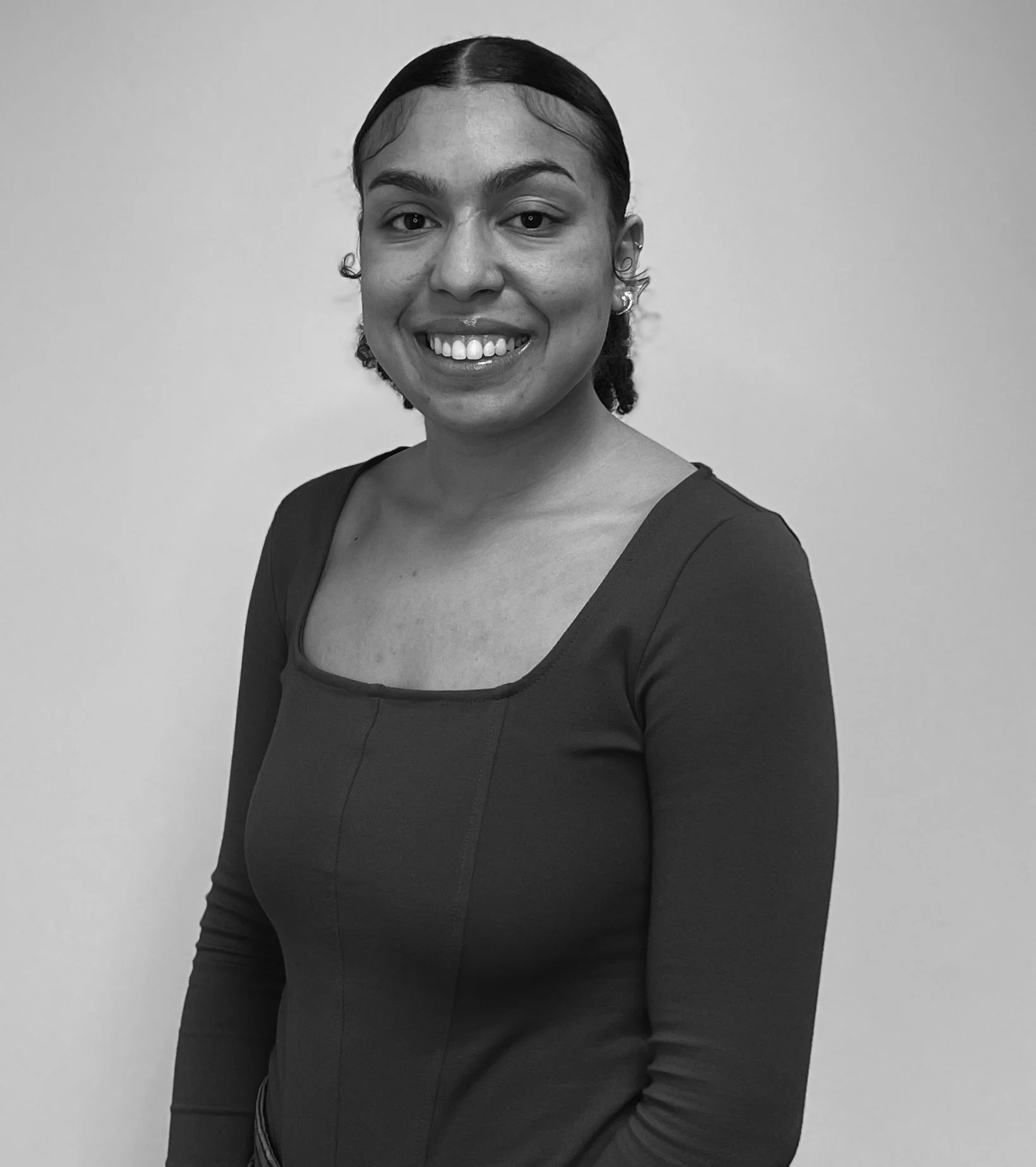
Lives in Columbus, Ohio
What do you do? My main role at Yellow Arrow is to help support workshops and events through social media posts by creating graphics in Canva to promote different activities. I also write the monthly newsletter and by the end of the internship, two blog posts.
Where do you go to school? I got to Ohio State University. I graduate in May this year.
What are you currently working on? I am currently in my last semester of undergrad and am a community engagement arts administrator at Urban Arts Space. I am editing and planning the launch of their first community journal. I have also begun to work on my own independent research using docupoetics as an archival tool.
Arrieonna Derricoatte (she/her) is currently a senior at Ohio State University. She is an English major with a concentration in writing, rhetoric, and literacy with minors in human rights and professional writing. She is passionate about reading and community-building around arts, education, and policy. Arrieonna is also a student art administrator and writing intern at Urban Arts Space. She plans to pursue a Master’s in Public Administration upon graduation. After school, she hopes to further her career in nonprofit work and community programming while seeking a career in publishing. She can be found on Instagram @arrieonnaderricoatte.
She plans to attend graduate school next fall to pursue a masters in public affair.
What is your favorite course at school? Why did you choose to take it?
My favorite course this semester is Black women: culture and politics. I chose to take this course because I wanted to know more about the genealogy of Black feminism and where it appears in literature, media, and politics.
Have you read anything this year that has stuck with you?
Long After We Are Gone by Terah Shelton Harris is about healing intergenerational trauma through a Black family in the South after their land is seized by private investors. I’m invested in not only affordable housing but land restoration and equitable home/land ownership for marginalized communities.
Why did you choose an internship with Yellow Arrow?
I chose this internship with Yellow Arrow because I not only wanted experience in the publishing industry but because I am deeply invested in lifting up the voices and history of marginalized peoples especially women of color.
How are things going so far?
I am enjoying my internship so far. I have learned about the publication from submissions to release. I have also been a part of programming like fundraising and workshop curriculum and marketing.
Jacqueline Goldman, Publications Intern
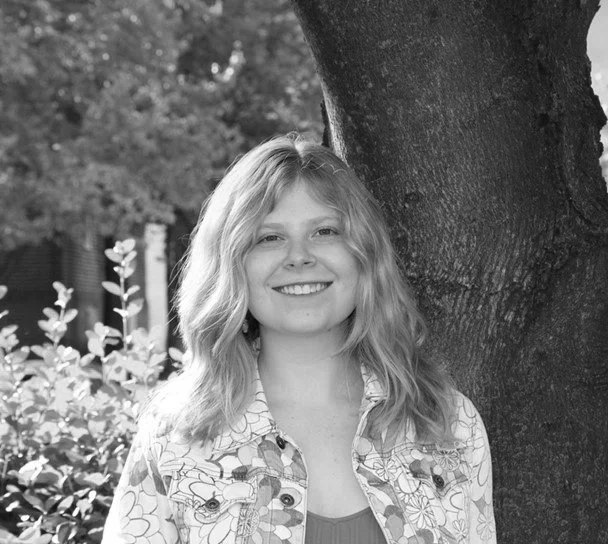
Lives in Baltimore, Maryland
What do you do? Several things! I draft and publish the .W.o.W. and Her View Friday blogs on the website and social media, reviewed submissions for Yellow Arrow Journal, write blogs, research for Yellow Arrow mentions, edit, and much, much more.
Where do you go to school? Loyola University Maryland. I will graduate May 2026.
What are you currently working on? Currently I’m submitting applications for internships over the summer, fingers crossed! I’m also planning to go to a renaissance faire this Sunday [now, a few Sundays ago!] so I’m prepping for that.
Jacqueline Goldman (she/her) is an aspiring publishing professional pursuing a degree in communications and media with a specialization in journalism and a minor in writing and business journalism at Loyola University Maryland. With experience as Publication Intern for Yellow Arrow Publishing, Managing Editor-in-Chief for The Greyhound, Nonfiction Editor at Corridors Literary Magazine, and an acquisitions editor at Apprentice House Press, she enjoys shaping compelling narratives and pushing the envelope.
She would love to work toward becoming an acquisitions editor at a publishing company.
What is your favorite course at school? Why did you choose to take it?
My favorite course was a manuscript development and evaluation course in the communication and media department. I took it because I’ve always loved reviewing other individuals work. After taking the course, I realized I wanted to go into the publishing industry.
Have you read anything this year that has stuck with you?
“Counting Dogwood Flowers” by Lish Ciambrone from Yellow Arrow Journal kitalo (Vol. IX, No. 2) touched me since my dog passed away recently. Seeing her read it in person was even more striking.
Why did you choose to do an internship with Yellow Arrow?
One of my professor’s in the writing department suggested that I apply for Yellow Arrow as I was looking to gain more hands-on experience in the publishing industry. Yellow Arrow stuck out because of its goal of uplifting women’s voices, which aligns with my personal values.
How are things going so far?
I think things are going well so far! . . . So much information to take in at once, it was a lot! But as I received feedback and tasks became more repetitive I found them coming to me more naturally.
Gabby Granillo, Author Support Intern (6 months)
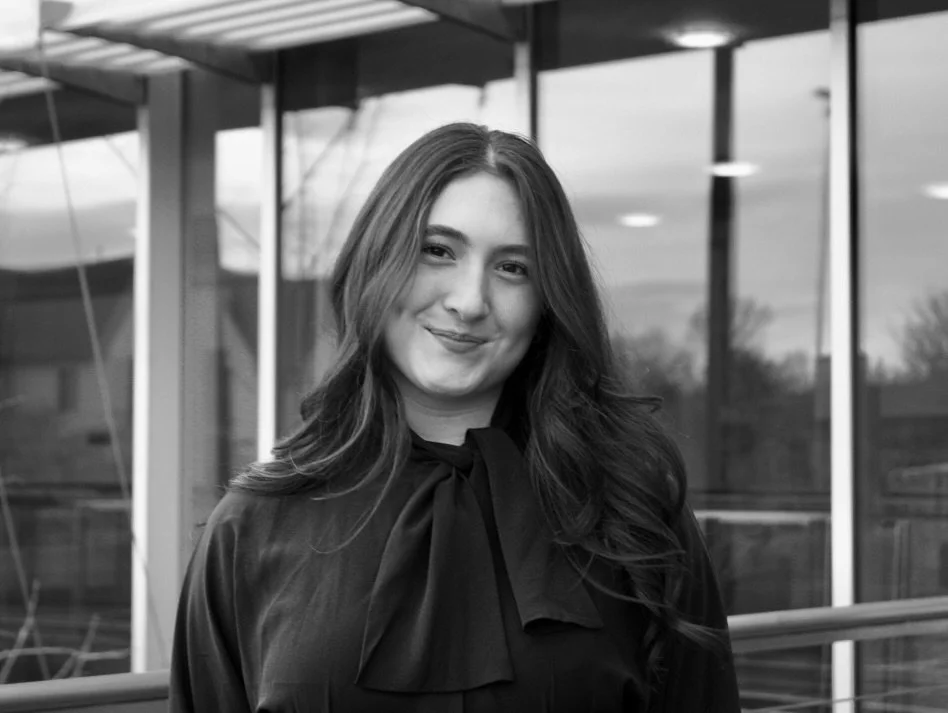
From Shrewsbury, Massachusetts, but lives in Baltimore, Maryland
What do you do? I work closely with the chapbook authors and other published authors to develop a network and foundation for future interns. I pride myself on building relationships with past and present authors and fostering a comfortable environment for the creative minds of our company. I am working on developing blog posts, social media graphics, and planning events, such as poetry readings, to celebrate the successes and contributions of our authors to the literary world. It is a pleasure to be a member of such an invaluable team and get to know all the different moving parts that make Yellow Arrow a wonderful place to work.
Where do you go to school? I attend Loyola University Maryland, and I will graduate in the spring of 2026. I am an English and writing major with minors in environmental studies and art.
What are you currently working on? I am currently working on creative nonfiction short essays that will be used in my writing portfolio for graduate school. I love art as a creative medium outside of writing and work on collages from vintage magazines and printouts in my free time. I go for a lot of walks about Baltimore and am a huge foodie. My favorite thing to do is cook dinner and create new recipes.
Gabrielle Granillo is studying English and writing at Loyola University Maryland, minoring in environmental science and art. Raised in Arizona, with much of her family still on the west coast, she now lives in central Massachusetts, her home for the past 12 years. She aims to live in northern Europe after graduation and receive a master’s degree in photojournalism. Gabby spends her days reading Irish novels, practicing street photography, and trying out new recipes. Her three favorite things are hot tea, antiquing, and road trips. She looks forward to making valuable contributions to the Yellow Arrow team, as a woman-identifying writer herself, looking to explore further editorial practices and enhance her voice using inspiration of her fellow staff members. Find her on Instagram and LinkedIn @gabriellegranillo.
In the fall of 2025, she will be living in Copenhagen, Denmark, and attending DIS Study Abroad as a study abroad student through Loyola Maryland. She will be studying photojournalism, creative writing, and environmental science while in Europe.
What is your favorite course at school? Why did you choose to take it?
My favorite course is a seminar on James Joyce. I am currently taking it for degree credit toward my major. It has enhanced my ability to do close readings, and I find the class to be joyful, entertaining, and enlightening. It has changed my perception of the English language and the different ways to interpret how authors choose to convey a message or theme.
Have you read anything this year that has stuck with you?
I read Breakdown by Cathy Sweeney, and it was one of my favorite novels I have read. I have a preference for Irish literature and Irish authors. There is something about their writing styles and scenes that is so intriguing. I felt that the novel was enjoyable for the sake of it being an easy read but packed full of gendered philosophy, and it challenges what it means to be a woman and a mother in a world so set out to determine our identities for us.
Why did you choose to do an internship with Yellow Arrow?
I was inspired by the idea of being a support system for other individuals in the writing community. This opportunity presented itself unexpectedly, as Annie Marhefka (Executive Director) came to visit one of my seminars and pitched Yellow Arrow’s mission to the students. I felt moved by the work she was developing and desired to be a member of her team. Yellow Arrow proved to be unlike any other internships I looked into, and the platform they provide for female-identifying authors to express themselves is vital to the publishing community.
How are things going so far?
Things are going very well. It is important work that Yellow Arrow does, and I feel challenged. I am learning a lot about event planning and professional communication. I am working with a diverse group of individuals, and the tasks being asked of us interns are not busy work. Each task is meticulously crafted and I find myself brainstorming things for my position outside of the job description. I feel motivated to work toward the goals with my team and look forward to meeting with them each week. It is a treat to work with such like-minded and devoted individuals.
*****
Thank you to everyone who supports these women and all writers who toil away day after day. Please show them some love in the comments below or on social media. If interested in joining us as an intern, you can learn more at yellowarrowpublishing.com/internships.
Yellow Arrow Publishing is a nonprofit supporting women-identifying writers through publication and access to the literary arts. You can support us as we BLAZE a path for women-identifying creatives this year by purchasing one of our publications or a workshop from the Yellow Arrow bookstore, for yourself or as a gift, joining our newsletter, following us on Facebook or Instagram or subscribing to our YouTube channel. Donations are appreciated via PayPal (staff@yellowarrowpublishing.com), Venmo (@yellowarrowpublishing), or US mail (PO Box 65185, Baltimore, Maryland 21209). More than anything, messages of support through any one of our channels are greatly appreciated.
The Literary Therapist: Delving into Reflection

By Arrieonna Derricoatte, written March 2025
Writing and journaling are more than just putting pen to paper, they can be a way to work through things going on in your life. Therapeutic writing can offer a way to reflect on your emotions and experiences and give you insight into your feelings and behaviors. Through therapeutic writing, you can find ways to move through grief and complex life events, aiding in the healing process. As well, it can be good for reducing stress and anxiety. It can also help navigate challenges and organize your thoughts, leading to clarity and calmness.
To start the therapeutic writing process, set aside some undisturbed time to write. You can decide on a frequency that works for you right now. Use this time to express yourself using visuals, prompts, poetry, or any medium. Sometimes, even just free writing for 15 minutes to an hour, putting whatever you’re feeling on a page, helps.
If you’re looking for more inspiration for therapeutic writing, you can join our spring workshop offering, The Literary Therapist: A Creative Writer’s Guide To Therapy, taught Caroline R. Jennings. This workshop invites you to begin the cathartic and therapeutic process of putting pen to paper. Participants should be open to personal growth, insight, exploration, and healing. Each session will begin with a prompt from a woman-identifying writer (a poem, quote, or excerpt from a short story), and then participants will have the opportunity to write, journal, and reflect. Through your writing, you will be encouraged to identify challenges and navigate patterns to better process grief and loss and begin the art of self-healing. At the end of each session, Jennings will allow everyone to come together and share their writing. The group will practice reflective listening to create an environment built upon empathy, acceptance, and mutual trust.
Jennings knows the power of therapeutic writing on a personal level. She holds a master’s in rehabilitation counseling from The University of Texas at Southwestern. She recently found her way back to creative writing about three years ago after her mother passed away from ALS. Her husband was advancing in his career at a law firm, and their children were getting older and busier. Jennings felt lonely and lost, which led her back to writing. Caroline shared the following about her return to the page:
“I discovered the Westport Writers’ Workshop and signed up for a class, and then another. I’m not saying it was a cure-all, but slowly and surely, I found my way back to myself . . . writing was often my saving grace as I found solace in poems and short stories. But once I had children, my time was often not my own. My experiences aren’t unique. . . . Grief is not linear. Marriage and motherhood are hard. But we have one another, and we have our craft. And while writing can feel scary and vulnerable, it is also incredibly cathartic and therapeutic.”
Yellow Arrow Publishing is honored to offer this workshop because we believe writing and healing don’t have to be done alone. We can do this in community with others. This workshop is less about teaching writing but centered on fostering an environment where people are encouraged to process and reflect on their experiences. Jennings will meet you as a woman, mother, and friend in this space. Writing, listening, and reflecting, among others, is a start to initiate the healing process. If you’re interested in this kind of writing, this workshop is for you.
Arrieonna Derricoatte (she/her) is currently a senior at Ohio State University. She is an English major with a concentration in writing, rhetoric, and literacy with minors in human rights and professional writing. She is passionate about reading and community building around arts, education, and policy. Arrieonna is also a student art administrator and writing intern at Urban Arts Space. She plans to pursue a master’s in public administration upon graduation. After school, she hopes to further her career in nonprofit work and community programming while seeking a career in publishing. She can be found on Instagram @arrieonnaderricoatte.
*****
Yellow Arrow Publishing is a nonprofit supporting women-identifying writers through publication and access to the literary arts. You can support us as we BLAZE a path for women-identifying creatives this year by purchasing one of our publications or a workshop from the Yellow Arrow bookstore, for yourself or as a gift, joining our newsletter, following us on Facebook or Instagram or subscribing to our YouTube channel. Donations are appreciated via PayPal (staff@yellowarrowpublishing.com), Venmo (@yellowarrowpublishing), or US mail (PO Box 65185, Baltimore, Maryland 21209). More than anything, messages of support through any one of our channels are greatly appreciated.
Her View Friday
Yellow Arrow Publishing supports women-identifying writers from a wide variety of backgrounds, not just because it’s the right thing to do, but because it makes us stronger. Women’s voices have historically been underrepresented in literature, and we aim to elevate those voices and stories through our programs, publications, and support.
Part of our mission in supporting and uplifting women writers is to promote the Yellow Arrow community’s individual accomplishments. We’d like to further expand that support and promotion outside of our Yellow Arrow publications. Twice a month, we’d like to give a shout out to those within the Yellow Arrow community who recently published:
single-author publications
single pieces in journals, anthologies, etc., as well as prizes/awards, book reviews, and podcasts/interviews
You can support our authors by reading this blog and their work, sharing their news, and commenting below or on the blog. Congratulations to all the included authors. We are so proud of you!
Every writer has a story to tell and every story is worth telling.
Author: Heather Brown Barrett

Heather Brown Barrett is an award-winning poet in southeastern Virginia. She mothers her young son and contemplates life, the universe, and everything with her writer husband. She is a member and regular student of The Muse Writers Center, a member of The Poetry Society of Virginia, and a former board member of Hampton Roads Writers. Her work has appeared, or is forthcoming, in Literary Mama, The Ekphrastic Review, Yellow Arrow Journal, Black Bough Poetry, OyeDrum Magazine, and elsewhere. She’s the author of Water in Every Room (Kelsay Books, 2025). Find her at heatherbrownbarrett.com.
Where are you from: southeastern Virginia
Tell us about your main writing space in three words: kitchen, predawn, coffee.

Tell us about your publication: Water in Every Room (February 2025, Kelsay Books) embodies the fluctuations of emotion and form in new motherhood. Ferocious and tender, tending and transformed, mother embraces both her child and the dualities of self in this collection of poems.
Why this book? Why now? How did it happen? This book happened because I became a mother. Writing guides me through my own mind, helps me to process, express, and discover. Writing poetry allows me to explore the motions and emotions of the darker recesses and emerge lighter. I’ve always been a very creative person. But motherhood plunged me deeper into my creativity. New motherhood has been the most challenging and most rewarding experience of my life; a bit isolating, and a lot transformative. It was my intention to create tension and visual appeal in the book with opposing forms, lines, subject, and point of view, and to thread hope throughout. Very much embodying the new mother experience! My son is great inspiration; watching a human grow and change is incredible. I also want to show him, by example, that passion and effort can lead to accomplishment, and that accomplishment fulfills us more than the accumulation of physical things.
What advice do you have for new writers? Someone with a book that needs a home? Be patient with yourself, with your writing and revision. Study the craft of writing. Create a thick skin for the inevitable rejections. It’s all part of the process. If you embrace it, you will grow as a writer.
What else are you working on/doing that you'd like to share? I'm always working on poems and creative nonfiction pieces. I prefer not to go into much detail about works in progress—sometimes works change significantly as I progress through! But I will say that lately I’ve noticed how my work on the whole—published and unpublished pieces and works-in-progress and scribbles—is a body of work in conversation with itself. Themes and motifs and metaphors continue to show up and offer something new. Motherhood and other subjects, all in conversation. This was a very exciting macro view of my own work, and helped me realize a potential full-length poetry collection.
Yellow Arrow (past and present) board, staff, interns, authors, residents, and instructors alike! Got a publication coming out? Let us help celebrate for you in Her View Friday.
Single-author publications: here.
Single pieces as well as prizes/awards, book reviews, and podcasts/interviews: here.
Please read the instructions on each form carefully; we look forward to congratulating you!
*****
Yellow Arrow Publishing is a nonprofit supporting women-identifying writers through publication and access to the literary arts. You can support us as we BLAZE a path for women-identifying creatives this year by purchasing one of our publications or a workshop from the Yellow Arrow bookstore, for yourself or as a gift, joining our newsletter, following us on Facebook or Instagram, or subscribing to our YouTube channel. Donations are appreciated via PayPal (staff@yellowarrowpublishing.com), Venmo (@yellowarrowpublishing), or US mail (PO Box 65185, Baltimore, Maryland 21209). More than anything, messages of support through any one of our channels are greatly appreciated.
Why I Love Poetry

By Caroline Kunz, written August 2024
In the words of Robert Frost, “Poetry is when an emotion has found its thought and the thought has found words.” A simple, yet meaningful phrase that largely sums up why I love poetry. Writing poetry allows one the space to grapple with and sort out their most complicated emotions and experiences. Reading poetry allows one the ability to find names for the feelings they once found too difficult to identify. In my experience, poetry brings with it the greatest sense of comfort and relief, no matter how one engages with it.
My sentiments toward poetry haven’t always been so fond. Growing up, I couldn’t stand it. English class was always my favorite—I loved sinking my teeth into books that made me think, like The Giver and To Kill a Mockingbird, and I aced every quiz on figurative language and literary terminology. However, something about the yearly poetry unit left me less than enthused. I thought that poetry’s primary purpose was to remain mysterious and inaccessible, hiding some deeper message that only those well-versed in literature could decode. I believed that all poems needed to sound like a nursery rhyme—the more elaborate the rhyme scheme, the better. Squinting at the board in the front of the room, I tried to piece together what Edgar Allen Poe’s Raven meant when it squawked, “Nevermore,” wondering what was so important about the repetitive word, anyway. I took a stab at analyzing “Jabberwocky” by Lewis Caroll but felt as though I was reading another language. Were “brillig” and “slithy” even real words?
It wasn’t until I studied poetry in my junior year of high school that my opinions started to shift. It’s true that one teacher can completely change a mindset, proving all preconceived notions about a subject to be false. On the first day of the unit, my English teacher had our class open our American Literature Anthologies to a piece called “Desert Places” by Robert Frost. My only experience with Frost at that point had been reading “Nothing Gold Can Stay” in S.E. Hinton’s The Outsiders. All I remembered was how confused the short poem had made me feel. I didn’t expect to enjoy this next one, either. Nonetheless, we read.
“What do the images in this poem have in common?” My teacher asked. Everything is desolate and blank, I thought. “Beyond nature and the outdoors, what do these images make you think of?” Loneliness, isolation, melancholy. Maybe it was the step-by-step analysis that my teacher walked us through. Or maybe, it was the fact that at that point in my life, I’d learned the stresses of balancing school with a part-time job and extracurriculars, friendship drama, keeping a strong GPA, and applying to colleges. I’d experienced the nostalgia of growing older (perhaps, Frost was right, after all, when he concluded that “nothing gold can stay”), the sadness of losing a grandparent and an aunt, the uncomfortable presence of change. Maybe it was because I’d shared in these human experiences that I was able to put aside the rhyme scheme and see the poem for what it was: a testimony to the feelings of loneliness and uncertainty that all of us have experienced. An ode to the notion that, at times, we’ve all felt as though we’re wandering a barren path, isolated and alone in our fears that we’ll never find our way through the uncharted territory. It was beautiful. I felt a strange sense of comfort in reading these words—I didn’t know that poetry could be emotional and relatable, allowing readers to see their feelings represented and validated in such short stanzas. I copied the poem down into my notebook so I wouldn’t forget it.
From that point on, I became eager to find poems like “Desert Places”—poems that I could read and digest and apply so easily to my own life. I inhaled the works of Emily Dickinson and Wendy Cope, Oscar Wilde and Ralph Waldo Emerson. I was fascinated by the fact that older poems such as these could still hold so much weight, still resonate so deeply with readers of any age. Before I knew it, my bookshelf was overtaken by a collection of little poetry books.
It’s no surprise that once the poetry bug bit, I decided to study English and writing at college. At present, I’ve completed three years, and I can say with confidence that the poetry classes I take are my favorite. I love the poems that my professor brings for us to read each week—Elizabeth Bishop, Louise Glück, Robert Lowell. I love getting to explore new genres, forms, styles, and narrative voices. I love getting to know my classmates and their opinions so well as we bounce ideas across our classroom’s round conference table. I love our in-class workshops; before every Thursday, we each write a poem to be brought in and edited, questioned, admired, and reworked by our professor at the front of the room.
“No, you can’t use that cliche.”
“I admire the risks you took with this one.”
“Why don’t we just get rid of the first three stanzas?”
“The heart of the poem is really here, in the last two.”
I love the conversation that I have with her red pen as I make my edits the day after a workshop. It’s fascinating to create my own work, seeing which topics I gravitate toward and which I shy away from. While the essays and analyses that I’m assigned in my English classes often prove to be stressors, these poems that I have due each Thursday act as a release, both creatively and emotionally. And, in turn, I’ve found that crafting so many poems has helped to strengthen my writing in every other academic area—it’s helped me to find a sense of conciseness, a greater awareness of pace and phrasing.
Last spring, during the final week of my “Poetic Influence” class, my professor could see the weariness in our eyes. Our once lively class discussions had turned sullen and sparse. We begged for extensions and handed in late assignments left and right, which she usually had no tolerance for. With mere days before final exams began, we were giving her all that we had. “I thought today I’d bring in one of my favorites by Ellen Bass called, ‘The Thing Is,’” she said. “You all could clearly use it.”
In that moment, these words were exactly what I needed to hear. The stress and anxiety brought on by the upcoming exams, the 12-page paper I had due that night, my yearly end-of-semester mystery illness, the bittersweetness of saying goodbye to my friends for the summer, the fact that I hadn’t even begun to pack up my apartment for move-out . . . all seemed to melt away. Bass reminded me that pain, fear, and grief are all inevitable. Suddenly, my problems seemed to become a lot smaller, and I knew that, while I didn’t love life in this particular moment, I would soon “hold it like a face” and appreciate it once again.
So, if you ask me why I love poetry, the answer is simple. Poetry allows us to feel less alone. Poems are like companions. Little reminders that we can stick in our back pocket, taking them out and consulting their advice when we need it most. Poetry grows up with us; “Desert Places” is still with me, in that old notebook from junior year, and in the Frost books that I keep on my shelf. Poetry is more than mere pretty words strung together to sound like an ode or a fairy tale. Poetry is complex, emotive, withstanding. Poetry is universal.
Caroline Kunz (she/her) is a rising senior at Loyola University Maryland, where she studies English and writing on a pre-MAT track. She enjoys traveling, scouting out new coffee shops, and of course, reading and writing. As an aspiring educator, she hopes to share her love of the written word with future generations of students. Her current favorite authors include Taylor Jenkins Reid and Celeste Ng.
*****
Yellow Arrow Publishing is a nonprofit supporting women-identifying writers through publication and access to the literary arts. You can support us as we BLAZE a path for women-identifying creatives this year by purchasing one of our publications or a workshop from the Yellow Arrow bookstore, for yourself or as a gift, joining our newsletter, following us on Facebook or Instagram, or subscribing to our YouTube channel. Donations are appreciated via PayPal (staff@yellowarrowpublishing.com), Venmo (@yellowarrowpublishing), or US mail (PO Box 65185, Baltimore, Maryland 21209). More than anything, messages of support through any one of our channels are greatly appreciated.
Where We Are: A Conversation with Ann marie Houghtailing

I will let your heart beat like an ancient drum
and let you feel the suffering place
that can feel like an ocean with no horizon
You may want to run
but I invite you to stay
“The Suffering Place”
The transcendent nature of the written word allows us to see and be seen beyond the boundaries of time. Storytelling allows us to share and shoulder the joys and burdens of humanity, and writers like Ann marie Houghtailing embolden us to embrace this philosophy in our daily lives.

Ann marie Houghtailing is a multigenre writer, visual artist, and cofounder of the firm Story Imprinting. Her debut chapbook, Little by Little, will be published by Yellow Arrow Publishing in April 2025. Today, we are excited to introduce Ann marie along with the exquisite cover of Little by Little. Reserve your copy at yellowarrowpublishing.com/store/little-by-little-paperback and make sure to leave some love for Ann marie here or on social media. This collection reflects on layers of loss universally experienced and offers communal suffering as a means of embracing wild resilience. It is a celebration of domestic storytelling that calls us to truly see ourselves, each other, and a world in which we are free to shamelessly grieve all the sorrows of this life—however slight—together.
Melissa Nunez, Yellow Arrow interviewer, and Ann marie engaged in conversation over Zoom where they discussed acceptance and compassion in the creative process and the world.
Who are some of your favorite women-identified writers?
This is an interesting question to answer, because for me, writing and language do not come from my formal education alone, but from the storytelling tradition of the women that I grew up with. I dragged around a complete collection of Emily Dickinson when I was a teenager and studied all the women writers you would expect in college. But the truth is I was surrounded by storytelling my entire life. I grew up among women who “talk story,” a phrase that comes from my mother’s Hawaiian upbringing. They shared their lives through this medium as a way to make sense of their struggles and connect. This might be an unsatisfactory answer, but it is an accurate one. My writing is rooted in the gifts I was bestowed by women in my family and my culture. My sister was a teenager when I was born. She learned words just so she could teach them to me. She wasn’t really engaged in school for herself, but she wanted something better for me. No writer has done more for me than those women who were not formally educated, who no one will ever know, who embraced storytelling as a means of survival. My mother, my sister, my aunties, and my extended family are the people who made me revere storytelling.
That said, of course there are many women writers who have inspired me. Someone who is not a poet, but who I love dearly is Cheryl Strayed for the rawness of her work. I think she’s wildly undervalued. I also adore Maya Angelou, Mary Oliver, Sylvia Plath, and Elizabeth Bishop. But I think that so often these kinds of dialogues miss the domestic storytelling that all my poetry is very much about. This particular group of poems (Little by Little) grapples with the nature of loss and was birthed after losing four members of my family in just over a year.
Can you share more about how these pieces came together as a complete chapbook?
All the poetry was written in response to this year of loss that I mentioned. My nephew died at 44 years of age. He was my sister’s only son. Then, my brother died when I was in Portugal, three months later. Our mom died surrounded by my family in my home nine months or so after that, and then my sister’s husband died a few months later. My sister, in the course of a year or so, lost her husband, her only son, her brother, and her mother. Imagine that. My brother-in-law was somebody I knew my entire life. These weren’t distant relatives; I lost my family. This all happened during the pandemic. No one could come and be with me in my grief. People had to love me from afar.
I was using writing and painting to try to survive and not lose my mind. I don’t think I was considering this as a collection. I was just waking up with poetry in my mouth, writing it down, walking the dog, and then writing again.
When I later looked back, I saw that there were themes about different kinds of loss. I also wrote a poem about a little girl and the loss of feeling perfect when you’re young. You have all this power because you think you can be anything. You can wear all the glitter and a crown while carrying a sword and walk through the world feeling wildly powerful, and then life chips away at you. That’s another kind of grief and loss. Learning to be with loss is a constant thread in life and this collection. It’s broken up into moments, some about death, but others about being a woman and feeling crushed or silenced by restricting expectations. People are grieving all the time: children leave the nest, beloved dogs die, relationships end, and people lose their jobs. I was wrestling with these ideas about loss and what it means to sit inside of grief. There are a million ways in which we grieve, and I think that as a society we’re incredibly uncomfortable with talking about loss and death. We’re typically ill-equipped to be open about grief. Recently, I’ve talked to numerous people who shared stories about friends who cut them off without explanation. That, too, is a kind of grief that is such a common experience that people have so much shame around. Death and loss in all its forms is everywhere.
What drew you to Yellow Arrow Publishing?
A friend of mine, Candace Walsh, published a collection (Iridescent Pigeons) with Yellow Arrow. She posted about it on social media, and it caught my attention. I just thought, “I have all these poems that are sitting around. I’m just going to send them off.” I had read her collection—she’s extraordinary—and started looking through all the material from Yellow Arrow available to read online. It just encouraged me to put my work out there.
Can you talk about the process of creating your cover art?
I’m using my own art, and I sent it to Alexa Laharty (creative director) for consideration. In consort with writing, I produced a series of paintings called the See Jane Project. I did one small painting every single day that I posted and sold. They were small 8-by-10 pieces addressing visibility and invisibility. The name Jane is laden with cultural references. We call an unidentified, murdered woman, Jane Doe. Plain Jane is a phrase used to describe a woman that doesn’t meet cultural beauty standards. There are all these ways in which Jane, as a name, has cultural power that’s largely negative. I wanted to challenge that idea.
All these paintings came with little bios and backstories. None of the bios referenced the relationships in their life. It was all about who they were and their little quirks. If you go to a bookstore there are so many book titles that reference women in relationship to someone else. For example, the Pilot’s Wife, The Bone Setter’s Daughter, and on and on and on. It’s so interesting the way women are valued or defined in terms of their role in a relationship. The cover art is a collage piece of a woman with a typewriter on her head. It came from the same period as the poems, so it felt very right to pair these together.
I will rock in the cradle of sorrow with you
I will stand in the darkness until morning with you
I will go back and back and back to a place I’ve never been with you
“I Will”
Your poems on suffering are truly insightful. I appreciated the different spin on how this concept is usually presented or perceived. What would it look like to sit in someone’s suffering? And what would the world look like if we did more of this for each other?
This is really important to me. I just lost a dear friend. I was with her when she took her last breath. Sitting in suffering is allowing someone to be in pain without judgment or interference. It’s the ability to bear witness. I think most of us want to run away from it because we want people to be okay. It’s hard to witness suffering. To honor the suffering of another is transformational. We’re all guilty of saying that we’re fine when we’re not because we don’t want anyone to be uncomfortable. After experiencing so much loss I would say, “I’m terrible, but I’m sure it will get better.” I could tell that people didn’t know what to do with that. We don’t know how to be okay with people who are not okay.
I remember years ago I was going through a really hard time. I was with a friend of mine in a Target parking lot, and my seatbelt got stuck in the car. I just got so pissed off and was yelling. And she did the most generous thing anybody could have done. She put her hand on mine, and said, “I know you’re super angry right now, and you have every single right to be. Things have been so hard. This isn’t who you are, it’s just where you are, and I’m going to be here with you.” It was the most radical thing somebody could do because people want to shut down or turn away from somebody who is filled with pain or rage or sorrow. We want to tell them they’re fine or it will all be okay. I don’t know that we always need to be cheered up. I think we need to be where we are without shame or apology. There are some things you cannot fix. People will get sick or die, the worst things will happen. People lose their children; their loved one will be drug-addicted or mentally ill. It is agonizing. But being with somebody, just being in it, is not nothing. It’s everything, but most people can’t do it.
It always shocks people, but after all this loss I experienced I did a year of volunteering with hospice. People would say, “Oh, my God! How could you do that? Why would you do that? After all this?” For me it was affirming and made me useful. Being with someone at the end of life is a singular experience. It’s the most vulnerable anybody is ever going to be. It’s honest, pure, and sacred. It’s the most precious place you can occupy. I can think of no greater privilege than sitting with the dying.
I also loved the concept of poetry as food in your collection. From your perspective, how is poetry important for our world?
Everyone who reads poetry knows that it’s the most nutrient rich language. Everything’s packed in there; you’re getting the most out of the language. It’s not an exaggeration to say that the right story or the right poem at the right moment can save you. It’s like medicine for your soul. Poetry is a portal to go deeper and examine what it means to be human. It’s a way to connect with other people who may not even be living anymore. You realize you are part of this greater human experience. You are a person who has a broken heart, as millions and millions of people before you. It makes you feel less alone.
The modern version of this is why people are obsessed with memes, right? There’s something that strikes some little chord in them that vibrates when they hear the right thing. They think, “That’s me. You’re talking to me.” That’s what poetry does. It speaks to us. For me, who is not a spiritual person at all, the closest I can get to spirituality is through poetry.
We did not need bread
nor butter
We feasted only on words
fat with truth
dripping with the warmth of breath
“Feasting on Truth”
Can you share more about your visual art process and how that might speak to you or interconnect with your poetry?
I didn’t know anything about neuroaesthetics until after I’d gone through the grieving process. Then I read about it and understood why I was painting and writing. It was keeping me present. It was definitely the tactile aspect of it for me. I distinctly remember being in my studio and having moments where I couldn’t even use a brush because I didn’t want that distance between myself and the canvas. I wanted to get paint on my hands and under my nails and in my hair. It was a way to hold on to life. All my work is filled with color, which is very much rooted in my mom’s background from Hawai’i. If you look at the room I’m in right now, it’s like an explosion of color. Color is joyful. It’s life affirming. The cross-section of painting and writing were the ways in which this intersection of life and death were coming together for me. Pain coexists inside of life. All my suffering had something to do and somewhere to go. I spent lots of really late nights in my studio making bad art, and okay art, and kind of good art, and none of it mattered. It was process focused. I could feel it making me a little bit better every day, just a little, tiny bit better every day.
Would you like to share about your work with Story Imprinting?
Story Imprinting is the business that I run with my business partner, Holly Amaya. We work with large corporate clients and teach them the neuroscience, application, and structure of storytelling for leadership. They learn how to use storytelling in business development, recruiting, and management. Storytelling is something that humanizes the corporate world, and it helps connect people more deeply than just data, statistics, or fact patterns. Whether you’re talking about how to give somebody feedback or how to deliver a keynote or a presentation, storytelling is the most powerful tool at your disposal. This is not just my opinion. It’s backed by neuroscience and extensive scholarship. We train large corporate clients all over the country, largely in big tech, big law, and big accounting. Those are primarily the verticals we operate in.
Do you have any words of wisdom for the women-identified writers in our audience?
Writing can be such a tender, fragile thing. There’s an impulse to want to keep it to yourself and not let the world step all over it. The fear of criticism is real. If you want to be true to yourself, you have to turn off that noise. Don’t get me wrong, you need quality feedback. But not all feedback is equal. Writing isn’t for you to stick in a drawer. Writing is for readers. You have to make yourself vulnerable. You cannot be defined by the people who don’t love your work or think your work is garbage. Those aren’t your people. But if you have enough people that support your writing and say that it’s meaningful, that’s all that matters. You don’t need everyone’s approval. You don’t need anyone’s approval to write. You need to write, because that’s who you are. Be brave.
Do you have any future projects that we should keep an eye out for?
I’m currently working on a book proposal. It’s still an infant. It’s also about grief and the creative process. I’m hoping it finds a home. I’ve learned so much from my own experience and will also discuss what some of the research says about how creativity can support the grieving process.
Thank you Ann marie and Melissa for such an engaging conversation. You can find out more about Ann marie Houghtailing and her work at annmariehoughtailing.com and can order your copy of Little by Little at yellowarrowpublishing.com/store/little-by-little-paperback. We appreciate your support.
Little by Little by Ann marie Houghtailing explores the universality of human suffering and how we find our way to meaning and purpose. Houghtailing is a visual artist and cofounder of the firm Story Imprinting. She delivered a TEDx Talk entitled Raising Humans and performed her critically acclaimed one woman show, Renegade Princess, in New York, Chicago, Santa Fe, San Francisco, and San Diego. “Little by little” is the phrase that Houghtailing’s mother used to say when things were hard. Things were almost always hard. Houghtailing grew up in a culture of poverty and witnessed violence, struggle, and wild resilience every day. What she did not realize was that her mother’s phrase would become a life affirming strategy. It was a map that took her back to herself when life took so much from her.
From 2019–2020, four members of Houghtailing’s family died in rapid succession, including her mother. Their deaths were an extension of historic and epigenetic trauma that would require her to sit inside of suffering and paint, write, and garden her way through to transformation. Little by Little delves into how Houghtailing was able to find meaning in the suffering by examining the beauty of life itself. Every day we experience loss. The loss of innocence, youth, relationships, jobs, money, confidence, power, life, and hope are in constant play. Learning to sit inside of deep suffering can be intellectually, emotionally, and physically demanding territory that invites us to examine who we are and what we are made of. Little by Little is a way to see, a way to suffer, and ultimately, a way to live.
Melissa Nunez makes her home in the Rio Grande Valley region of south Texas, where she enjoys exploring and photographing the local wild with her homeschooling family. She writes an anime column at The Daily Drunk Mag and is a prose reader for Moss Puppy Mag. She is also a staff writer for Alebrijes Review and interviewer for Yellow Arrow Publishing. You can find her work at her website melissaknunez.com and follow her on Twitter @MelissaKNunez and Instagram @melissa.king.nunez.
*****
Yellow Arrow Publishing is a nonprofit supporting women-identifying writers through publication and access to the literary arts. You can support us as we BLAZE a path for women-identifying creatives this year by purchasing one of our publications or a workshop from the Yellow Arrow bookstore, for yourself or as a gift, joining our newsletter, following us on Facebook or Instagram, or subscribing to our YouTube channel. Donations are appreciated via PayPal (staff@yellowarrowpublishing.com), Venmo (@yellowarrowpublishing), or US mail (PO Box 65185, Baltimore, Maryland 21209). More than anything, messages of support through any one of our channels are greatly appreciated.
Reaching New Orbits with Feminist Speculative Writing by Angela Acosta

By Angela Acosta, written September 2024
The worlds of feminist speculative fiction and poetry are vast. They are filled with spacefaring humans creating homes on new planets, Earth dwellers seeking respite from the sun, ferocious river-born monsters, and high fantasy cities full of spells and runes. You may have read stories by Ursula K. Le Guin, Octavia Butler, or CJ Cherryh that made you rethink what you thought you knew about science fiction, fantasy, and horror. Works by these writers offer alternate histories, examine human nature alongside aliens, and ask their readers tough questions. Feminist speculative fiction decenters whiteness and dismantles colonialism. It walks away from the Omelas to envision more just queer, trans, crip, Black, Indigenous, Latine, and Asian futures.
When I joined the Science Fiction & Fantasy Poetry Association (SFPA) in early 2022, I was in awe of the ecosystem of speculative poets, journals, and presses that awaited me. Since then, I have published my work in over 30 speculative literary magazines and worked with small presses to publish two Elgin nominated collections, Summoning Space Travelers (Hiraeth Publishing, 2022) and A Belief in Cosmic Dailiness (Red Ogre Review, 2023). Before then, I had only published a handful of nongenre poems and often got lost in the maze of poetry contests, vanity publishers, and beautiful literary magazines for which my work was simply not a good fit. I had read plenty of science fiction novels, YA dystopias, and literary classics, but I had yet to experience SciFaiku, experimental work, and narrative speculative poems.
I got my start as a speculative poet publishing “The Optics of Space Travel” in Eye to the Telescope. This piece, like much of my speculative writing, grapples with questions of cultural erasure, multilingualism, and family legacies:
My eyes are the bridge between worlds and generations,
when languages and cultures have been assimilated out of me.
I can still see the road ahead, of stories yet to be told,
onward towards Mars and the deceleration of the universe.
Feminist speculative literature is multilingual and multicultural, held steady with the promise that the cultures and languages of Earth will be spoken and celebrated in the future. As a child, I yearned to speak Spanish and to know the recipes and cultural traditions of my Mexican ancestors. Though I didn’t learn Spanish from my family, the language in all its linguistic diversity has become a part of who I am. I have grown from this cosmovisión, a worldview amplified by the many cultures where Spanish and indigenous languages of the Américas are spoken. The literature of Abya Yala, a Kuna word for the misnomer that is Latin America, is full of myths like El Dorado and La Malinche, fantastic journeys and lost homelands, and the recuperation of indigenous cultures and voices. For those who speak Spanish, I recommend Rodrigo Bastidas Pérez’s anthology El tercer mundo después del sol, a collection of stories from across Abya Yala that bring together techno futurism, folklore, horror, and many other speculative subgenres.
My science fiction poetry seeks to envision Latine characters thriving in worlds beyond Earth. I write in English and Spanish about a city built over the Chicxulub crater in “Paradise of the Abyss,” cook tamales with Martian cheese in “Tamales on Mars,” find a new home for the delightfully resilient axolotl in “Rewilding the Axolotl” (Star*Line vol. 47, no. 2), and celebrate a quinceañera (15th birthday celebration) en route to a new galaxy in “Andromeda’s First Quinceañera” (Space and Time issue 142). My bilingual collection A Belief in Cosmic Dailiness contains poems that envision the dailiness of human emotions and experiences in settings beyond Earth, from parties onboard a spaceship to creatures gathered around a campfire listening to filk music (sci-fi folk music). I wrote the collection to capture the wonder and possibility of Latine futures, even when our names and histories cannot be found on star charts.
Recent fiction by Valerie Valdes and Becky Chambers has shown me that space can be for every human and alien species. Their books depict a future where people of all backgrounds and abilities can make their way to crowded space stations and settle on exoplanets without destroying the local flora and fauna. Theirs is a future of accessibility and acceptance of ourselves and our pasts, a place full of found families, multispecies communities, and heartfelt laughter.

For those entering the world of speculative fiction, there are many journals accepting feminist work. The Sprawl Mag, edited by Mahaila Smith and Libby Graham, is a feminist speculative journal “focused on publishing perspectives that have historically been left out of canonical sci-fi and fantasy.” Radon Journal publishes antifascist and anarchist poetry and prose, including science fiction, transhumanism, and dystopia. Most importantly, these journals offer excellent feedback and support their contributors. Other venues for speculative work that I enjoy reading and writing for are Solarpunk Magazine, Heartlines Spec, If There’s Anyone Left, Utopia Science Fiction, and Shoreline of Infinity. Speculative writers of color should consider submitting to FIYAH (Black writers of the African diaspora) and Anathema (on hiatus, planning to return in 2025). For those with poetry manuscripts ready for submission, Interstellar Flight Press is a mainstay of the genre, Aqueduct Press publishes feminist science fiction, Prismatica is for LGBTQ+ writers, and I have personally enjoyed working with the editorial team at Red Ogre Review.
When I first watched the Diné science fiction short film “Sixth World,” written and directed by Nanobah Becker, I was excited to see Diné astronauts tackling the challenges of a mission to Mars. These feminist, anticolonial futures are not without the conflicts of present-day society but offer new perspectives on age-old challenges. Feminist speculative futures are not necessarily utopian, nor do they portray an amalgamation of existing human cultures. They are as specific to the cultures and peoples they depict as they are vast, always venturing for the journey through space and time to be inclusive and accessible.
Angela Acosta, PhD (she/her), is a bilingual Mexican American poet and Assistant Professor of Spanish at the University of South Carolina. She is a 2022 Dream Foundry Contest for Emerging Writers finalist, 2022 Somos en Escrito Extra-Fiction Contest honorable mention, and Utopia Award nominee. Her Rhysling nominated poetry has appeared in Heartlines Spec, Shoreline of Infinity, Apparition Lit, Radon Journal, and Space & Time. She is author of the Elgin nominated poetry collections Summoning Space Travelers (Hiraeth Publishing, 2022) and A Belief in Cosmic Dailiness (Red Ogre Review, 2023).
*****
Yellow Arrow Publishing is a nonprofit supporting women-identifying writers through publication and access to the literary arts. You can support us as we BLAZE a path for women-identifying creatives this year by purchasing one of our publications or a workshop from the Yellow Arrow bookstore, for yourself or as a gift, joining our newsletter, following us on Facebook or Instagram, or subscribing to our YouTube channel. Donations are appreciated via PayPal (staff@yellowarrowpublishing.com), Venmo (@yellowarrowpublishing), or US mail (PO Box 65185, Baltimore, Maryland 21209). More than anything, messages of support through any one of our channels are greatly appreciated.
Poetry by Proxy: A Conversation with Jennifer Sutherland


“Words smoothly figure an exchange even when the trade is made at gunpoint or by the small print no one reads.”
Jennifer Sutherland is a poet, essayist, and attorney from Baltimore, Maryland. Her writing is elegant, poignant, and marked by her discernment of law and language. You can find out more about Sutherland and her work on her website jenniferasutherland.com.
Sutherland’s book, bullet points, was written after her experience as witness to a courthouse shooting and explores concepts like power and violence, from the personal to the global, from her distinct and intersecting perspectives as lawyer, writer, woman, human. It is a powerful read, especially considering the current political landscape. The unlabeled quotes within this blog are from bullet points.
Melissa Nunez, Yellow Arrow interviewer, and Sutherland engaged in conversation over Zoom where they discussed the evolution of identity and language and the power of poetic voice.
Can you share some women-identified writers who inspire you?
Linda Hull and Louise Gluck are writers I go to again and again. Robin Schiff, Carol Moldaw, Linda Gregerson are also writers I admire. And, of course, I must mention Anne Carson.
Can you talk about the transition from law to writing, to poetry?
I’m not sure I fully transitioned. I still pay the bills practicing law, but not in the same way. I don’t go to court anymore; I'm more of an office person now. I mostly write things for other lawyers, which just works better for me now. I was a writer before I ever thought about going to law school. My parents were both teachers. My dad taught English in Baltimore, so I grew up around his books and around literature. I was drawn to poetry before anything else. I was writing poetry before law school. I went to law school for reasons tied to wanting control over my life after some difficult experiences and because people told me I’d be a good lawyer due to my debating and communication skills. I love the intellectual exercise of the law, but I don’t enjoy the confrontational aspects anymore. I’m more interested in talking about how the law works and why it works a certain way than I am in fighting with somebody over who did what. I stopped writing a lot once I got into law school. I think there’s something that changes in your brain when you start thinking from a lawyer’s perspective. Lawyering is very much about shaving things down into small pieces that you can then do away with, and poetry is much more about expansive thinking and considering what I can bring into a topic or subject. I would write little pieces here and there for years when I was practicing actively, but it was after the [courthouse] shooting that I truly came back to poetry in a devoted kind of way. I think it saved me.
What is the process of writing something like bullet points? What was the process of creating the lyric which reads more linear as compared to a collection of shorter stand-alone pieces?
In 2018, I walked away from practice almost entirely and did an MFA in Roanoke, Virginia, at Hollins University. While there, I kept getting close to writing about the shooting, but I couldn’t find the right words or approach. I wrote a lot of poems about other things, and then the pandemic happened during my last semester of my MFA. I think it was the first pandemic winter, so probably February of 2021. I had read Maggie Nelson’s Bluets recently, which is also an important book to me. There was something about the way that she organized that book. It’s written in these little chunks of text, one to a page, and that container was very appealing to me. I digested that book a little bit, and I woke up one weekend morning and had the first line for bullet points. I grabbed a notebook and started writing and most of the book came out basically over that weekend. I wrote it in one extended session. Then I spent months and months after that working with what I had, taking things out, reshaping things, figuring out what the stanzas were going to look like. But substantively, it came out in one chunk, and I think that’s because I had just been cooking it for so long that once it was ready, once I had the shape for the stanzas, it was there.
“Verse lets me throw my voice in a way that prose does not, and I cannot stand too near or my voice will scream at me.”
You make an interesting statement in this lyric about only being able to write poetry. What is the difference between the truth of a story or essay and the truth of a poem for you?
That line is still very true for me. I would love to be someone who can write fiction. I read a lot of fiction, but my brain just doesn’t seem to work that way. Voice is very important to me in my work. Voice is an important aspect of the work of a lot of the poets that I read. I think that has something to do with how lyric works in general. Lyric poetry is like a voice suspended in space without the passage of time. Something about that position, that suspension, allows me to speak. It feels safer.
You also make interesting use of language (legal language and definitions) and commentary about language in cyberspace. How does this new medium of communication/expression impact language for you?
Thank you for picking up on that. I don’t think a lot of people have picked up on this sort of second body/proxy body idea that is in the book. As a lawyer, I’m used to working with abstract entities that are not necessarily people, whether that’s a corporation, a trust, or intellectual property. When situating this piece in historical context, which I tried to do, it was important to me to think about the ways that human beings have been figured or proxied in history. Oftentimes that’s been done to reduce risks of various kinds in business. People want to be able to make investments without necessarily losing their personal assets, which is a way for them to do things that are otherwise very harmful. If you think about the Middle Passage and the business in the trafficking of human beings, that business was possible because people could effectively work behind these corporate proxy bodies and protect themselves. That was an idea that I wanted to bring into the book, the idea that we are doing some of these same kinds of things in the virtual world of social media and the Internet. We are allowing ourselves to create these personas, these people in a literal sense. People have alt or fake accounts, and they can post anything they want as harmful as it might be, as awful as it might be without fear of personal repercussions. But we also have these personas, even if we’re writing underneath our own names and our own photos, that we are projecting into cyberspace that don’t necessarily represent who we are in reality. What is that allowing us to do? Why are we doing that? For most of us, it’s not necessarily intentional or with bad motives, but for some of us I think it is. In the book, I’m working through some of that. In the immediate aftermath of the shooting, there were people who were coming at me on social media because I had posted about it. A lot of these were accounts that were just the bird accounts or fake photos and stuff like that who were coming and saying the most awful kinds of things to me. Someone logged on and told me that I was fat. We are able to do that because we can cultivate these second bodies where we give in to and display our worst impulses while in disguise. I wanted to consider that in the book.
“This space makes a whole new country, a world, a fleet of ships with fictitious names and faces, and they swarm the shoreline with their eely words.”
I admire your honesty and bravery in the way you process these experiences. How are you doing with the concept of feeling stuck in that moment or being separate people? Is it still impacting your daily life?
It will always affect my daily life in some way. I’ve learned coping mechanisms and changed my life significantly. Pulling back from practicing law was part of that. My first marriage was also volatile and not healthy for me. My life changed a lot, partly before the book. I met a supportive person who helped me through this process. But I think there will always be that person in the stairwell representing that awful moment. It changes you; it doesn’t stop.
What would you want readers to take away from this book?
The takeaway for bullet points for me would be nuance. Be open to the possibility of many ideas, many meanings, many contributing factors. The title, the stanzas, a lot of the components of this book have to do with our tendency to want to focus on tiny things and the necessity of expanding past that.
I love your range, from lyric and prosey poetry to pieces more succinct. Talk to me about numbers, which I believe is alluded to in your lyric. “8bsolute” is such a compelling poem visually and otherwise.
I have a couple of pieces with numbers. There’s a couple of pieces in a manuscript that I’m working on now that’s about a Greek mythological character named Alcestis. I think math is an easy stand in for something that’s objectively truthful (although I don’t know that even math is necessarily objective.) A lot of what I’m doing in my work is figuring my way through objective and subjective, which are ideas that are very important in postmodernism and they’re important in law. I think numbers for me are kind of a stand in for objective truth and the likelihood that even objective truth is subject to interpretation.
“You permit me
2 locate myself in your midst, and you in mine, and 2 complete
7he necessary calculations. Through you 1 acquire —
6ravity. A density 1 can’t aspire to when 1 am more obviously
3yself. No one suspects. They only see what 1 project.”
Do you have any advice you can share with fellow women writers?
Women and women-identified people are very often the people who are doing the work that keeps homes going. For that reason, they often don’t have access to the time and the spaces that are necessary to write in the way that we have often been told that we should. We have all these very impressive novelists from the 60s and 70s who talk about shutting themselves away in attic rooms and writing for six hours a day and all this stuff and claim that is what writers should do. For many of us that doesn’t work in our daily lives. It didn’t work for me in my daily life. I think that the tiny moments when you write down a line or a thought in a notebook—it may take you two minutes—those count. Those minutes can be productive. You might come back to those moments, to those lines a year or five years from now. It may become something that is valuable to you. MY advice is not to think that because you only have five minutes to write something down or an hour to work on something that you shouldn’t bother. You should.
Do you have any new projects in the works you’d like to share with our readers?
I’m still working on that manuscript about Alcestis, a character in Greek mythology, who was given the choice to die instead of her husband. He found out about it, because this is Greek mythology, and you get to find out about things ahead of time. She chose to die instead of him and went down to Hades and then Hercules showed up at the house and sort of had this wild party and went down to hell and brought her back. It’s a very odd story, which I think is what interested me. It’s not completely a tragedy, it’s not a comedy. It’s a weird story that felt like a way for me to start thinking through my experience of domestic violence. I am also working on a collection of poems called Errors and Omissions that is still about this issue of risk and of our wish to avoid it by creating proxies to stand in for us. Both projects are more traditionally-lined individual pieces of poetry.
Melissa Nunez makes her home in the Rio Grande Valley region of South Texas, where she enjoys exploring and photographing the local wild with her homeschooling family. She writes an anime column at The Daily Drunk Mag and is a prose reader for Moss Puppy Mag. She is also a staff writer for Alebrijes Review and interviewer for Yellow Arrow Publishing. You can find her work on her website melissaknunez.com/publications and follow her on Instagram @melissa.king.nunez or Twitter @MelissaKNunez.
Jennifer A. Sutherland is the author of Bullet Points: A Lyric, from River River Books, a finalist for the Eric Hoffer Medal Provocateur and Foreword Indies Poetry Book of the Year. Her work has appeared or will soon appear in Birmingham Poetry Review, EPOCH, Hopkins Review, Best New Poets, Denver Quarterly, and elsewhere. She earned her MFA at Hollins University, and she lives and works in Baltimore.
*****
Yellow Arrow Publishing is a nonprofit supporting women-identifying writers through publication and access to the literary arts. You can support us as we BLAZE a path for women-identifying creatives this year by purchasing one of our publications or a workshop from the Yellow Arrow bookstore, for yourself or as a gift, joining our newsletter, following us on Facebook or Instagram, or subscribing to our YouTube channel. Donations are appreciated via PayPal (staff@yellowarrowpublishing.com), Venmo (@yellowarrowpublishing), or US mail (PO Box 65185, Baltimore, Maryland 21209). More than anything, messages of support through any one of our channels are greatly appreciated.
Her View Friday
Yellow Arrow Publishing supports women-identifying writers from a wide variety of backgrounds, not just because it’s the right thing to do, but because it makes us stronger. Women’s voices have historically been underrepresented in literature, and we aim to elevate those voices and stories through our programs, publications, and support.
Part of our mission in supporting and uplifting women writers is to promote the Yellow Arrow community’s individual accomplishments. We’d like to further expand that support and promotion outside of our Yellow Arrow publications. Twice a month, we’d like to give a shout out to those within the Yellow Arrow community who recently published:
single-author publications
single pieces in journals, anthologies, etc., as well as prizes/awards, book reviews, and podcasts/interviews
You can support our authors by reading this blog and their work, sharing their news, and commenting below or on the blog. Congratulations to all the included authors. We are so proud of you!
Every writer has a story to tell and every story is worth telling.

Author: Michele Evans
Michele Evans, a fifth-generation Washingtonian (D.C.) and high school English teacher, is the author of purl. Poems in this debut collection from Finishing Line Press have found homes in places like ASP Bulletin, Maryland Literary Review, Mid-Atlantic Review, Yellow Arrow Journal, and elsewhere. Despite always wearing the color black, she loves blueberries, blue hydrangeas, blues musicians, and Blue Mountain coffee. She lives online at WordSmithie.com and on Instagram @awordsmithie.
Where are you from: Washington D.C.
What describes your main writing space: Bright and airy; safe; coffee and coconut.

Tell us about your publication: Released by Finishing Line Press on February 14, 2025, purl, a collection of poems, reimagines feminine forces from Homer’s Odyssey and transplants them to modern, urban landscapes. This poignant debut, inspired by the poetry of Phillis Wheatley Peters, amplifies a chorus of the marginalized: queens and maidens, mothers and daughters, wives and mistresses, goddesses and slaves. With each page turn, readers are invited to celebrate the resilience of women bound by those universal traumas threaded through literature and life.
Why this book? Why now? How did it happen? This book is my COVID baby. I was teaching the Odyssey in my English 9 honors class when schools shut down during the pandemic. With a bit more time on my hands, I decided to reclaim my writing voice. I took a few virtual workshops with Moira Egan that summer and penned ten poems. By the time I returned to school the next year (virtually), I had made a list of other women from the epic poem I wanted to write about. My very first published poem ever was accepted by Tangled Locks in December 2022. It is so fitting that the beautiful blue queen on my first book cover wears a crown of tangled locks.
What is your writing goal for the year? I have a draft of a novel that has not been touched in over a year because I have been preoccupied with purl as well as februaries, a finalist manuscript in 2024. At some point this year, I would like to take a course or a trip (a residency or retreat) and find my way back to the story. I also want to make a dent in my “to be read” pile.
What advice do you have for new writers? Someone with a book that needs a home? Write often. Read often. Build relationships with other writers. Find a writing community or an accountability partner, or both. Be patient with the publishing process.

Author: Laurel Maxwell
Laurel Maxwell is a poet from Santa Cruz, California, whose work is inspired by life’s mundane and the natural world. Her work has appeared at baseballballard, coffecontrails, phren-z, Verse-Virtual, Tulip Tree Review, and Yellow Arrow Vignette SPARK. Her creative fiction was a finalist for the Women on Writing Flash Fiction Contest. Her piece, A Still Life, was nominated for Best of the Net by Yellow Arrow Publishing. She has a chapbook forthcoming from Finishing Line Press in 2025. When not writing Laurel enjoys putting her feet in the sand, reading, traveling, and trying not to make too much of a mess baking in a too small kitchen. She works in education.
Where are you from: Santa Cruz, California
What describes your main writing space: cluttered, sunlit, safe.

Tell us about your publication: Released by Finishing Line Press on February 14, 2025, All the Pretty Things Are Dying includes poems that speak to environmental loss, longing for the heart’s desires to be seen and recognized, beauty in life’s everyday moments, and questions that reach into the soul. Many poems rely on close observation of the natural world in order to make sense of our place in the universe and grapple with how to exist while living within a constant state of change and uncertainty.
Why this book? Why now? How did it happen? This book was a long process. I submitted All the Pretty Things Are Dying to a chapbook competition held by Finishing Line Press. It was the second time I had submitted this manuscript for consideration. I worked to put poems together which had a connective bond—in this instance loss and nature. Although I didn’t win the competition, Finishing Line Press wanted to publish my manuscript. It was took two years from acceptance to publication.
What is your writing goal for the year? My writing goal for the year is to keep up a daily writing practice and find ways to continue to experiment with form.
What advice do you have for new writers? Someone with a book that needs a home? My advice for new writers would be to have patience and tenacity. Rejections hurt, but it is a way to regroup and continue to edit work. Look for publishers who align with who you are as a writer.
Yellow Arrow (past and present) board, staff, interns, authors, residents, and instructors alike! Got a publication coming out? Let us help celebrate for you in Her View Friday.
Single-author publications: here.
Single pieces as well as prizes/awards, book reviews, and podcasts/interviews: here.
Please read the instructions on each form carefully; we look forward to congratulating you!
*****
Yellow Arrow Publishing is a nonprofit supporting women-identifying writers through publication and access to the literary arts. You can support us as we BLAZE a path for women-identifying creatives this year by purchasing one of our publications or a workshop from the Yellow Arrow bookstore, for yourself or as a gift, joining our newsletter, following us on Facebook or Instagram, or subscribing to our YouTube channel. Donations are appreciated via PayPal (staff@yellowarrowpublishing.com), Venmo (@yellowarrowpublishing), or US mail (PO Box 65185, Baltimore, Maryland 21209). More than anything, messages of support through any one of our channels are greatly appreciated.
Ecopoetry: The Web That Connects

By Laurel Maxwell, written December 2024
As humans we are part of an interconnected web just like the mycelium that snake underneath the soil. As writers we have found ways to write about this connection we feel to the earth, what makes us pause in delight. We know how to select the right words to write about a bee tumbling inside the lip of a poppy. Writing about nature has gone by different names over the course of history. Today we know it as ecopoetry, or ecopoetics. This form of poetry focuses on how humans interact with the world around them, the observations they make, and the natural world itself. It runs deeper than personifying a tree, it is seeing that tree surrounded by forest and wondering what the forest will look like in 10 or 20 years. Ecopoetry works as a way to understand and untangle our thoughts on how humans can harm something beautiful while simultaneously striving to protect it. It can also serve as a call to action to protect all that is already disappearing.
One of the first poems I fell in love with was Mary Oliver’s Spring Day. The iconic line “what will you do with your one wild and precious life” set something free in my soul. Since reading those words I have slowly gravitated toward poets who use nature to make sense of the world. Over time I found myself writing in the same vein. It wasn’t an intentional change, there was suddenly more to write about as climate catastrophe became front and center in my personal life. Months of extreme smoke kept me indoors during summer, and flooding disrupted daily life in the winter. But ecopoetry can also be a love poem. Writing about the way a hummingbird dips into a flower or a honeysuckle vine tangles in a chain-link fence. How nature is resilient in the face of its own destruction in the way humans are not. Years after a massive fire swept through a state park I returned to visit with my mom and husband. Yes, tree bark was blackened, but there were also tufts of green sprouting above our heads.
Ecopoetry isn’t a new form of poetry, think of those early contemporaries Henry David Thoreau and Walden. It does seem ecopoetry has taken on a sudden sense of urgency as the world tips and spins with an increase in natural disasters. It has heightened our awareness of being on this marble in the universe. In my quest to learn more I searched in the scraps of time before dinner, in a few silent morning moments for poets who were writing now. Isabella Zapatas’ Una Ballena es Un Pais (A Whale is a Country) showed me it was possible to write about ecological concerns in a way free of scientific jargon. I loved the creativity she used to discuss animals in their habitats and her perspective on the way humans interact with them. Wound Is the Origin of Wonder by Maya C. Popa was the second book that shook me awake to what writing to the natural world could look like. What made her work different was that she wrote from the lens of loss, to an environment that is all too quickly disappearing. Mary Oliver is the queen of writing toward what is outside our window from geese to grasshoppers. Maria Popava writes at the intersection of science, the environment and wonder. Rebecca Elson used her background in astronomy to write clearly crafted scientific prose while boldly coming to terms with her diagnosis of non-Hodgkin’s lymphoma in Responsibility to Awe. Newer publications that give a nod toward women writers and the environment are Poetry in the Natural World edited by Ada Limon and Leaning Towards the Light, an anthology of poems geared toward gardeners. All these writers are playful and serious while grasping the fragility of humanity.
I didn’t see the turn in my own work toward ecopoetry until I submitted a series of poems for critique. The reader pointed out how often I returned to interweaving actions between humans and the environment. Within this larger theme I was also seeking to gather a sense of self. He gratefully pointed me toward writers who “document human interaction with the landscape.” I began to become aware of the poems I was drawn toward and found they all touched on nature with a hint of science to provide a sense of grounding. “Write about your obsessions,” Ellen Bass said in a workshop. I’m obsessed with this earth, its changing, and my place in it, the harm humans have caused. How destruction brings about beauty. And this is the root of ecopoetry: work that focuses on the natural world and how humans interact with the spaces they inhibit.
As writers we are often keen observers of the world. We don’t have the luxury of being Walden and spending years at a pond, but we can look outside the front door, at the spider web stranded between two porch beams, a flower sprouting in an unexpected location. This sense of observation lends itself to ecopoetry which places nature at the center rather than humanity. This written word helps to weave our existence within that of the natural world. How many times have I written about the waves in some sense? Their meditative fall and retreat? Or that waves always return to where they started. Smoothing eons of mountains to sand. One of the things I love about ecopoetry is that it can bring our world into focus with something as small as an ant; does the ant know the size of the leaf it carries across the foundation of the world? Or as large as the cosmos.
If you are interested in submitting, there are a variety of publications that are looking for pieces which focus on the natural world. These include Fly Away Literary Journal, Kelp, Tiny Seed, Canary, and Ecotone, among others. The website Poets for Science explores the connection between science and poetry. This well-curated site has ways to advocate for the environment as well as opportunities to share your own work.
In this world of uncertainty I know that I can write what I see as I walk to the store, as I move between classes where I teach. I have my favorite tree whose leaves alert me to the season’s changing well before the air cools. For me, when I write about the environment it helps to keep me rooted. It also helps me pay attention, which in turn provides me with more to sift through as I put words on the page. I hope that you, too, can find joy in the small moments of the natural world to keep yourself moving forever forward.
“What Needs Care”
By Laurel Maxwell
This warming cracked, catastrophically changed planet.
Even though it may be too late to reverse course.
Except right now there is a squirrel with a yellow nut in its jaws skimmering across the patio.
Buttercup blooms on the yarrow plant daring the sun to emerge.
On Thursday I swam out in the ocean.
Investigated a log surfing the currents.
Head in the murky wet I didn’t notice the seal patrolling close to shore.
Today Ruth brought a bounty of pears from her garden.
We handled them like treasures.
The once burned landscape is beginning to care for itself.
Regrowth slow, but there all the same.
The birds which are inhabiting the charred branches, hip high weeds marking the trail.
People tentatively stepping into a brighter landscape than the one they knew.
Who will care for the coral bleached of their colors?
The rising tide battering roads.
Floods that disappear whole towns.
Seeds whose DNA have been so altered whole plant species are disappearing.
What needs care are these bodies we forget
as we hurtle through time.
Their age insignificant as space dust on this
billion-year-old planet.
If interested in learning more about ecopoetry or writing your own, check out Writing Ecopoetry with Joanne Durham, which starts on March 5. In this workshop, participants will read and discuss poetry that spans a wide range of relationships between people and the rest of the natural world from anthologies such as Poet Laureate Ada Limon’s 2024 You Are Here: Poetry in the Natural World, Camille Dungy’s Black Nature, and Bradfield, Furhman & Sheffield’s Cascadia Field Guide. Learn more about the class at yellowarrowpublishing.com/workshop-sign-up/p/writingecopoetry2025.
Laurel Maxwell is a poet from Santa Cruz, California, whose work is inspired by life’s mundane and the natural world. Her work has appeared at baseballballard.com, coffecontrails, phren-z, Verse-Virtual, Tulip Tree Review, and Yellow Arrow Vignette SPARK. Her creative fiction was a finalist for Women on Writing Flash Fiction Contest. Her piece “A Still Life” was nominated for Best of the Net by Yellow Arrow Publishing. She has a chapbook forthcoming from Finishing Line Press in 2025. When not writing, Laurel enjoys putting her feet in the sand, reading, traveling, and trying not to make too much of a mess baking in a too small kitchen. She works in education. You can find her at lgtanza.wixsite.com/writer or on social media @lomaxwell22.
*****
Yellow Arrow Publishing is a nonprofit supporting women-identifying writers through publication and access to the literary arts. You can support us as we BLAZE a path for women-identifying creatives this year by purchasing one of our publications or a workshop from the Yellow Arrow bookstore, for yourself or as a gift, joining our newsletter, following us on Facebook or Instagram, or subscribing to our YouTube channel. Donations are appreciated via PayPal (staff@yellowarrowpublishing.com), Venmo (@yellowarrowpublishing), or US mail (PO Box 65185, Baltimore, Maryland 21209). More than anything, messages of support through any one of our channels are greatly appreciated.
Writing Process Notes: How Not to Dread Revision
By Isabel Cristina Legarda, written October 2024
I often get a little flutter in my belly when I turn on my laptop to open a work in progress. Revision can be exciting, but also dreadful. I totally get the well-known quip (often attributed, probably erroneously, to Dorothy Parker), “I hate writing. I love having written.” It’s a joke, of course. I love writing. What I actually dislike is feeling unable to translate what’s in my mind faithfully onto the page. The many stops and starts of finding the right words, the right structure, or the right direction fill me with anxiety. I’ve put my forehead on a desk surface many times and whined, “C’mon, you can do it. Keep going.”
Shirley Jackson claimed she wrote her masterpiece “The Lottery” in one sitting. Her essay about the process, “Biography of a Story,” used to fill me with envy. It describes what I (and I suspect many others as well) fantasize about when envisioning the ideal writing process: sitting in front of a blank page, a lone figure is struck by a compelling idea which then gives rise to streams of just the right words, all written in one great, almost unstoppable torrent, bringing the mental vision to perfect fruition. Inspiration with a captial “I” makes the words flow as if beckoned by some unseen power, and the author sits there writing or typing furiously, barely able to keep up. Jackson’s first version of “The Lottery” may have flowed out with the kind of unusual ease writers dream of experiencing, but in reality, writing it still involved drafts, feedback, and revision, as the process does for most writers.
Though this much-desired writing flow does happen once in a while, I think it’s rare—certainly for me. I might be an especially slow writer. I dread what I’ll euphemistically call the shoddy first draft; I wince at how inadequate it looks and sounds, how embarrassing it is in the ways it misses the mark. I procrastinate to avoid reopening it and seeing all its blotches, blemishes, and giant pores.
The truth, however, is that revision is the heart of the writing process. It’s the space in which the chiseling and shaping of a block of words can set free the hidden, essential work (to borrow from Michelangelo). Craft takes good writing and turns it into art. Although the creative process can be mysterious and elusive, craft is technical enough to lend itself to a methodical approach.
When I’m revising a piece, any piece, I comb through it line by line and ask myself the same six questions:
1. Do I encounter glitches reading it out loud? (e.g., stumbling, awkward pauses, unpleasant sounds, and bad rhythm)
2. Do I need this word (or phrase)? (I’ll question articles and weak verbs like “to be,” adverbs, adjectives, and redundancies.)
3. Can I replace groups of words with fewer words or one word?
4. Is each word the best word?
5. Is the piece “saying” what I want it to? (What do I want it to say?) Can I apply Flannery O’Connor’s well-known quote about stories to it, i.e. is it “a way to say something that can’t be said any other way, and it takes every word in the [piece] to say what the meaning is?”
6. Does the piece contain a DYBI moment? (DYBI = draw-your-breath-in. Often in the form of a fresh image, insight, use of language, or surprising way of seeing something. Examples from the poetry world include “How to Prepare Your Husband for Dinner” by Rachelle Cruz, “Cult of the Deer Goddess” by Caylin Capra-Thomas, and “Epithalamion for the Long Dead” by Danielle Sellers.)
I take heart that even the greatest writers of the past have wrestled, Jacob-like, with the Angel of Revision, like Victor Hugo and Emily Dickinson, whose home in Amherst contains a large interactive display of lines from “A Chilly Peace infests the Grass” for which she trialed different words to see if they would work.
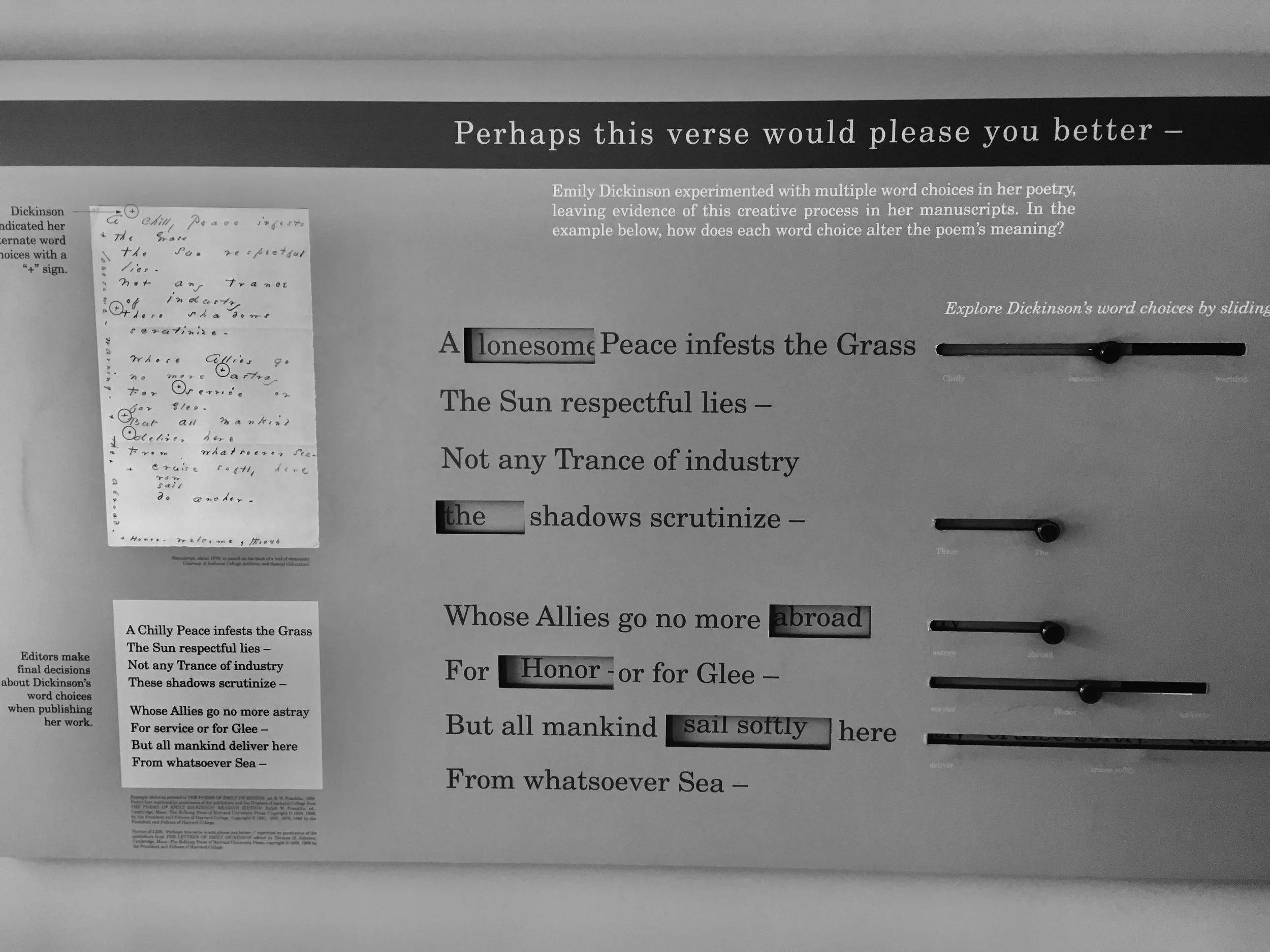
Interactive display at the Emily Dickinson Museum, Amherst, Massachusetts; photo by author
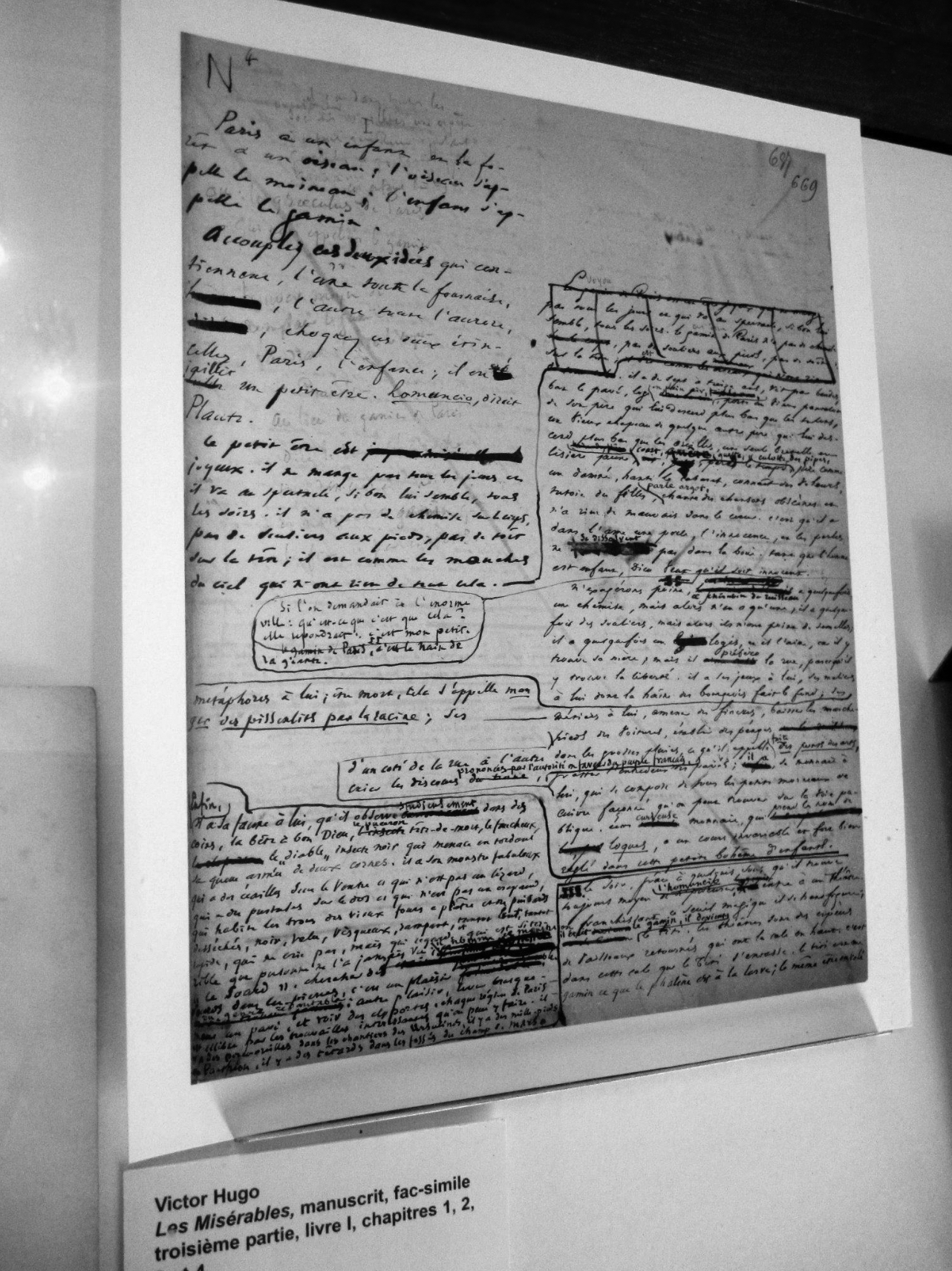
Facsimile of a page from Volume III, Book 1 of Victor Hugo’s Les Misérables, displayed at an exhibit of his drawings, Maison Hugo, Paris; photo by author
I enjoy catching glimpses of a writer’s process. Images of manuscript pages, with the authors’ crossings-out and scribblings, and literary journals like The Account, where writers explain the backstories of their works, and Underbelly, in which first and final drafts of each work are printed side by side, inspire me and fill me with curiosity and wonder. There’s a kind of flow evidenced in these too—the unfolding of increasing clarity as writers draw ever-closer to the voice and words they want. When I look at the opening lines of my own poem “Boondocks,” published in Beyond the Galleons (2024), in their very first and last iterations, I am startled by how different the two are, yet pleased that the soul of the poem inhabits both:
“Boondocks” ~ opening lines as published
I.
We hear the word and think
uncouth, naive, unsophisticated,
ramshackle huts off the grid,
prints of bare feet pressed
to dirt roads, scattered
corn husks, the smell
of burning wood, skin
prickling against the elements –
where a bad fall can mean
the end of life.
“Boondocks” ~ first draft of opening lines
If you’re from the boondocks
you might be stereotyped as uncouth,
naïve, unsophisticated, a fish
out of water in the civilized world.
We joke about the boonies –
how remote they are, how nothing
of any use can be found for miles,
just corn husks and the smell of wood
burning, ramshackle huts off the grid
along dirt roads carrying the prints
of the bare feet of unwashed, unschooled
children and the men who sired them,
who gather and cut firewood by hand.
Having crafted a piece for hours, days, or weeks, set it aside, revisited it, agonized, had the occasional break-through, and done as much as we think we can do, how do we know when a piece is “finished?” I don’t think we can ever be totally sure. Even the best writing samples could probably be tweaked or rewritten in a hundred more ways. I’ve had the experience of multiple voices offering feedback that led me to rework a piece many times, only to realize after some time away from the piece that my gut was still telling me the original “said it best” and later to have that very original accepted for publication. I’ve often wondered what would happen if I took a lesser-known work by a literary giant like John Donne or Virginia Woolf and distributed the piece without identification to a group of writers to workshop. I have no doubt there would be lots of eager critiquing. Someone always has a suggestion for even the greatest pieces of writing. At the same time, truly helpful feedback, from readers who understand and support the author’s vision, can elevate a work from good to great.
Flannery O’Connor wrote in The Habit of Being, “I am amenable to criticism but only within the sphere of what I am trying to do; I will not be persuaded to do otherwise.” I admire her strong faith in her own voice and work and strive to trust my own intention and vision for each piece that I write. In the end there’s nothing like applying a revision to a poem or short story, reading it to yourself, and exclaiming, “Yes!” in your heart. That feeling might even surpass the pleasure of writing that flows effortlessly onto the page by some “miracle” of Inspiration. With this in mind, I try to embrace revision. It is, after all, what makes us true writers, aspiring masters of our craft.
Isabel Cristina Legarda was born in the Philippines and spent her early childhood there before moving to Bethesda, Maryland. She holds degrees in literature and bioethics and is currently a practicing physician in Boston, Massachusetts. She enjoys writing about women’s lived experience, cultural issues, and finding grace in a challenging world. Her work has appeared in America Magazine, Cleaver, The Dewdrop, The Lowestoft Chronicle, Ruminate, Sky Island Review, Smartish Pace, Qu, West Trestle Review, and others. Find Isabel on Instagram and Twitter @poetintheOR.
*****
Yellow Arrow Publishing is a nonprofit supporting women-identifying writers through publication and access to the literary arts. You can support us as we BLAZE a path for women-identifying creatives this year by purchasing one of our publications or a workshop from the Yellow Arrow bookstore, for yourself or as a gift, joining our newsletter, following us on Facebook or Instagram, or subscribing to our YouTube channel. Donations are appreciated via PayPal (staff@yellowarrowpublishing.com), Venmo (@yellowarrowpublishing), or US mail (PO Box 65185, Baltimore, Maryland 21209). More than anything, messages of support through any one of our channels are greatly appreciated.
Meet a Board Member: Kelsea-Marie Pym
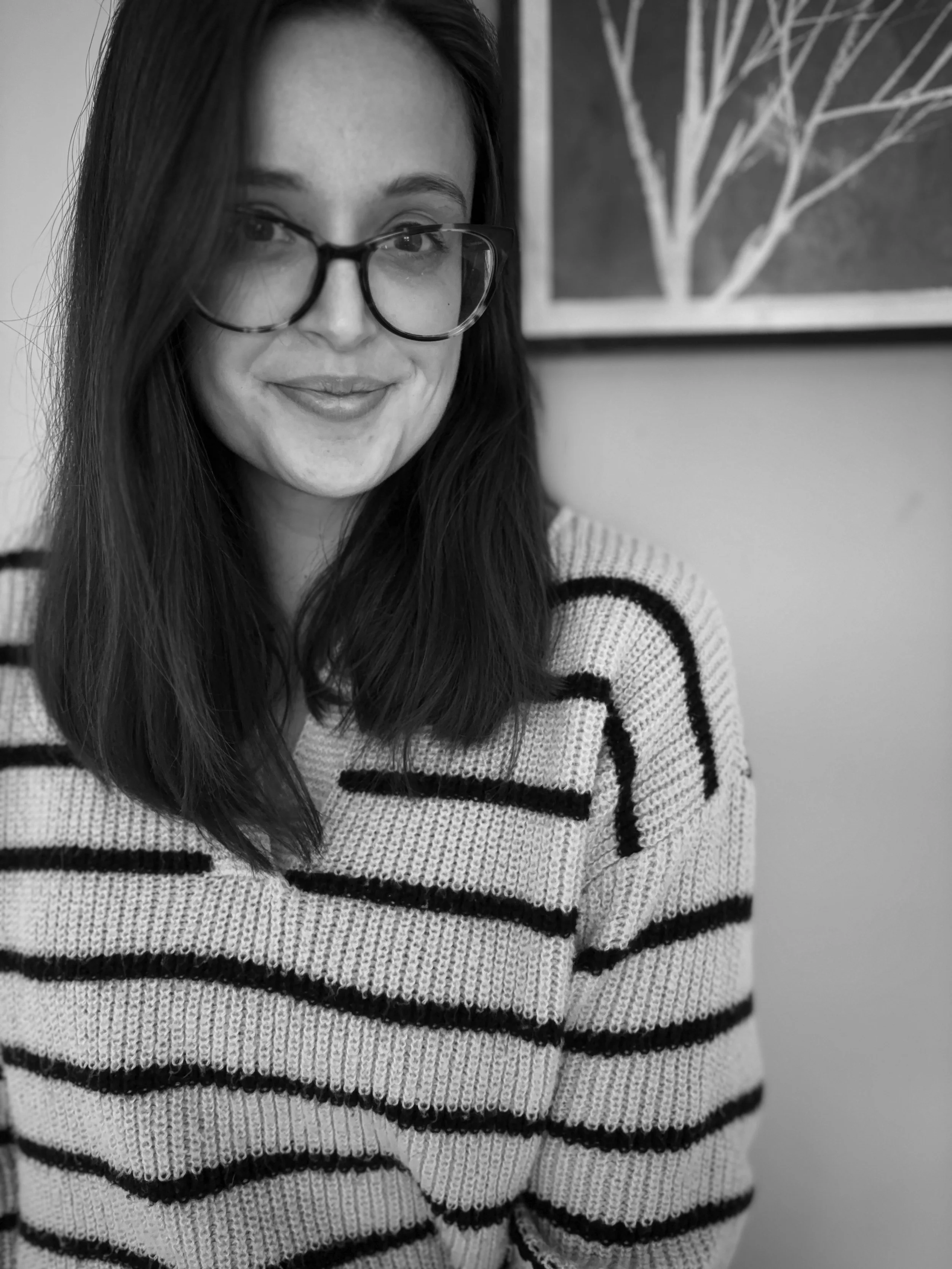
Yellow Arrow Publishing would like to introduce Kelsea-Marie Pym, board secretary. She started in October 2024, and we are excited to have her on the team. Kelsea is a political consultant primarily working in the nonprofit advocacy space, focusing for the past decade in nonpartisan civic engagement and democracy issues. Kelsea’s professional ghost writing has appeared in outlets from the New York Times to the Sacramento Bee, and everywhere in between. Kelsea has been fortunate to live on both coasts, from Portland to San Diego and from Boston to Washington, D.C., and to now reside in west Michigan. The perspectives from different cities in addition to a multitude of life experiences inform both her professional and personal work. Kelsea holds her BA from Boston University.
Kelsea’s hobbies outside of reading include baking, gardening, and running. Kelsea is a mother of a one-year-old son who keeps her on her toes. Kelsea and her husband are constantly running around after their son and after any of their three older pets (two dogs and one cat). It’s a busy life that doesn’t allow time for many hobbies, but above all else, Kelsea is still an avid reader who finds solace in all things written narrative.
Kelsea says, “I am inspired by others constantly. I love meeting new people and learning their stories. I am so excited to learn from the other women involved, to learn and be inspired by the work that is a part of Yellow Arrow, and to feel another thread of connection in a world that is somehow so wildly connect but disconnected at the same time.”
Tell us a little something about yourself:
My first award for writing came in 8th grade, when my anthology of poems titled “Ode to Oprah,” a middle-schooler’s ‘witty’ way of writing an anthology about social justice issues, won an award.
What do you love most about the Baltimore area and where you live in Michigan?
When I lived in D.C., I loved visiting Baltimore and going to the harbor. I’ve always been someone most inspired and at ease by the water, so that was a favorite. That is the only reason why I allowed us to move to the “landlocked Midwest” because I live within 35 minutes of Lake Michigan, which feels like a beach!
How did you get involved with Yellow Arrow and what do you do for us? Why did you want to join the Yellow Arrow team?
When I came across Yellow Arrow, I was immediately inspired. As a new mother, I cannot explain how many times essays, poetry, etc., have gotten me through some of the more difficult moments. Also, I have dedicated much effort in my professional life to uplifting the work of women, and to advancing opportunities for them in fields where we still do not have true opportunity equity.
Combining this love of uplifting women with this personal understanding of the importance of written word to inspire and connect us as women who have so many common experiences, is what led me to apply for the board.
What are you working on currently?
Right now, I am solely focused on the 2024 cycle. After November 5 and subsequent follow up, I will explore some more creative options to uplift the experiences of working mothers.
What genre do you write?
I write creative literary essays. My preferred writing is always poetry though.
What book is on the top of your to-be-read pile?
I feel like I’m the only person yet to read “The Midnight Library.” I’m also a huge Lilian Moriarty fan, and she does have a new one out.
Who is your favorite writer and why?
I have read and reread and loved every word Frederick Backman has written. I find his writing to be poetry in long form. I will never not read Roxane Gay when looking for analysis. Finally, I read the work of rupi kaur monthly, selecting from different collections as I need them.
Who has inspired and/or supported you most in your writing journey?
I was fortunate to grow up with two very creative parents, who were very supportive of any outlet that I chose to be creative.
What do you love most about writing?
There are seemingly finite ways to string together 26 letters into words and sentences, but seemingly infinite ways to then string those sentences or fragments together to actually evoke intense emotion, thought, or understanding. Writing is a true art form.
What advice do you have for new writers?
Don’t be intimidated by an industry that is not easy to navigate. Don’t think anything reflects the quality of what you have to offer other than your own feelings about your own art. The hustle and the work to get our writing out is not representative of the worth of our words. It unfortunately feels that way all too often.
What’s the most important thing you always keep near your computer or wherever you work?
Fluids (I always have at least three different drinks nearby because I get sucked into writing, creatively or professionally, and can be there for hours)
A notepad that has no purpose (not for work or anything dedicated) other than to scribble the many random ideas that come to me throughout the day
A mug with the Malala quote “Let us pick up our books and our pens, they are our most powerful weapons”
What’s your vision for Yellow Arrow in 2025?
I see no reason why Yellow Arrow can’t be a nationally known nonprofit, not just known in and around Baltimore. This mission, these women, this passion—all the components are there to spark true magic. I hope to add most to this . . . as I feel that [Yellow Arrow] has done the hard work setting up something so special and so critical.
*****
Yellow Arrow Publishing is a nonprofit supporting women-identifying writers through publication and access to the literary arts. You can support us as we BLAZE a path for women-identifying creatives this year by purchasing one of our publications or a workshop from the Yellow Arrow bookstore, for yourself or as a gift, joining our newsletter, following us on Facebook or Instagram, or subscribing to our YouTube channel. Donations are appreciated via PayPal (staff@yellowarrowpublishing.com), Venmo (@yellowarrowpublishing), or US mail (PO Box 65185, Baltimore, Maryland 21209). More than anything, messages of support through any one of our channels are greatly appreciated.
Down to Every Word: A Conversation Across Genres with Jennifer Martinelli Eyre

For Jennifer Martinelli Eyre, life comes with many hats. She is a wife, a mother, an employee, a daughter, a sister, a niece, and a writer, residing in Harford County, Maryland. At the end of a long day, you might find her tucked away in a home office, scribbling her next work on a vibrant pink chair. Jennifer’s poem, “If Barbie Were My Daughter,” was featured in Yellow Arrow Journal ELEVATE (Vol. IX, No. 1). You can also find her poem, “Better” in Yellow Arrow Vignette AMPLIFY.
Elizabeth Ottenritter, Yellow Arrow Publishing’s fall 2024 publications intern, and Jennifer engaged in a conversation through email where they discussed the craft of free-verse poetry and writing realities across genres.
You have resided in Maryland your entire life—do you have any early memories rooted in Baltimore that may have influenced your interest in writing?
I have been a fan of musical theater since early childhood. I was, and continue to be, drawn to the power of lyrics and the stories they tell. Seeing as though I cannot sing or dance, my admiration for the performing arts often took place in the seat of many Baltimore theaters such as the Morris A. Mechanic Theatre, Lyric Baltimore, and Hippodrome Theatre. I have countless memories of sitting on the velvet edge of my seat, mesmerized by the words being sung from the stage. Having access to these performances fueled my love for words and played a large role in my obsession with storytelling.
How would you describe the writing scene in Baltimore? Have you found a network of fellow artists?
I am just beginning to dip my toe into the Baltimore writing scene. Through social media, I have discovered local treasures such as the Ivy Bookstore, and I’ve long admired the city’s devotion to independent booksellers. I recently attended my first Baltimore Book Festival and was overwhelmingly inspired by the city’s love and support of the literary arts. The amount of joy and inspiration in the air was infectious, and I honestly didn’t want the day to end.
Prior to Covid, I joined the local Society of Children’s Book Writers and Illustrators (SCBWI) chapter where I connected with fellow Maryland writers all in various points of their writing careers. The resources and comradery were unlike anything I’ve ever experienced, and I’m proud to say I’ve made some lifelong friends through the SCBWI. I highly recommend seeking out the SCBWI if you write (or illustrate) for children and young adults.
I would love to hear about your MFA experience and how writing for children/young adults has influenced your approach to writing.
Writing for children and young adults has taught me the importance of unique character perspective. For example, an adult character walking down dark, basement stairs may view their surroundings differently than a child walking down the same set of steps. An adult may view the darkness as nothing more than an annoyance because their spouse failed to change a lightbulb. A child on the other hand, may feel like they are venturing down a dark tunnel to a deadly dungeon. A story can go in multiple directions when you take the time to analyze a character’s perspective. It’s so easy to write from the perspective of where we are in life (adults) but to step into the shoes of a child truly changes everything. This is just one of hundreds of lessons I took with me from the program.
When you write a free verse poem, where do you begin? What tends to come to you first?
My approach to free-verse poetry is rather unstructured. I view free-verse poems as internal thoughts. For example, we don’t think in complete sentences. We don’t process information internally with proper grammar or rhyme schemes. Thoughts come to us as an immediate reaction to a given event, and it’s those unfiltered moments that typically spark my entry point into a free-verse poem. From that point on, I work to fine tune the message or theme while striving to keep the vulnerability and honesty of the poem’s message.
Give me Better Homes and Gardens
without the strands of pearls.
Show me the woman bundled in a blanket, her golden strands now gone.
A warrior on a hospital bed throne, pulling the weeds of cancer from her garden
with grace, poison, and prayer.
“Better” from Yellow Arrow Vignette AMPLIFY
Your poem “Better” is unique in its framing and repetition. Do you feel that the poems you write reflect a certain headspace you were in at the time? Or a physical place?
I have had moments in my life that I was only able to process through writing. I find that these poems tend to be more for me than for sharing. It’s a way for me to face the truth of what I’m experiencing which is not always easy.
Poems such as “Better” come from a space held a little more at arm’s length. The line, “Show me the woman bundled in a blanket, her golden strands now gone,” wasn’t written from a specific personal experience, but more from a collection of experiences watching people I love battle cancer at various points in my life. However, pulling bits and pieces from my past for a poem doesn’t always feel intentional. Sometimes the truth I weave into my poems is so quiet that I don’t even realize I’m pulling from experiences until the words settle on the page.
You mentioned weaving pieces of yourself alongside vulnerabilities in “If Barbie Were My Daughter.” How do you move past fear of exposure while crafting a candid piece such as this?
Poems such as “If Barbie Were My Daughter” do expose a part of myself that isn’t always easy to see. I’d be lying if I said that I’ve never been afraid to share personal experiences and vulnerabilities in my poems. The fear and discomfort typically boil over in the drafting/revising phase. Having your truth stare back at you from a page can be disarming, and it’s in those moments that I allow myself to experience the fear.
However, when the piece is complete and ready to share, I no longer view the work as something private I’m revealing about myself. Rather, I take a few steps back from the piece and create space for others to connect to the work in their own way. My poems are bigger than me, and it would be selfish to think I’m the only one on the planet who’s felt a particular way. My hope is that by sharing my vulnerabilities, I can inspire others to come to the table with their experiences. Fear feeds of off loneliness and wilts in a crowd.
How do you approach revising your own poetry?
I approach my revisions by first determining what it is that I want a poem to convey. I then look for areas where I said too much or said too little. It’s important to me that my words not only share a thought or experience (whether fiction or reality) but that they also leave room for the reader to find their own connection and interpretation. I will rework a poem endlessly until I feel that I’ve created a space for both on the page.
What types of art do you feel you respond to the most? How do they manifest in your own work?
I enjoy contemporary prose fiction, and my nightstand is currently stacked with such books. In free-verse poetry, there is an overwhelming call for brevity that doesn’t exist on the same level in prose. Every word in a poem must serve a precise purpose. That’s not to say that prose allows for needless detail, but it does add a layer of storytelling that inspires me. For example, I will get lost in a chapter that talks about nothing but the smell of a fresh cut grass from the perspective of a man who’s just been freed from prison. I want to know every detail of what that grass smells like to this character because it’s significant to who this person is and what they’ve been through.
After I finish a story written in prose, I will always take a moment and ask myself if that same story could have survived in a free-verse format. Sometimes the answer is yes and sometimes it is no. Regardless of the answer, it’s the process of asking myself these questions that helps me become a stronger, more intentional storyteller.
At the Baltimore Book festival, you told me to write what I wanted and to not let anyone tell me what I should write. I think this is such a powerful notion. Do you have any more advice for young women writers who are new to the publishing/literary world?
Women continue to be challenged by those too afraid to hear what we have to say. We are told to be quiet, comply, and to not talk about the hard things because it makes others uncomfortable. In my experience, being silenced and censored has only strengthened my literary voice.
My advice to women new to the publishing world is to go with your gut when it comes to your writing. Only you know what drove you to pick up that pen and place those words on paper; it’s crucial that you hold onto this. It can be quite easy to let the opinions of others dim the spark that started the whole project, but don’t let it. You have something to say, and the world needs to hear it.
Jennifer Martinelli Eyre graduated with her MFA in writing from the Vermont College of Fine Arts in January 2023, where she spent her time studying writing for children and young adults. Jennifer enjoys exploring various literary styles of writing, particularly free verse poetry. When she is not writing, Jennifer can be found behind a desk at her full-time job or reading one of the many books piled on her nightstand. Jennifer has resided in Maryland her entire life and currently lives in Harford County with her husband, daughter, and ornery cat. You can find her on Instagram and Thread at @jmeyrewriter.
Elizabeth Ottenritter (she/her) is a senior at Loyola University Maryland, where she studies writing. She is passionate about reading, crafting poetry, contributing to Loyola’s literary art magazine, Corridors, and traveling worldwide. Upon graduation, Elizabeth hopes to continue her love of learning and language in a graduate program.
*****
Yellow Arrow Publishing is a nonprofit supporting women-identifying writers through publication and access to the literary arts. You can support us as we BLAZE a path for women-identifying creatives this year by purchasing one of our publications or a workshop from the Yellow Arrow bookstore, for yourself or as a gift, joining our newsletter, following us on Facebook or Instagram, or subscribing to our YouTube channel. Donations are appreciated via PayPal (staff@yellowarrowpublishing.com), Venmo (@yellowarrowpublishing), or US mail (PO Box 65185, Baltimore, Maryland 21209). More than anything, messages of support through any one of our channels are greatly appreciated.
Tips on Submitting Your Work to Literary Publications

By Leticia Priebe Rocha
During the early days of the COVID-19 pandemic, I found myself (like many people) contemplating where my life was going after any semblance of a plan went out the proverbial window. I had an epiphany that I refer to as my Billy Crystal in When Harry Met Sally confession moment: “When you realize you want to spend the rest of your life with somebody, you want the rest of your life to start as soon as possible.” Except for me, instead of a stunning Meg Ryan as Sally, my beloved is poetry. I felt a great sense of urgency to share my work with others. I was also acutely aware of my inexperience—I’d been writing since high school, but I had virtually no exposure to the literary world and had no idea how any of it worked.
I vaguely remembered advice from a creative writing professor in college—typically people start their writing careers by submitting their work to literary magazines. I Googled around and eventually found some open submission opportunities. My head filled with questions. What on earth is a Submittable? How do I write a cover letter? Which poems should I even send in? Needless to say, it was quite the learning curve.

Five years and hundreds of submissions later, I’d like to share the knowledge that I picked up along the way. Over the last two years, I have also had the pleasure of working with Yellow Arrow Publishing as guest editor of the EMBLAZON issue of Yellow Arrow Journal, later joining their editorial staff. Seeing the other side of the submission process was incredibly illuminating, so I will share tips from the perspective of both a writer and an editor. Submissions to the next issue of Yellow Arrow Journal, UNFURL on the process people go through when finding and transforming into their authentic selves, are open until February 28. Learn more about the submissions process and how to submit at https://www.yellowarrowpublishing.com/submissions.
Submit with Care: Choosing Where to Submit
You’ve written some pieces, wrestled with revision, and you’re ready to share them with the world. Where do you start? There are thousands of literary publications out there and it can quickly get overwhelming.
I have three sources that I use to find submission opportunities. Many publications have a social media presence and post about their reading periods. I especially like being able to see the online community that surrounds a publication. I also use ChillSubs, which is an online database of literary publications. It’s a great tool because you can filter your search to find what works best for you. There are other databases, too, like Duotrope. I also look at the acknowledgments page of poetry collections that I read and research any publications listed that I haven’t heard about.
Aside from finding submission opportunities, I urge you to find publications that align with your values and will take care of your work. When I started sending out submissions, I was so excited by the prospect of someone liking my work enough to publish it that I was not especially concerned with who was publishing it. With more experience, I started thinking more about how where I choose to publish could be seen as a reflection of my own values. Since then, I’ve been more intentional about where I submit, evaluating each publication’s website to determine whether we are in alignment. Reviewing the “about” section for every publication, observing whether they’re transparent about their editorial team (often called “the masthead”), and checking their social media presence are a few ways that I vet a journal.
Once I feel comfortable with a publication’s credibility, there are a few other layers I’ve learned to consider. How you approach them is dependent on your preferences and writing goals:
Publications can be in print, digital, or both. I personally don’t prioritize where I submit with this in mind, though it is really exciting to see my work in print!
Many publications charge reading fees, typically ranging from $2.00 to $5.00. This is fairly standard in the literary world, though there are plenty of magazines that are free to submit to. Personally, I tend to submit to free publications.
While a lot of publications don’t have the funds to pay their contributors, there are many who do. How much they pay varies widely. Typically, more established and “prestigious” publications can pay more than others.
Reading is Fundamental: Submission Best Practices
Now you’ve found literary publications that you want to send your work to who are open for submissions. Yay! The most important advice I can give you on the logistics of submitting is to read and follow the guidelines on the submission call.
Each publication has its own rules about how many pieces you can send, formatting, and other important details to keep in mind when submitting, like a theme. Considering the number of submissions most places receive, failing to follow guidelines can be an automatic disqualifier. Reading the guidelines also helps me get a feel for the publication and whether it is somewhere I want to see my work in.
One aspect of the submission process that initially baffled me was the cover letter. Once you get the hang of it, it’s pretty simple, and you should not spend a lot of time writing it. I created a template for myself and adjust it as necessary to save time when submitting. Starting off with a simple “Dear editors” will suffice, unless an editor’s name is listed in the guidelines or easily found on their website. In the body of the letter, I list how many poems I am submitting, their titles, and any content warnings. Most publications ask that you include an author bio in the cover letter, which gives them a glimpse of your previous publications, background, and anything you want to include to give a glimpse of your personality. Additionally, if you have a personal connection with the publication, have published there before, or received an encouraging rejection in the past, these are all details you can include in the cover letter. Otherwise, keep it simple.
Before serving as an editor, I sometimes had a hard time remembering that there are other people on the end of the “submit” button who will actually engage with my work. While editors can feel intimidating, they are humans with their own busy lives. For many publications, editorial staff are volunteers. Be gracious and make the process easier by following guidelines.
The Waiting Game: Keeping Track of Your Submissions
You’ve read and followed all the guidelines, drafted a beautiful cover letter, then clicked submit or sent off that submission email. Now what?
The waiting game begins! Everything is out of your hands and all you can do is wait for a decision. Many literary magazines and journals list how long they take to reply. Transparency around waiting times is another factor that makes me more likely to submit to a publication. From my experience, most places take at least three months to send decisions, though six months is common. Usually, more “high-profile” publications will take at least eight months to respond, but don’t be surprised if over a year goes by due to the volume of submissions they receive. If you are eager for a piece to be out in the world, many journals offer “fast response” options and these typically cost more than standard submissions. I encourage writers to submit the same piece(s) to multiple publications (called “simultaneous submissions”) unless a publication explicitly indicates against it in their guidelines. If a piece gets accepted, be sure to notify any other publications and withdraw it from consideration.
Aside from waiting, you can also keep track of your submissions. When I first started submitting, I did it pretty sparingly and did not see a need to track them. I eventually decided to get more sophisticated with my system and created a spreadsheet, especially to avoid any snafus with simultaneous submissions. My spreadsheet is organized into the following columns: Title, Publication Name, Submission Date, Response Timeline, and Submission Status. I also have a column that notes whether this is a simultaneous submission. I’m a big fan of color coding, so whenever I receive a response, I turn each row (which corresponds to an individual poem) green for accepted, red for rejected, or yellow if I need to withdraw any poems from consideration.
While tracking your submissions is not essential, it has been a useful practice for me because it helps me stay organized. I’m in this for the long haul, and I appreciate having this kind of data to look at over the years. Do what works for you! It should feel useful, not like so much work that it discourages you from submitting.
Give Yourself Grace: Swat the Rejections Like Flies
One aspect of living as a writer that I was not initially prepared for was the magnitude of rejections sent my way. I had a difficult time not taking each rejection personally at first. My stubborn nature served me well in those early moments, because I refused to give up when the desire to create and share was so strong within me. Over time, I also built up a community of writers through social media and attending literary events. Being in community with other writers helped me understand that rejection is a universal writerly experience.
Now that I’ve been on the other side of the process as an editor, I also better understand how incredibly subjective these decisions are. Editors are just people, and they approach your work with all their lived experiences and personal tastes. Another layer of this is the sheer volume of submissions that most publications receive. Even relatively “small” journals receive hundreds of submissions per reading period. Resonant work inevitably gets turned away for reasons that have nothing to do with its quality. One thing to keep an eye out for is that some publications send out “tiered” rejections with feedback and encouragement to send more work their way. Even if you get a rejection from a publication, you should absolutely try again if it is somewhere you truly see your work in alignment with.
When I receive a rejection, I still feel a little sting, but I can brush it off easily now. I try to reframe every rejection as an opportunity. Perhaps the poem could use some revision. Sometimes revisions are obvious right away, sometimes it takes years to see a new direction. What matters most is how you feel about the piece. If you still believe in it without revising, keep submitting. If you have doubts or are less excited about it, try to revise or take a break from submitting that specific piece until your excitement returns. I also strongly believe that each piece has the home it’s meant to be in, so a rejection only means that specific publication was not its home. I recently received an acceptance for a poem I wrote nearly eight years ago that I revised very little. It simply had to make its way to this specific publication, even if that took time. I’ve also realized that a lot of getting published is a numbers game—the more you send out work, the more acceptances you will get.
While I’ve laid out the submission process in a linear way, I want to recognize that submitting your work is no easy feat. It can be time-consuming, tedious, and tiring, especially when rejections start piling up. Sharing your work with anyone is a vulnerable act, and sending your work to editors requires tremendous courage. With all of this in mind, it is essential that you give yourself grace. Don’t let rejections define your worth as a writer. Take a break from submitting when you need to (my longest break was almost a year) and come back when you’re reenergized. Don’t self-reject from publications by not sending your work out, even to the most “prestigious” places. What do you have to lose? Listen to your intuition. I wish you all the best on your submission journey—here’s to many acceptances coming your way!
Leticia Priebe Rocha is a poet, visual artist, and editor. She is the author of the chapbook In Lieu of Heartbreak, This is Like (Bottlecap Press, 2024). Leticia earned her bachelor’s from Tufts University, where she was awarded the 2020 Academy of American Poets University & College Poetry Prize. Born in São Paulo, Brazil, she immigrated to Miami, Florida, at the age of nine and currently resides in the Greater Boston area. Her work has been published in Salamander, Rattle, Pigeon Pages, and elsewhere. Leticia is an editorial associate for Yellow Arrow Publishing and served as guest editor for their EMBLAZON issue. You can find her on Instagram @letiprieberochapoems or her website, leticiaprieberocha.com.
*****
Yellow Arrow Publishing is a nonprofit supporting women-identifying writers through publication and access to the literary arts. You can support us as we BLAZE a path for women-identifying creatives this year by purchasing one of our publications or a workshop from the Yellow Arrow bookstore, for yourself or as a gift, joining our newsletter, following us on Facebook or Instagram, or subscribing to our YouTube channel. Donations are appreciated via PayPal (staff@yellowarrowpublishing.com), Venmo (@yellowarrowpublishing), or US mail (PO Box 65185, Baltimore, Maryland 21209). More than anything, messages of support through any one of our channels are greatly appreciated.
Yellow Arrow Journal (X/01) UNFURL Submissions are Now Open!

Yellow Arrow Publishing is excited to announce that submissions for our next issue of Yellow Arrow Journal, Vol. X, No. 1 (spring 2025) are open February 1-28, exploring the process people go through when finding and transforming into their authentic selves. In her introductory blog, guest editor Sara J. Streeter (she/her) recently explored her personal journey with her adoption and her Korean-American heritage.
“I gave myself space and tended to my pain, prioritizing self-compassion when grief gnawed at me. Like a tree burning from the inside out, a flame inside me flickered, begging for release, though once I let it out, I couldn’t go back to the person I had been. . . . Writing my story gave me permission to examine the parts and pieces that were at times too ugly, too dark, too broken to touch. When people read what I wrote, it felt like the fire leapt from my throat and danced its way out into the world.”
The first issue of volume X will be a survey of the unique journeys people take when experiencing and undergoing self-transformation, journeys that all start with a little fire, a desire, deep inside. This issue’s theme is UNFURL
: to release from a furled, coiled, or wrapped state
: to open out from or as if from a furled state
: to unfold
Do you need some help choosing the right piece to submit? Here are some guiding questions about the topic and theme:
What role did community play in finding yourself?
How has your sense of self changed due to your transformation? What about your relationships?
What did you find along the way?
What do you still need to be authentically you?
Was there something that forced you to be a different version of yourself? How did you internalize it?
Yellow Arrow Journal is looking for creative nonfiction, poetry, and cover art submissions by writers/artists who identify as women, on the theme of UNFURL. Submissions can be in any language as long as an English translation accompanies it. For more information regarding journal submission guidelines, please visit yellowarrowpublishing.com/submissions. Please read our guidelines carefully before submitting. To learn more about our editorial views and how important your voice is in your story, read about the journal. This issue will be released in May 2025.

UNFURL’s guest editor, Sara J. Streeter or 한혜숙 Hea Sook Han, is a writer and a Korean-American adoptee. Since starting her writing journey in 2021, Sara found her writing community through Adoptee Voices and developed a meaningful connection to readers, both within the adoption constellation and beyond. She mainly writes creative nonfiction prose and has been published in literary journals, such as Longleaf Review, Hippocampus Magazine, Peatsmoke Journal, The Rappahannock Review, GASHER Journal, Cutleaf Journal, and others. Sara has been nominated for Best of the Net, Best Microfiction, and Best Small Fiction. She joined the Yellow Arrow community when her piece “Bitter / Sweet” was included in Yellow Arrow Journal kitalo Vol. IX, No. 2. She lives in Silver Spring, Maryland, with her family and is an interior designer for a small hospitality firm. You can find her at sarajstreeter.com. We are excited to work with Sara on UNFURL over the next few months.
The journal is just one of many ways that Yellow Arrow Publishing works to support and inspire women-identifying creatives through publication and access to the literary arts. Since its founding in 2016, Yellow Arrow has worked tirelessly to make an impact on the local and global community by advocating for writers who identify as women. Yellow Arrow proudly represents the voices of women from around the globe. Creating diversity in the literary world and providing a safe space is deeply important. Every writer has a story to tell, every story is worth telling.
*****
Yellow Arrow Publishing is a nonprofit supporting women-identifying writers through publication and access to the literary arts. You can support us as we BLAZE a path for women-identifying creatives this year by purchasing one of our publications or a workshop from the Yellow Arrow bookstore, for yourself or as a gift, joining our newsletter, following us on Facebook or Instagram, or subscribing to our YouTube channel. Donations are appreciated via PayPal (staff@yellowarrowpublishing.com), Venmo (@yellowarrowpublishing), or US mail (PO Box 65185, Baltimore, Maryland 21209). More than anything, messages of support through any one of our channels are greatly appreciated.
Her View Friday
Yellow Arrow Publishing supports women-identifying writers from a wide variety of backgrounds, not just because it’s the right thing to do, but because it makes us stronger. Women’s voices have historically been underrepresented in literature, and we aim to elevate those voices and stories through our programs, publications, and support.
Part of our mission in supporting and uplifting women-identifying creatives is to promote the Yellow Arrow community’s individual accomplishments. We’d like to further expand that support and promotion outside of our Yellow Arrow publications. Twice a month, we’d like to give a shout out to those within the Yellow Arrow community who recently published:
single-author publications
single pieces in journals, anthologies, etc., as well as prizes/awards, book reviews, and podcasts/interviews
You can support our authors by reading this blog and their work, sharing their news, and commenting below or on the blog. Congratulations to all the included authors. We are so proud of you!
Every writer has a story to tell and every story is worth telling
PRIZES/AWARDS
Tangles by Kay Smith-Blum from Seattle, Washington

Genre: historical suspense
Name of award: Best (New) Debut Fiction from the American Writing Awards
americanwritingawards.com/american-writing-awards
TANGLES is Kay’s debut novel. You can find Kay on Twitter @kaysmithblum, Instagram @discerningksb, and Facebook/Linkedin @kay.smithblum. You can also find her on her website kaysmith-blum.com. Kay was one of our 2023 Pushcart Prize nominees for “On Edge” in Yellow Arrow Journal UpSpring.
Yellow Arrow (past and present) board, staff, interns, authors, residents, and instructors alike! Got a publication coming out? Let us help celebrate for you in Her View Friday.
Single-author publications: here.
Single pieces as well as prizes/awards, book reviews, and podcasts/interviews: here.
Please read the instructions on each form carefully; we look forward to congratulating you!
*****
Yellow Arrow Publishing is a nonprofit supporting women-identifying writers through publication and access to the literary arts. You can support us as we BLAZE a path for women-identifying creatives this year by purchasing one of our publications or a workshop from the Yellow Arrow bookstore, for yourself or as a gift, joining our newsletter, following us on Facebook or Instagram, or subscribing to our YouTube channel. Donations are appreciated via PayPal (staff@yellowarrowpublishing.com), Venmo (@yellowarrowpublishing), or US mail (PO Box 65185, Baltimore, Maryland 21209). More than anything, messages of support through any one of our channels are greatly appreciated.
Writing About the Cure

By Charlie Langfur, written October 2024
I have written all my life and learned to trust important events in my life as apt subjects for my writing. One such event that impacted me in a big way was when I was asked to leave high school to be cured of being gay in 1964. The school was Northfield School, an old and distinguished prep school in the sweet rolling hills of northern Massachusetts. I was there on a scholarship from my mother’s boss even though I came from a family always struggling financially.
In 1964, you ask? Back then, being a lesbian was considered to be a disease with the American Medical Association (AMA) and the American Psychological Association (APA), but no one told me about it until I was forced to return home to Hasbrouck Heights, New Jersey, to see a psychiatrist every week to be cured. In 1974, the medical establishment altered the diagnostic code for gay people (homosexuals at the time) so that the disorder was no longer considered pathological. The APA made the change first. The fact that there was no such disease (and therefore, no cure) in the 1960s emboldened me and gave me the courage to try and talk my way out of things without talking about being gay at all. The Harvard therapist from Northfield School told me what I said to him was private (between us), but then he and the headmaster sent me home anyway without any warning. “I did not say I was gay, the Northfield doctor did,” I told my New Jersey therapist, but he told me I had to say more to be cured, even though I had no idea what more was any more than he did.
A couple of years after all this, I wrote a short story about what happened called “Curing Sarah,” and in it I tried to make sense of what happened and also to memorialize it for me in some authentic way because it impacted my life in every way possible for many years. Writing about it saved me and helped me understand what happened in a way I could absorb. After I wrote “Curing Sarah,” I began to send it out for publication, even more so after the APA declared gayness was no longer a disease in the 1970s, but the story was always rejected (some with and some without comments). Some years ago, the editor of Zoetrope wrote me, “God, I think this is a funny piece, but I couldn’t possibly publish it.”
But finally in 2012, the University of Southern Kentucky accepted it for Ninepatch: A Creative Journal for Women and Gender Studies. The story is still online and last month my neighbor told me she read and loved it. I’ve reread it and feel it still holds up. The tone matches how it was back then, and it shows how it led me to my life today. I am still writing and sending out my work for publication and recently my poem, “The Way Back,” was nominated for the Best of the Net 2025 by Yellow Arrow Publishing, and I was asked to write a poem for Poetry East’s special issue on Monet (a plumb piece for an organic gardener like me).
Over the years I have learned with writing to never give up on what I have to say. Writing has helped me through good times and bad, reflecting my life as an LGBTQ and green writer, in times when what I had to say was okay and when it was not. Recently Paul Iarobbino, an editor for Bold Voices, who is putting together an anthology of defiant moments in gay lives asked me about putting a reprint of “Curing Sarah” in his publication. He said it had “historical value” but wanted his editors to rework it in a first-person narrative. I politely declined because even though a reprint is a good idea, I know the text is right the way it is now—at least for me it is as a writer and a person. The tone works and so does the style.
Writing helps me pave a way through the difficult, and I try to write my way out of difficulty every chance I get. Nowadays, aging presents many experiences for me to do this, and I finally wrote my first short essay about what an elder is. So, I keep writing and changing and learning anew, and as always I write on.
You can read “Curing Sarah” for yourself at encompass.eku.edu/cgi/viewcontent.cgi?article=1027&context=ninepatch.
Charlene Langfur is an LGBTQ and green writer, an organic gardener, a Syracuse University Graduate Writing Fellow in Poetry in 1970 and she has hundred of publications in poetry, fiction and creative non-fiction. She lives in the southern California desert in the Palm Springs oasis.
*****
Yellow Arrow Publishing is a nonprofit supporting women-identifying writers through publication and access to the literary arts. You can support us as we BLAZE a path for women-identifying creatives this year by purchasing one of our publications or a workshop from the Yellow Arrow bookstore, for yourself or as a gift, joining our newsletter, following us on Facebook or Instagram, or subscribing to our YouTube channel. Donations are appreciated via PayPal (staff@yellowarrowpublishing.com), Venmo (@yellowarrowpublishing), or US mail (PO Box 65185, Baltimore, Maryland 21209). More than anything, messages of support through any one of our channels are greatly appreciated.