
Yellow Arrow Publishing Blog
Community Building–Community Love: Reflections on KINDLING by Matilda Young

By Matilda Young
For Yellow Arrow Journal Vol. VIII, No. 1, KINDLING, we asked our authors to share what the idea of “kindling” means to them, and how it’s reflected in their work. We posted some on our Facebook/Instagram stories in May, but here are a few of the amazing responses we received:
Kathleen McTigue: One of the core values of our immigration justice network here in Boston (BIJAN) is this: “We fight for one another as family, because we are.” Though my activism for justice has always been driven by strong convictions, what has sustained and inspired me all these years is the love I’ve received from others. We are family and how we treat each other matters more than we sometimes know.
Al Kelly: I was drawn to the idea of the beginning of something. The idea that, before the fire, there is a spark, a thought. It takes those initial steps of gathering the wood and putting it all in one place which allows the person that comes behind to start the fire.
Thomasin LaMay: What drew me to this is that I spend lots of time with people, especially women/teens in southwest Baltimore, who are such beautiful folks with a huge capacity to care and love. They are overlooked in so many ways, and one of [the ways] is that they are too messed up to care and be involved in community. Honestly I have met some of the most loving and good people in hard places. Kindling for me is a way to startle some (more empowered) folks into taking another look: at how they think, who they find lovable, who is worth helping. And really, as a poet, to just celebrate what love is in all its messy and beautiful ways.
Sarah Piper: “CALLING” came to me in a moment of self-determination, of realizing no one’s answers outside of myself could resolve the questions I had. And even if I didn’t have those answers yet, I could incubate the uncertainty into something beautiful and powerful. And when I saw the issue theme of KINDLING, it evoked that same awakening, a return to the self as a beginning, a new start to build communities of our own ideals from the raw materials we already have available within us. And to set loose a freeing fire in the world.
I love all these answers, and how each of us are drawn to our content and to this theme by connected yet disparate things. We each have our own take, and we each found our way to one another.
Kindling to me is recognizing that we are all capable of creating and sharing light. The light you give touches lives in ways you may never know. I know that my life has been touched by the work shared in KINDLING, by our authors and artists, and by everyone who shared their work with us. It has been touched by the incredible Yellow Arrow staff and volunteers working tirelessly behind the scenes to make this journal a success. And it has been touched by everyone who showed up in support of the creators and the work, whether by attending the reading, or buying a copy, or telling the people in their life they should give KINDLING a read (and you should!).
I hope that the writing and cover art provide shifts in perspective, discoveries and challenges, stories to hold on to, encouragement to go out and keep doing the good work—whatever that means to you.
This is my first time guest editing a journal and from what I’ve seen from all the individuals who made this issue possible, it is truly an act of community building. It is a collective labor of love by people who share a common passion for writing and giving that writing a home. I could not be more grateful to be part of this community, and I hope we can all find connections here for years to come.
Paperback and PDF versions are available from the Yellow Arrow bookstore. Discounts are also available (here) if you would like to purchase copies for friends and family (minimum purchase of five). You can also search for Yellow Arrow Journal on any e-book device or anywhere you purchase books, including Amazon and most other distribution channels. And with this blog, the reading—Scorching, Speaking: A KINDLING reading—is available on the Yellow Arrow YouTube channel at https://youtu.be/GEygfG8v2XI. Make sure to subscribe to our channel and show everyone who read some love in the comments.
Thank you to everyone who contributed to KINDLING, and to the many wonderful submitters whose pieces we couldn’t fit into this issue.
Matilda Young (she/they) is a poet with an MFA in poetry from the University of Maryland. She has been published in several journals, including Anatolios Magazine, Angel City Review, and Entropy Magazine’s Blackcackle. She enjoys Edgar Allan Poe jokes, not being in their apartment, and being obnoxious about the benefits of stovetop popcorn. Matilda’s poem “This Yes, This” was part of Yellow Arrow Journal FREEDOM, and Matilda was our .W.o.W. #7.
*****
Yellow Arrow Publishing is a nonprofit supporting women writers through publication and access to the literary arts. You can support us as we SPARK and sparkle this year: purchase one of our publications from the Yellow Arrow bookstore, join our newsletter, follow us on Facebook, Instagram, or Twitter or subscribe to our YouTube channel. Donations are appreciated via PayPal (staff@yellowarrowpublishing.com), Venmo (@yellowarrowpublishing), or US mail (PO Box 65185, Baltimore, Maryland 21209). More than anything, messages of support through any one of our channels are greatly appreciated.
Healing the World with a Spark: Yellow Arrow Journal (Vol. VIII, No. 1) KINDLING
There is no one way to heal the world; the only requirement is that we try. There is so much darkness in the world, but even the smallest spark can start a fire.

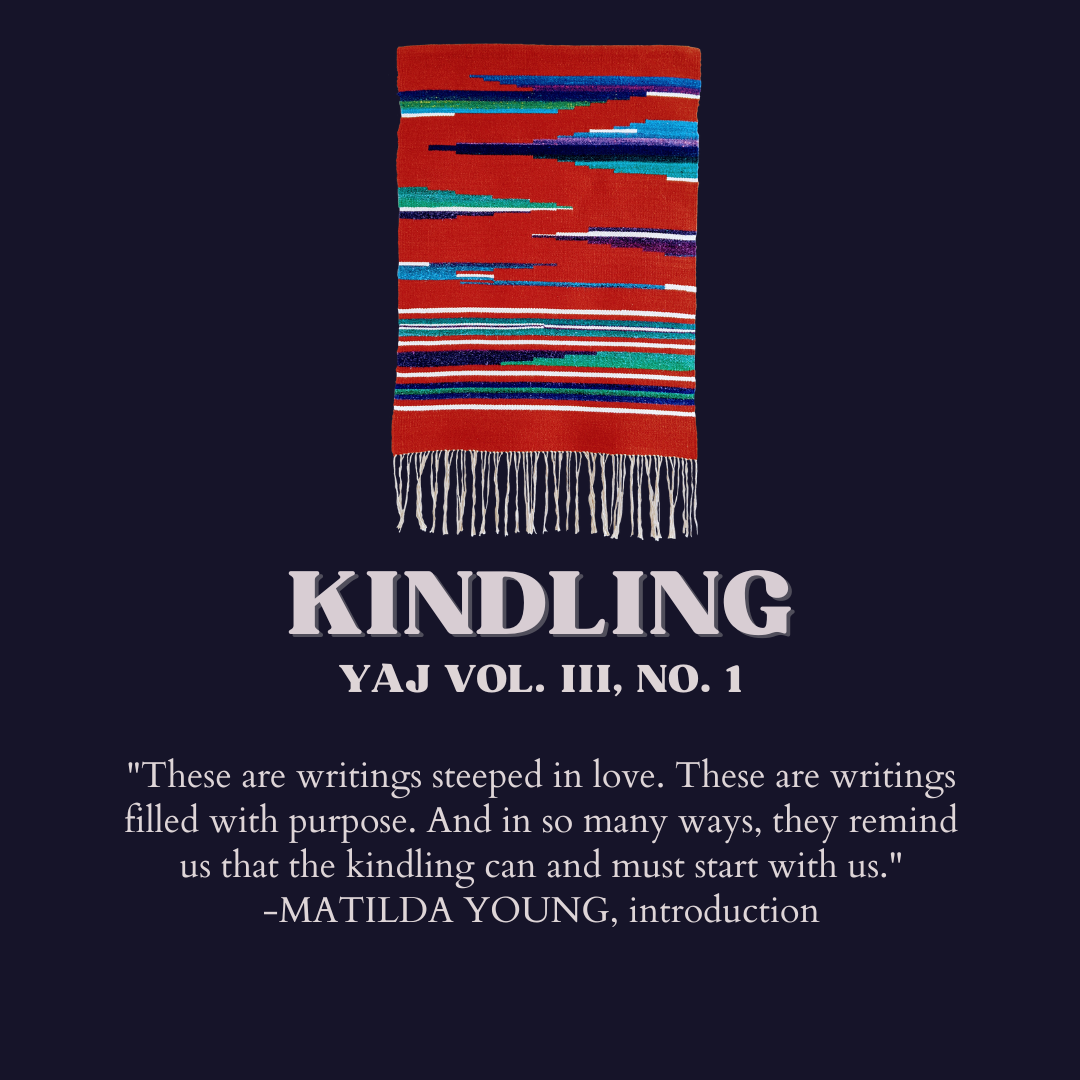
Matilda Young (she/they), guest editor of just released Yellow Arrow Journal Vol. VIII, No. 1 KINDLING, began her introduction of the issue getting straight to the heart of the topic: advocacy and community care. And how both terms weave their way through the pages. The pieces within explore various facets of advocacy and community through changemaking. Included poems and prose speak about the author’s connections to others, to bearing witness, and to visions of paths to brighter days ahead. Matilda professes, “These are writings steeped in love. These are writings filled with purpose. And in so many ways, they remind us that the kindling can and must start with us.”
And with that thought, we are excited to release the latest issue of Yellow Arrow Journal and privileged to share the voices included within our KINDLING issue. Paperback and PDF versions are now available from the Yellow Arrow bookstore. Discounts are also available (here) if you would like to purchase copies for friends and family (minimum purchase of five). You can also search for Yellow Arrow Journal on any e-book device or anywhere you purchase print and electronic books, including Amazon and most other distribution channels.

Matilda is a poet with an MFA in poetry from the University of Maryland. She has been published in several journals, including Anatolios Magazine, Angel City Review, and Entropy Magazine’s Blackcackle. She enjoys Edgar Allan Poe jokes, not being in their apartment, and being obnoxious about the benefits of stovetop popcorn.
The beautiful artwork on the cover (cover design by Alexa Laharty), “Doña Sedona (a gradual elevation)” by Violeta Garza (who also contributed a poem!), was created of wool, acrylic, and cotton. For Violeta, their weaving has been the kindling to help not just fuel creativity but also cope with multiple brain injuries.
We hope you enjoy reading KINDLING as much as we enjoyed creating it. Thank you for your continued encouragement of Yellow Arrow Publishing and the women involved in KINDLING. And on June 1 at 8:00 pm EST, please join Matilda and some of our authors for the live, virtual reading of KINDLING. More information is forthcoming but you can let us know you plan to join us at fb.me/e/RMrS7pvs.
*****
Yellow Arrow Publishing is a nonprofit supporting women writers through publication and access to the literary arts. You can support us as we SPARK and sparkle this year: purchase one of our publications from the Yellow Arrow bookstore, join our newsletter, follow us on Facebook, Instagram, or Twitter or subscribe to our YouTube channel. Donations are appreciated via PayPal (staff@yellowarrowpublishing.com), Venmo (@yellowarrowpublishing), or US mail (PO Box 65185, Baltimore, Maryland 21209). More than anything, messages of support through any one of our channels are greatly appreciated.
Yellow Arrow Journal (VIII/01) KINDLING Submissions are Now Open!

Yellow Arrow Publishing is excited to announce that submissions for our next issue of Yellow Arrow Journal, Vol. VIII, No. 1 (spring 2023) is open February 1–28 addressing the overarching concept of advocacy and community. Guest editor, Matilda Young, states,
The work of changemaking is the work of community and care, of recognizing how our lives and futures are inextricably linked. Our writing can reflect this vital work and be a part of how we bring change to life.
Maybe it is by sharing our full selves with the world or speaking clearly to the injustice of the past and present. Maybe it is sharing the story of how another person inspired us or helped us find healing or how we ourselves find healing and connection in the practice of community care. Like writing, changemaking is fundamentally an act of imagination: envisioning a world that does not yet exist but must.
This issue’s theme will be KINDLING
: easy combustible material for starting a fire
: something or someone that helps start (spark) a movement, an event,
changemaking, and/or advocacy
What is your vision for advocacy? How can you kindle changemaking in yourself? In others? How do people broaden their vision and their actions?
How have you (or how can you) create inspiration in yourself and in others?
How do you get yourself or someone else to join a journey toward advocacy?
Yellow Arrow Journal is looking for creative nonfiction, poetry, and cover art submissions by writers/artists who identify as women, on the theme of KINDLING. Submissions can be in any language as long as an English translation accompanies it. For more information regarding journal submission guidelines, please visit yellowarrowpublishing.com/submissions. Please read our guidelines carefully before submitting. To learn more about our editorial views and how important your voice is in your story, read About the Journal. This issue will be released in May 2023.
KINDLING’s guest editor, Matilda Young (she/they), is a poet with an MFA in poetry from the University of Maryland. She has been published in several journals, including Anatolios Magazine, Angel City Review, and Entropy Magazine’s Blackcackle. She enjoys Edgar Allan Poe jokes, not being in their apartment, and being obnoxious about the benefits of stovetop popcorn. Matilda’s poem “This Yes, This” was part of Yellow Arrow Journal FREEDOM, and Matilda was our .W.o.W. #7. Matilda was also one of our three fantastic Writers-in-Residence 2022 cohort. We are excited to work with Matilda over the next few months.
The journal is just one of many ways that Yellow Arrow Publishing works to support and inspire women through publication and access to the literary arts. Since its founding in 2016, Yellow Arrow has worked tirelessly to make an impact on the local and global community by advocating for writers who identify as women. Yellow Arrow proudly represents the voices of women from around the globe. Creating diversity in the literary world and providing a safe space is deeply important. Every writer has a story to tell, every story is worth telling.
*****
Yellow Arrow Publishing is a nonprofit supporting women writers through publication and access to the literary arts. You can support us as we SPARK and sparkle this year: purchase one of our publications from the Yellow Arrow bookstore, join our newsletter, follow us on Facebook, Instagram, or Twitter or subscribe to our YouTube channel. Donations are appreciated via PayPal (staff@yellowarrowpublishing.com), Venmo (@yellowarrowpublishing), or US mail (PO Box 65185, Baltimore, Maryland 21209). More than anything, messages of support through any one of our channels are greatly appreciated.
We are Each Other’s Harvest: Advocacy and Community Care
“We are each other’s harvest; we are each other’s business; we are each other’s magnitude and bond.” ~ Gwendolyn Brooks
Yellow Arrow Publishing would like to announce the next guest editor for Yellow Arrow Journal, Matilda Young. Matilda will oversee the creation of our Vol. VIII, No. 1 issue. Mark your calendars! Submissions open February 1 and the issue will be released in May.
This next issue of Yellow Arrow Journal will explore the overarching topic of advocacy and community care. To learn more about this idea, read Matilda’s words below. The theme will be released next week.

Matilda Young (she/they) is a poet with an MFA in poetry from the University of Maryland. She has been published in several journals, including Anatolios Magazine, Angel City Review, and Entropy Magazine’s Blackcackle. She enjoys Edgar Allan Poe jokes, not being in their apartment, and being obnoxious about the benefits of stovetop popcorn. Matilda’s poem “This Yes, This” was part of Yellow Arrow Journal FREEDOM, and Matilda was our .W.o.W. #7. She was also part of the fantastic Yellow Arrow Writers-in-Residence 2022 cohort.
Please follow Yellow Arrow on Facebook and Instagram for the theme announcement. Below, you can read more about Matilda’s perspectives on advocacy and community care. We look forward to working with Matilda over the next few months.
By Matilda Young
When I graduated college, I knew two things: I wanted to make my career as both a writer and a changemaker.
It didn’t turn out that way, until it did.
I spent many years as a government employee, fact checking legal briefs and researching case law, then writing commemorative emails and copyediting 100-page technical reports (the one about shark finning still haunts me).
Only over the last few years did I find my way into advocacy and writing full time. Even then, even when I found my path to my dream job, I’ve had high highs and low lows. Alongside some of the best, and brightest, and kindest, and funniest, and most passionate people I’ve ever known, I’ve navigated joy, victory, inefficiency, callousness, compassion, and unthinkable tragedy.
I am not the same person as when I started.
Being in LGBTQ+ advocacy has helped me find my way to the truth of my own gender queerness. It has also helped me understand the importance of being open and authentic, not just about my gender and sexuality, but also my struggles with depression and anxiety, about needing help some days to just make it to the next day.
I’ve also got to meet extraordinary people who, in so many different ways, are dedicated to healing the world around them: the Black trans community leader who has fought her entire life for justice and safety; the older lesbian who sat with the dying during the worst of the AIDS crisis and brought them comfort; the ally mom who gives out free hugs to LGBTQ+ people who need them; the D.C. drag queen who organized a fundraiser for abortion access; the young trans man who testified before his state legislature to ask them to stop attacking his identity and community.
Working in advocacy has also helped me begin to recognize my own limitations as an advocate and as an ally. I have made a lot of mistakes. I have learned the lesson of humility over and over again. But there is no shame in that lesson. As the great advocate Cecilia Chung said, “There is always more that I can learn.”
I don’t know if I will always have advocacy as my day job. But I do know that it will always be part of my life. Because it has brought me joy, and friendship, and fellowship, and healing, and hope, and laughter, and discovery. And because I have seen firsthand how our struggles—our survival—are interconnected. Or as the great Fannie Lou Hamer said, till all of us are free, none of us are free.
Another thing I have learned, what so many folks have taught me, is that there are so many ways to change the world. Sometimes it is voting, and marching, and donating. Sometimes it is telling our truth plainly and unapologetically; sometimes it is passing the mic. Sometimes it is checking in on a neighbor, or being part of a mutual aid group, or having the tough conversation with a loved one. Sometimes it is listening deeply and being willing to change.
There is no one way to heal the world; the only requirement is that we try.
There is so much darkness in the world, but even the smallest spark can start a fire.
*****
Yellow Arrow Publishing is a nonprofit supporting women writers through publication and access to the literary arts. You can support us as we SPARK and sparkle this year: purchase one of our publications from the Yellow Arrow bookstore, join our newsletter, follow us on Facebook, Instagram, or Twitter or subscribe to our YouTube channel. Donations are appreciated via PayPal (staff@yellowarrowpublishing.com), Venmo (@yellowarrowpublishing), or US mail (PO Box 65185, Baltimore, Maryland 21209). More than anything, messages of support through any one of our channels are greatly appreciated.
Gathering the Flock to Sing: Reflecting on PEREGRINE

By Raychelle Heath

My first contact with Yellow Arrow Journal was as a submitter. I have had two poems published within the journal, in the issues ANFRACTUOUS and UpSpring. I also have had the opportunity to teach the workshop Exploring Embodiment: The Ars Poetica in 2022; my Restorative Writing workshop series starts in January 2023—I hope to see you there. I really love what Yellow Arrow Publishing stands for. So when I received the email asking if I would be interested in guest editing PEREGRINE, Vol. VII, No. 2 (fall 2022), I was incredibly excited and delighted. In fact, I almost wondered if it was a mistake. But it wasn’t, and I was more than happy to say yes to going on this journey of curation with the Yellow Arrow team.
The journey of creating PEREGRINE started with me trying to figure out what it was that I wanted to say with this issue. And it just so happened that I was at a point in my creative exploration where I was thinking about language. I was thinking about how we use it, what languages we prioritize, and just what words do on a page. And while that may sound kind of basic for a writer (of course writers think about what words we’re going to use) this felt like a deeper question about connections and community. I wanted to explore what happens beneath the words we use, and editing this issue gave me the opportunity to do that and to ask others about their ideas around the languages that they use, don’t use, and why.

While the seed for PEREGRINE was a question around language, other things came to light as the issue came together. Submissions moved beyond exploring language and questioned who gets to speak. It was so beautiful to be able to read the voices of writers who were grappling with the question of how they had been silenced in certain ways and how they had found their voice again. There were also questions of identity that came up around language and how we express ourselves, not just in words but in how we express ourselves to the world through our bodies, our gender expression, and our relationships. I could not have asked for a more profound experience than being able to read through the variety of explorations of the PEREGRINE theme found in our submissions.
I learned a lot from being at the helm of this curation, one of the most important things being how necessary it is to work with a great team. And what I can say is that the Yellow Arrow team was with me every step of the way as this issue was coming together. From the initial selection of pieces to the final curation and outreach, to the marketing, down to picking the stunning cover that went along with this issue, this team has been an absolute joy to work with. I am so proud of PEREGRINE and what it is offering to the world. I believe that this issue truly gives voice to those of us who are trying to find out who we are and what we want to say.
With PEREGRINE, there are beautiful explorations of homelands; for example, these lines from Kathryn Reese’s “Glasshouse Mountains”: “The Maroochy gives herself to the sea. I trace her shimmering, seeking the mangrove-lined bend my grandfather fished . . .” There are explorations of identity like in Blaise Allysen Kearsley’s “Words to Call a Sweater.” The lines, “You believed in make-believe; the pretend transformed you into something you wanted to see, different from what was there,” remind me of my own time of wishing I could be something else. There are spaces where family ties are explored, such as in Rina Malagayo Alluri’s “Kitchen tales,” where she unpacks her relationship with language through her relationship with her mother: “When I ask why she never taught me, / she explains I was stubborn, / only responded in English / it is so painful . . .”
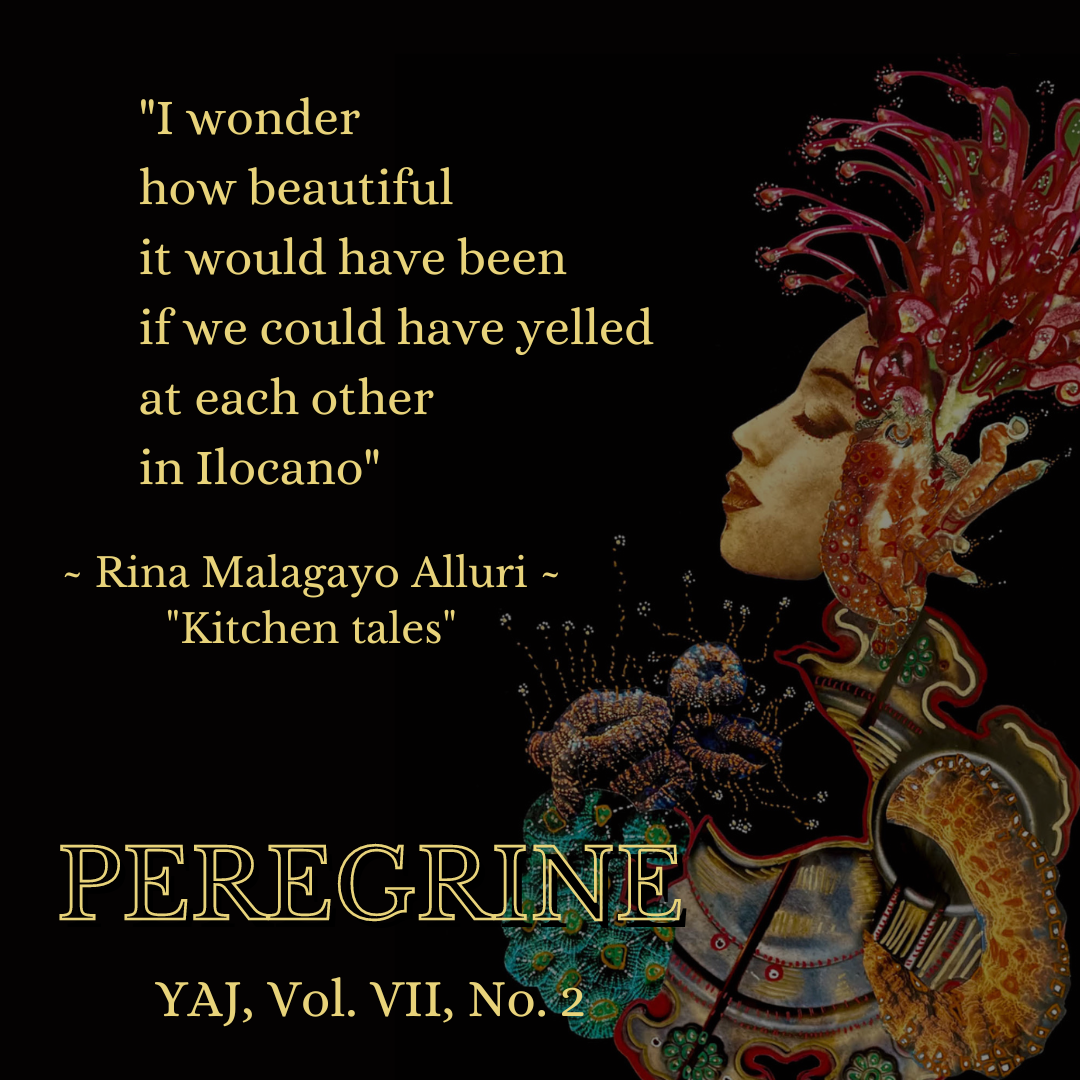
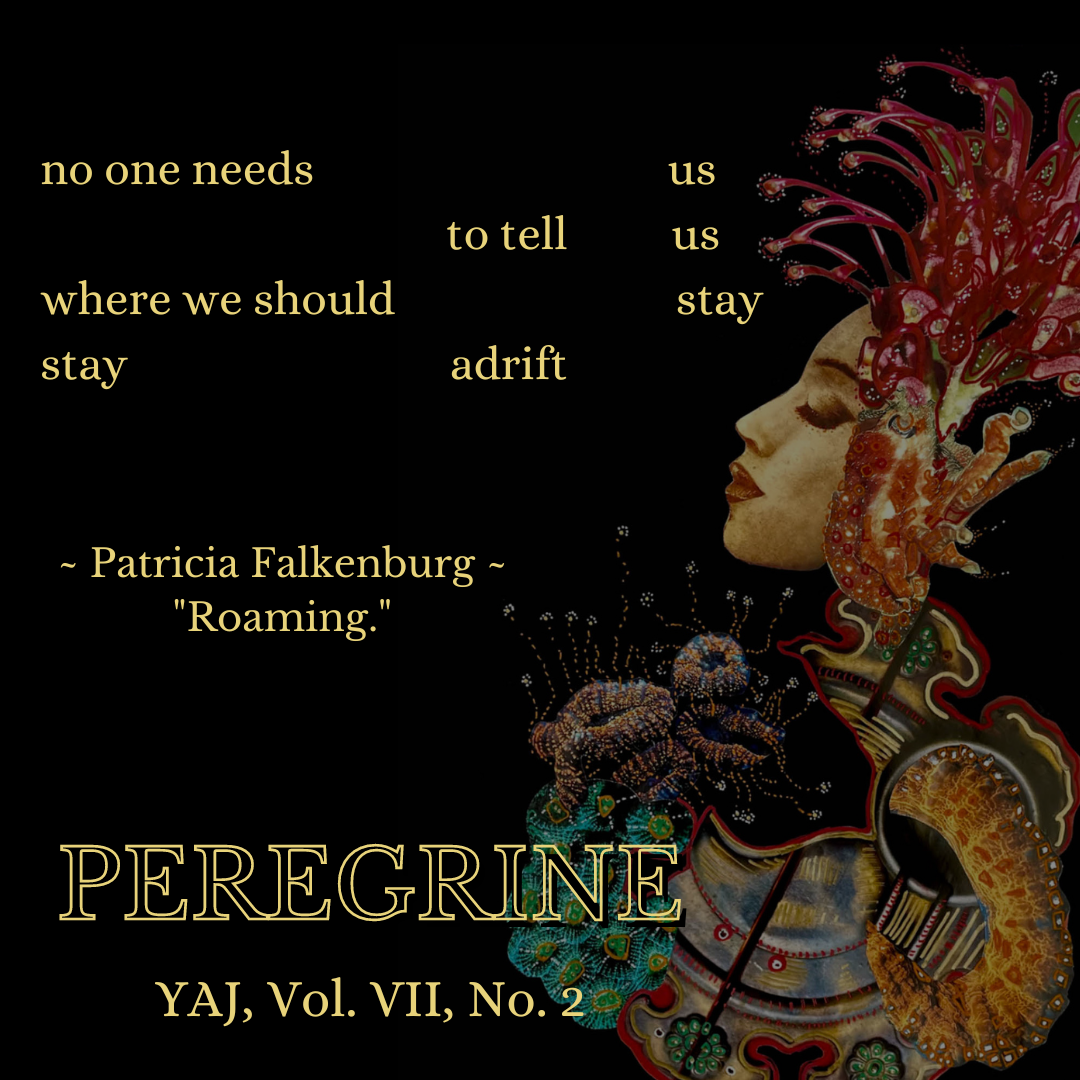
And there are just beautiful moments of wandering, like in Patricia Falkenburg’s poem “Roaming.” where the lines “no place / in midair / to stay / where we should / trust / come or go / on our own / wings only” invite us to fly away for a spell.
If you haven’t already had a chance to dive into this issue and really allow it to give you a nice warm hug, I hope that you will get a copy. From the cover to the last page, this issue really is a stunning exploration of what it means to be on this human journey.
Paperback and PDF versions are available from the Yellow Arrow bookstore. Discounts are also available (here) if you would like to purchase copies for friends and family (minimum purchase of five). You can also search for Yellow Arrow Journal on any e-book device or anywhere you purchase books, including Amazon and most other distribution channels. And don’t forget to join us for the reading of Fly to Me, Speak to Me: A PEREGRINE reading on December 15 at 8:00 pm EST; let us know you’re coming at fb.me/e/2uBha3laI.
Thank you to everyone who contributed to PEREGRINE and to the many wonderful submitters whose pieces we couldn’t fit into this issue. We look forward to seeing you on December 15.
Raychelle Heath holds a BA in languages from Winthrop University and an MFA in poetry from the University of South Carolina. She uses her poetry and her podcast to tell the multifaceted stories of black women in the world. Raychelle also explores her experiences with the culturally rich communities that she has encountered in her travels. Her work has been published by Travel Noire, Fourth Wave, Yellow Arrow Journal, The Brazen Collective, and Community Building Art Works. She currently works as curriculum director, sanctuary coach, and facilitator for the Unicorn Authors Club. She also regularly facilitates for The World We Want workshop.
*****
Yellow Arrow Publishing is a nonprofit supporting women writers through publication and access to the literary arts. We recently revamped and restructured its Yellow Arrow Journal subscription plan to include two levels. Do you think you are an Avid Reader or a Literary Lover? Find out more about the discounts and goodies involved at yellowarrowpublishing.com/store/yellow-arrow-journal-subscription.
You can support us as we AWAKEN in a variety of ways: purchase one of our publications from the Yellow Arrow bookstore, join our newsletter, follow us on Facebook, Instagram, or Twitter or subscribe to our YouTube channel. Donations are appreciated via PayPal (staff@yellowarrowpublishing.com), Venmo (@yellowarrowpublishing), or US mail (PO Box 102, Glen Arm, MD 21057). More than anything, messages of support through any one of our channels are greatly appreciated.
Reclaiming Language and Place: Yellow Arrow Journal (Vol. VII, No. 2) Peregrine
Raychelle Heath, guest editor of just released Yellow Arrow Journal Vol. VII, No. 2 PEREGRINE had a vision when she first began to formulate her ideas for the issue. She knew that she wanted to focus on illuminating and reclaiming languages, exploring authors’ personal connections with language and home. Something she understood all too well herself. Within the introduction of PEREGRINE, Raychelle writes:
“But it wasn’t until I began to read Lucille Clifton, Nikki Giovanni, and Alice Walker that the words I saw on the page sounded like me and the people around me. It was music that I could understand, and that invited me to participate. I wanted to show up on the page like they did.”
And just like the overarching idea, the issue’s theme—PEREGRINE—fit perfectly. According to Raychelle, “As a traveler myself, finding home in places of welcome, the word peregrine feels like it also applies to me, and to this broader human experience that we are all traveling through in one way or another.” The beautiful artwork on the cover by Daryle Newman (Instagram @daryle_shefloats) and the words within soar to new heights as those included explore language and their personal journeys through their individual voices.
Raychelle was an ANFRACTUOUS and UpSpring poet with her incredible poems “lineage” and “Before the War?” and was our December 2021 .W.o.W. author. She holds a BA in languages from Winthrop University and an MFA in poetry from the University of South Carolina. She uses her poetry and her podcast to tell the multifaceted stories of black women in the world. Raychelle also explores her experiences with the culturally rich communities that she has encountered in her travels. Her work has been published by Travel Noire, Fourth Wave, Yellow Arrow Journal, The Brazen Collective, and Community Building Art Works. She currently works as curriculum director, sanctuary coach, and facilitator for the Unicorn Authors Club. She also regularly facilitates for The World We Want workshop.
We are excited to release the latest issue of Yellow Arrow Journal and privileged to share the voices within. Paperback and PDF versions of PEREGRINE are now available from the Yellow Arrow bookstore. Discounts are also available (here) if you would like to purchase copies for friends and family (minimum purchase of five). You can also search for Yellow Arrow Journal on any e-book device or anywhere you purchase books, including Amazon and most other distribution channels.
Join us for Fly to Me, Speak to Me: A PEREGRINE reading on December 15 at 8:00 pm EST; let us know you’re coming at fb.me/e/2uBha3laI.
We hope you enjoy reading PEREGRINE as much as we enjoyed creating it. Thank you for your continued encouragement of Yellow Arrow Publishing and the women involved in PEREGRINE.
*****
Yellow Arrow Publishing is a nonprofit supporting women writers through publication and access to the literary arts. We recently revamped and restructured its Yellow Arrow Journal subscription plan to include two levels. Do you think you are an Avid Reader or a Literary Lover? Find out more about the discounts and goodies involved at yellowarrowpublishing.com/store/yellow-arrow-journal-subscription.
You can support us as we AWAKEN in a variety of ways: purchase one of our publications from the Yellow Arrow bookstore, join our newsletter, follow us on Facebook, Instagram, or Twitter or subscribe to our YouTube channel. Donations are appreciated via PayPal (staff@yellowarrowpublishing.com), Venmo (@yellowarrowpublishing), or US mail (PO Box 102, Glen Arm, MD 21057). More than anything, messages of support through any one of our channels are greatly appreciated.
Review of The Indomitable Florence Finch: The Untold Story of a War Widow Turned Resistance Fighter and Savior of American POWs by Robert J. Mrazek

Read Charity R. Bartley Howard review of The Indomitable Florence Finch: The Untold Story of a War Widow Turned Resistance Fighter and Savior of American POWs by Robert J. Mrazek, published in Yellow Arrow Journal’s Vol. V, No. 3 (Re)Formation issue (fall 2020). Information about where to find The Indomitable Florence Finch and (Re)Formation is below.
By Charity R. Bartley Howard
Florence Ebersole Finch (1915–2016) lived a fascinating and important life. The Indomitable Florence Finch: The Untold Story of a War Widow Turned Resistance Fighter and Savior of American POWs by Robert J. Mrazek is the true telling of the life of a hero many may not have heard of before. Florence Finch saved many American lives (prisoners of war or POWs) in the Philippines during World War II. The Americans were in the country starting in early 1942 to mid to late 1945. Their goal was to help the Filipino campaign against Japanese forces, to stop Japan from occupying the area. Now, with this engaging book, her story is finally being told. Florence was humble during and after the war, and her efforts were not for the sake of glory, but rather what she felt was necessary and right.
This is an exceptionally written biography about an exceptional person. Mrazek worked from personal journals, taped interviews, and other original sources. The information was compiled from the past experiences of an elderly woman who finally explained everything to her family only a few years before she died in 2016 at age 101. Born to a Filipina woman and an American serviceman in 1915, Florence was raised in the Philippines and married an American sailor, Charles Smith. She had worked for the U.S. Army in Manila in 1941 prior to the Japanese invasion of the Philippines; it is there she met her husband. Unfortunately, he would be killed in action in the Philippines in 1942, and she soon found herself a widow within the Japanese-occupied Philippines.
At the start of occupation, Florence had taken a job at the Philippine Liquid Fuel Distribution Union (controlled by the Japanese). For two years, this led her to slyly helping the Philippine resistance against the Japanese in many ways: diverting fuel shipments, falsifying documents, and obtaining supplies for POWs. In 1944, her actions were discovered; Florence was arrested, tortured, tried, and sentenced to three years of imprisonment. She remained in captivity until American troops liberated the Philippines in 1945.
Mrazek’s book does her justice. While at the beginning it might take readers some time to get into the story and stay with it, learning the background is important to knowing the full scope of Florence’s remarkable life and achievements. Readers are given vivid details as well as facts from her time during and before the war, creating a delightful read for those who appreciate history and learning about an unsung hero. Ultimately, this is a story of a remarkable woman all readers can admire. Florence was awarded the American Medal of Freedom in 1947 and was the first woman given the Asiatic-Pacific Campaign Ribbon. In 1995, the Coast Guard (who she worked for after the war) named a building on Sand Island in Hawai'i in her honor. Without her efforts, many family members would have lost their loved ones, making her sacrifices important.
Not all war heroes are on the frontlines or are known to us today. In The Indomitable Florence Finch, readers hear the account of one of these unknown heroes. Mrazek’s account is real without being overly violent, but accurately explains what happened. Readers journey in triumph and sadness, both through her war efforts and through her personal tragedies. It helps us understand what happened before us and the sacrifices people made that allow us to live the way we do today. Knowing about her and how she was selfless sets a good example of how we should care about as well as help others. Pertinent information given our current worldwide situation.
Florence lived an interesting and heart-breaking life, full of incredible bravery. Mrazek does a superb job of interweaving the historical narrative of World War II with Florence Finch’s personal life, into an engaging as well as emotional book. The Indomitable Florence Finch also relates an element of World War II many may not have much knowledge of, but will have a better understanding of, following this dramatic telling of Florence’s experiences. There are many other stories yet to tell of brave women, and men, throughout history. If you are interested in learning more about an unsung woman hero in history, this is a well-told story of Florence Finch’s brave efforts and strengths. It is an emotional story that was needed and done in a wonderful way. This is a must read for everyone.
A PDF of (Re)Formation is available in the Yellow Arrow bookstore or as a paperback or ebook through most online distributors. The Indomitable Florence Finch was published by Hachette Books (2020; 368 pages).
Charity R. Bartley Howard lives in central Indiana with her sons and husband. She enjoys time with them outside, camping and hiking. Her degrees are in English and journalism. There is always a book open in her house as she enjoys reading, and family reading time is important as well. Spare time also means editing as well as writing articles, stories, and poems.
*****
Yellow Arrow Publishing is a nonprofit supporting women writers through publication and access to the literary arts. We recently revamped and restructured its Yellow Arrow Journal subscription plan to include two levels. Do you think you are an Avid Reader or a Literary Lover? Find out more about the discounts and goodies involved at yellowarrowpublishing.com/store/yellow-arrow-journal-subscription.
You can support us as we AWAKEN in a variety of ways: purchase one of our publications from the Yellow Arrow bookstore, join our newsletter, follow us on Facebook, Instagram, or Twitter or subscribe to our YouTube channel. Donations are appreciated via PayPal (staff@yellowarrowpublishing.com), Venmo (@yellowarrowpublishing), or US mail (PO Box 102, Glen Arm, MD 21057). More than anything, messages of support through any one of our channels are greatly appreciated.
Yellow Arrow Journal (VII/02) Submissions are Now Open!
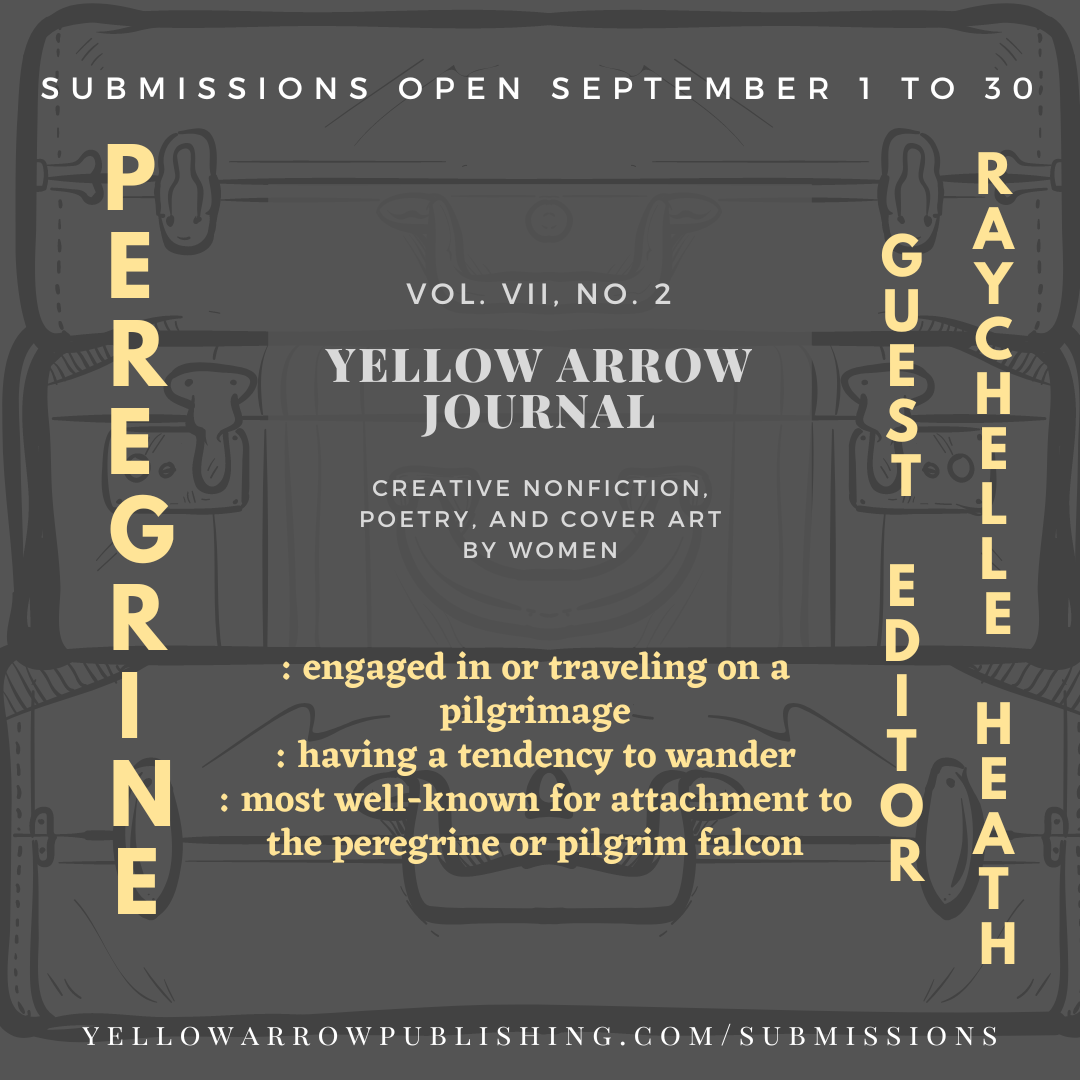
Yellow Arrow Publishing is excited to announce that submissions for our next issue of Yellow Arrow Journal, Vol. VII, No. 2 (fall 2022) is open September 1–30 addressing the overarching concept of illuminating language. Guest editor, Raychelle Heath states,
“From the moment we begin to speak we are also taught how to do it ‘correctly.’ We are given rules and protocols for how to present ourselves when we open our mouths. Without even realizing it, we are thrown into the task of code switching. One tongue for the playground, one tongue for the classroom, one tongue for speaking with our beloved abuelita Mexicana. One tongue to stay safe, one tongue to be daring, brave, to dismantle. For many of us, this code switching, this constant wrangling of words to fit into whatever space we find ourselves is our only way of knowing language. My proposition is we strip away those societal trappings that may, indeed, be holding our tongues hostage.”
This issue’s theme will be PEREGRINE
: engaged in or traveling on a pilgrimage
: having a tendency to wander
: most well-known for attachment to the peregrine or pilgrim falcon
And here are some guiding questions to help you consider what to write and what to submit:
1) What are the constituent parts of the words/language you love? Where did those parts come from? What do the sounds of those parts mean/evoke?
2) What words don’t exist in your language? What silences does that create? How does that effect how you connect with others? How does those words exist in other languages?
3) What does your language look like when it is untethered? When you allow it to wander? To dance with abandon on the page?
4) How does language illuminate our feelings? Our thoughts? Our beliefs? Is it possible to share these through different languages?
Yellow Arrow Journal is looking for creative nonfiction, poetry, and cover art submissions by writers/artists that identify as women, on the theme of PEREGRINE. Submissions can be in any language as long as an English translation accompanies it. For more information regarding journal submission guidelines, please visit yellowarrowpublishing.com/submissions. Please read our guidelines carefully before submitting. To learn more about our editorial views and how important your voice is in your story, read About the Journal. This issue will be released in November 2022.

PEREGRINE’s guest editor, Raychelle Heath, an ANFRACTUOUS and UpSpring poet with her incredible poems “lineage” and “Before the War?” and our December 2021 .W.o.W. author, holds a BA in languages from Winthrop University and an MFA in poetry from the University of South Carolina. She uses her poetry and her podcast to tell the multifaceted stories of black women in the world. Raychelle also explores her experiences with the culturally rich communities that she has encountered in her travels. Her work has been published by Travel Noire, Fourth Wave, Yellow Arrow Journal, The Brazen Collective, and Community Building Art Works. She currently works as curriculum director, sanctuary coach, and facilitator for the Unicorn Authors Club. She also regularly facilitates for The World We Want workshop. We are excited to work with Raychelle over the next few months.
The journal is just one of many ways that Yellow Arrow Publishing works to support and inspire women through publication and access to the literary arts. Since its founding in 2016, Yellow Arrow has worked tirelessly to make an impact on the local and global community by advocating for writers that identify as women. Yellow Arrow proudly represents the voices of women from around the globe. Creating diversity in the literary world and providing a safe space is deeply important. Every writer has a story to tell, every story is worth telling.
*****
Yellow Arrow recently revamped and restructured its Yellow Arrow Journal subscription plan to include two levels. Do you think you are an Avid Reader or a Literary Lover? Find out more about the discounts and goodies involved at yellowarrowpublishing.com/store/yellow-arrow-journal-subscription. Yellow Arrow Publishing is a nonprofit supporting women writers through publication and access to the literary arts.
You can support us as we AWAKEN in a variety of ways: purchase one of our publications from the Yellow Arrow bookstore, join our newsletter, follow us on Facebook, Instagram, or Twitter or subscribe to our YouTube channel. Donations are appreciated via PayPal (staff@yellowarrowpublishing.com), Venmo (@yellowarrowpublishing), or US mail (PO Box 102, Glen Arm, MD 21057). More than anything, messages of support through any one of our channels are greatly appreciated.
Review of Landing on Your Feet and Putting Down Roots by Sherry Burton Ways

Reread Kara Panowitz’s review of Landing on Your Feet and Putting Down Roots: 21 Rituals to Transform Your Life and Interior Space by Sherry Burton Ways, published in Yellow Arrow Journal’s Vol. V, No. 2 HOME issue (summer 2020). Information about where to find Landing on Your Feet and Putting Down Roots and HOME is below.
By Kara Panowitz
When my friend, Holly, read the opening to Yellow Arrow Publishing’s first Reading Club book selection, Landing on Your Feet and Putting Down Roots: 21 Rituals to Transform Your Life and Interior Space, she started crying. “This is me,” she said. “I could have written this.” The book opens with author Sherry Burton Ways sharing her personal experience with a relationship ending in divorce. This sets the stage for the book itself: how to transform your physical space, and yourself, after major life transitions. Burton Ways’ honesty and openness create a space of trust and relatability. Her recognition that it can feel daunting or too expensive to make transformations during significant life changes brings comfort, and her story demonstrates that no space is too small to create a refuge or a home. In her own words, Burton Ways’ goal for writing this book is to show readers “how their interior design can assist them with additional support.”
Burton Ways’ explanation that “interior design is not decorating” is a theme that carries throughout the rituals she presents. The biggest lesson I took away was that home is not just a physical space and group of objects, but the rituals and aspects of your life you bring to it and how they all connect together. The 21 rituals presented include some that might be expected, like rearranging furniture, selecting interior colors, and creating vision boards. Others I found less expected, such as the ritual of bathing and loving yourself through environment and crystal energy. Finally, there were rituals completely new to me, like Wabi-sabi.
One of the most useful and most accessible things about the book is that it presents actions you can take immediately or in the near future, which you can continue daily or just once in a while. You make it work for you. Burton Ways’ 21 rituals also come with tips and ideas, taking the abstract to the specific. There is something for everyone in this book and it may make you look at something you hadn’t really considered, or perhaps thought wasn’t for you, in a new way.
The rituals explored in Landing on Your Feet and Putting Down Roots also give new ideas for, and new meaning to, rituals you may already perform. The ritual of music and dance spoke to me the most. Why don’t I listen to music and dance more? I love both, and I can influence the mood and energy in my home through what I choose to listen to, and how I groove to it. Burton Ways’ descriptions made me think of music and dance affecting and permeating my space, spreading through the air and seeping into the walls (I danced that night!). She addresses the physical space by suggesting that readers create open space for dance and carry music into that physical space by displaying artwork that depicts music or even instruments.
Additionally, I enjoy the ritual of cooking but don’t always want to do it or give much thought to the process. When I read about it in the book, it brought new mindfulness and value to meal preparation and my place in it. Burton Ways writes,
“Cooking is an interior abundance ritual that can relieve stress and give your life a sense of purpose during major life transitions. Meal preparation allows you to have control over your life and express yourself . . . [and] is an anti-stress exercise because the process of cooking activates the senses that have been numbed.”
I thought about cooking in a new way, in terms of how it influences and spreads throughout my space, similar to music.
Burton Ways includes personal experiences by other women, intended for readers “to see [themselves] in this process.” These candid and insightful stories illuminate how rituals can be used in transitions, including divorce, death, a new career, and even constant change due to housing insecurity. It reaffirms that you can choose and adjust your rituals for any situation, and that something as small as a handheld rock can bring comfort and consistency during transitions. Burton Ways also shares examples from clients she has worked with that demonstrate the implementation of her rituals in an array of spaces. The stories are inspirational and a highlight of the book.
As I read Landing on Your Feet and Putting Down Roots, I felt like Burton Ways was a friend, mentor, and coach, and that we were blessed to have a visit from her for Yellow Arrow’s Reading Club. This author has many talents and a diverse array of expertise: she is an award-winning author, trainer, and speaker, and holds several certifications such as Certified Design Psychology Coach, Certified Graceful Lifestyles Consultant, and Certified Interior Environment Coach. Her passion for her work is evident in the guidance she shares on her pages.
This was a perfect book for Yellow Arrow's first Reading Club session because Yellow Arrow House in Baltimore, Maryland had just opened, and one of the primary missions of Yellow Arrow is to create a safe, welcoming refuge that feels like home, within the House and within workshops and events. The timing was also serendipitous for me because I was living alone in a new apartment and was ready to embrace transition. I immediately made changes to my space and life after reading the book and continue to revisit her words for reminders and ideas on how to implement her 21 rituals.
Finally, as I wrote this review, the COVID-19 pandemic forced everyone to spend a lot more time at home, and I began to use the rituals to ease anxiety and keep creativity flowing. That’s one of the greatest gifts of Sherry Burton Ways’ book. You can always revisit it to change your space and your life in small or big ways. Like life, changes are not always permanent. No matter what your reason for transforming your space and life, Landing on Your Feet and Putting Down Roots will speak to you and encourage you to find rituals to comfort and support yourself during times of transition.
PDF copies of HOME are available in the Yellow Arrow bookstore, and paperback and electronic versions are available through most online distributors. Landing on Your Feet and Putting Down Roots was published by FriesenPress (2017; 112 pages).
Kara Panowitz thrives on creating through writing, theatre, photography, and filmmaking, among other arts. She received both her BA in Theatre and her MA in Social Work from the University of Maryland. Kara works for an anti-hunger nonprofit and is the acting Executive Director of Megaphone Project. Previously, she has been a Peace Corps Volunteer in Madagascar, a Special Ed and ESL teacher in Baltimore, Maryland, and a bartender in Australia.
******
Yellow Arrow recently revamped and restructured its Yellow Arrow Journal subscription plan to include two levels. Do you think you are an Avid Reader or a Literary Lover? Find out more about the discounts and goodies involved at yellowarrowpublishing.com/store/yellow-arrow-journal-subscription. Yellow Arrow Publishing is a nonprofit supporting women writers through publication and access to the literary arts.
You can support us as we AWAKEN in a variety of ways: purchase one of our publications from the Yellow Arrow bookstore, join our newsletter, follow us on Facebook, Instagram, or Twitter or subscribe to our YouTube channel. Donations are appreciated via PayPal (staff@yellowarrowpublishing.com), Venmo (@yellowarrowpublishing), or US mail (PO Box 102, Glen Arm, MD 21057). More than anything, messages of support through any one of our channels are greatly appreciated.
Illuminating the Layers of Language and Shining a Light into Our Words
Yellow Arrow Publishing would like to announce the next guest editor for Yellow Arrow Journal, Raychelle Heath. Raychelle will oversee the creation of our Vol. VII, No. 2 issue. Mark your calendar! Submissions open September 1 and the issue will be released in November.
This next issue of Yellow Arrow Journal will be on the overarching concept of illuminating language. To learn more about this idea, read Raychelle’s words below. Yellow Arrow staff just finished voting on the issue’s theme, which will be released next week!
Raychelle was an ANFRACTUOUS and UpSpring poet with her incredible poems “lineage” and “Before the War?” and was our December 2021 .W.o.W. author. She holds a BA in languages from Winthrop University and an MFA in poetry from the University of South Carolina. She uses her poetry and her podcast to tell the multifaceted stories of black women in the world. Raychelle also explores her experiences with the culturally rich communities that she has encountered in her travels. Her work has been published by Travel Noire, Fourth Wave, Yellow Arrow Journal, The Brazen Collective, and Community Building Art Works. She currently works as curriculum director, sanctuary coach, and facilitator for the Unicorn Authors Club. She also regularly facilitates for The World We Want workshop.
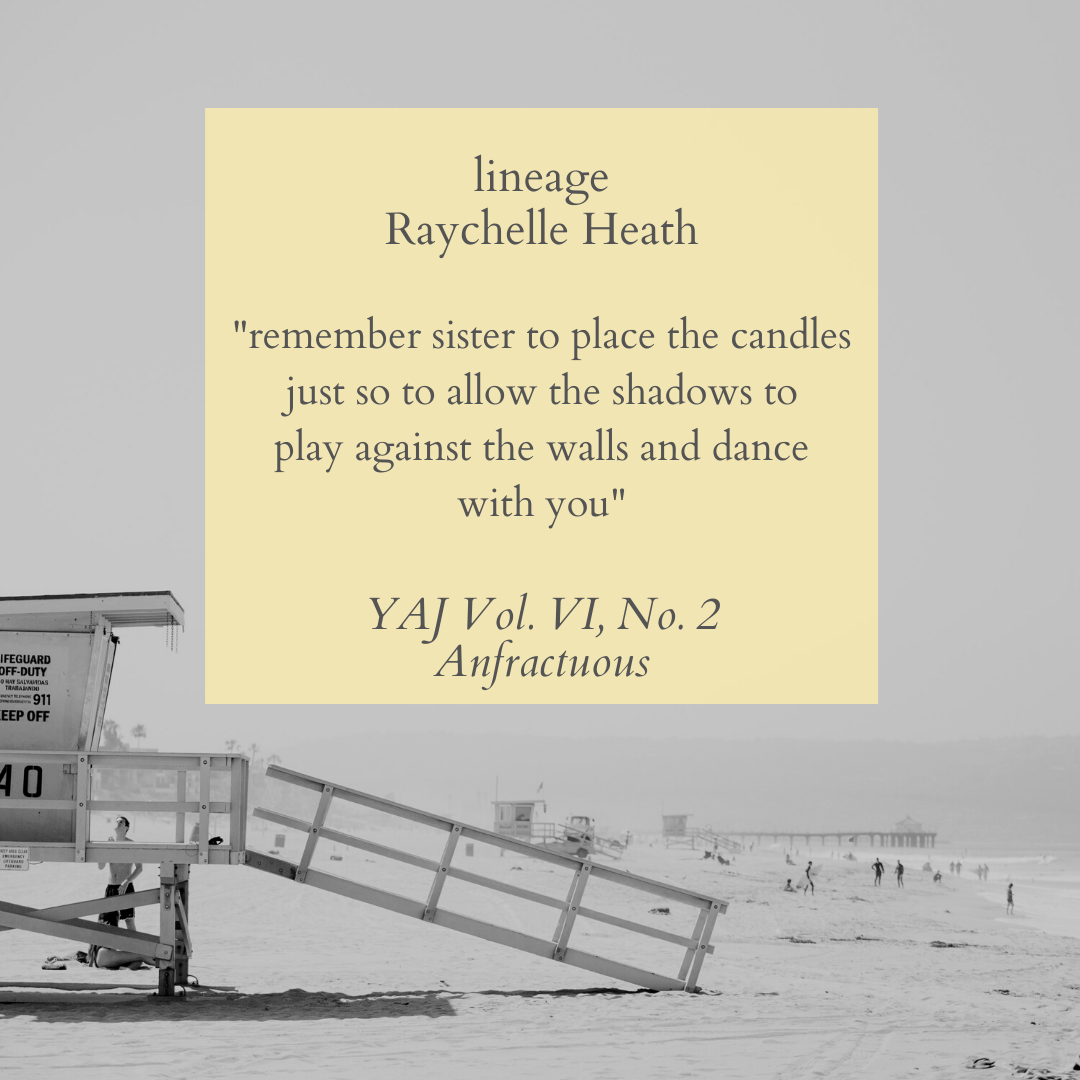
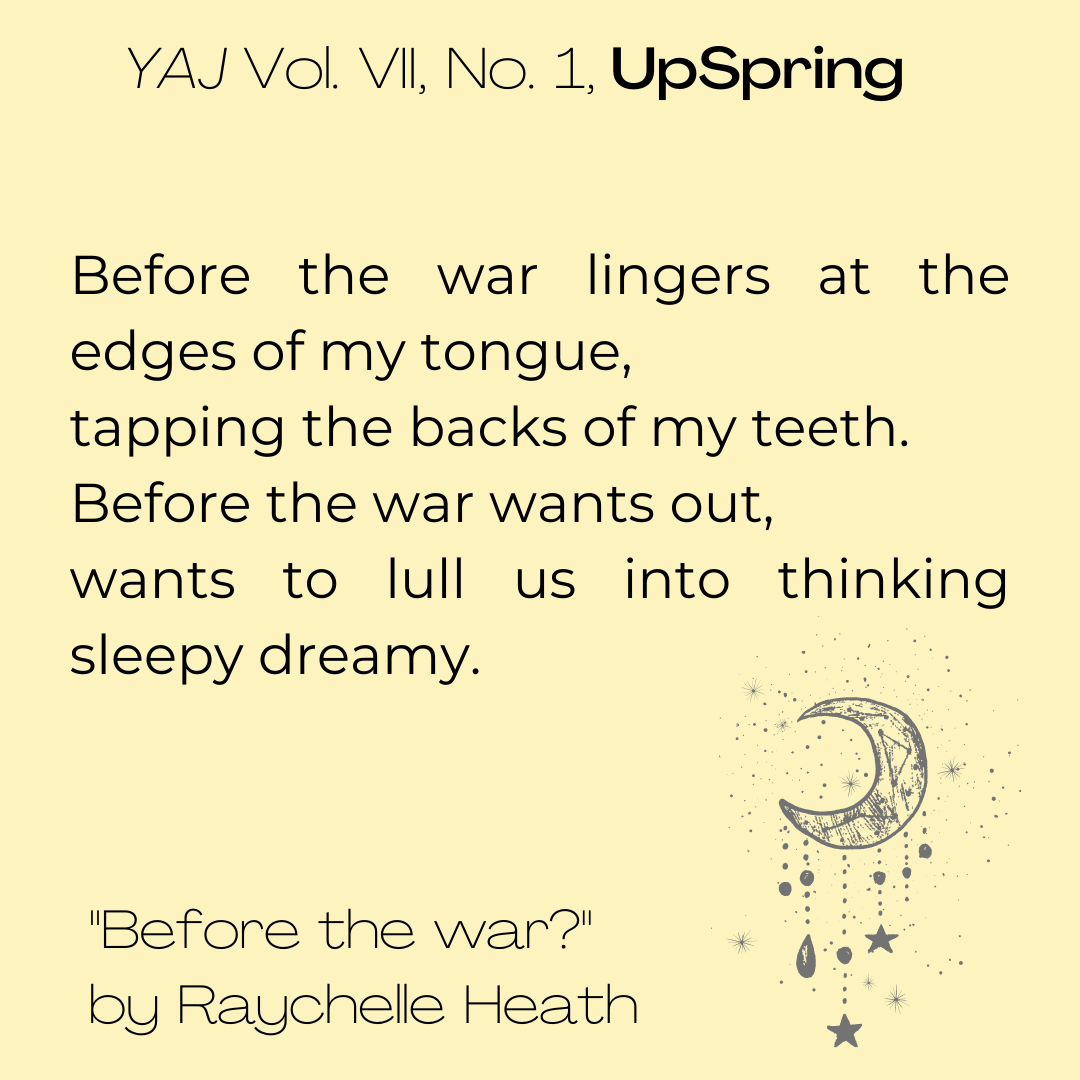
Find out more about Raychelle at https://sites.google.com/view/theraychelleheath/.
Please follow Yellow Arrow on Facebook and Instagram for the theme announcement. Below, you can read more about Raychelle’s perspectives on illuminating languages. We look forward to working with Raychelle over the next few months.
By Raychelle Heath
In her essay “Language is Migrant,” Cecilia Vicuña writes, “Language is migrant. Words move from language to language, from culture to culture, from mouth to mouth. Our bodies are migrants, cells and bacteria are migrants too. Even galaxies migrate.”
From the moment we begin to speak we are also taught how to do it “correctly.” We are given rules and protocols for how to present ourselves when we open our mouths. As a little black girl growing up in the south, I knew there was a way to speak when I was home and when I was out in public. Without even realizing it, I was thrown into the task of codeswitching as a means of survival. There was one tongue I could use on the playground and when I was running wild with my cousins; we could use “ain’t,” “y’all,” and shorten words to “comin’” and “goin’” without fear of consequence. We could try on language we heard in music and on TV. But when we were back in school or in mixed company, our tongues got buttoned up. And as I moved into adulthood, I realized that even my southern accent was a marker for some people. I felt the double-edge of so-called compliments like “well-spoken.”
But language was also a place of freedom and exploration for me. A place where I could create new connections and understandings of the world. At the age of 13, I began learning Spanish and German. I poured myself into cultural study and deep listening. I wanted to fall into the way different people curled their tongues around words like “pan” and “vielleicht.” I wanted to understand how sounds reflected place, reflected time, reflected how we love and how we hold space for each other. And somewhere along the way, my tongue, my words, got free.
Then in 2007, I made a decision that would change my life forever. I left the United States to go live in the Marshall Islands. It was my first time living outside of the only country I had ever called home. And for the next two years, I would live and work in the city of Majuro, the capital of a remote string of atolls in the Pacific Ocean. I would learn the meaning of “aelin” and “enno.” I would fall in love with words like “emman” and “enana.” Their sounds, as much as their meanings, allowed me a way in to understand my new home, and the people who had welcomed me in with “yokwe.”
“Yokwe” means hello, but it can also mean care, and its direct translation is “I love you; you are a rainbow.” It is still one of my favorite words because of all that it does. And learning it allowed me to recognize sayings from my own southern roots that hold multitudes. Sayings like “you hungry” or “bless your heart” that hold so much care, but also call a person in. Or “sweet summer child” that feels so warm but also gives you a little tap on the head. These touchstone words and phrases lay a path for how I connect to the world and others around me. They lay a path for how I see the world and my place in it.
I currently call Costa Rica home, and their version of this is “pura vida.” Pura vida directly translates to pure life. However, it is used to say hello, goodbye, and even “oh well,” depending on the day. And I think that there couldn’t be a more fitting touchstone for a place where it is not an uncommon occurrence to see a toucan or a monkey, and there are cloud forests to explore. Where there is a constant reminder of the pure life that we can have by honoring the Earth that provides for us.
Language’s primary aim is to communicate, but the ways that words do so are layered. There is a richness that lives inside of each word and each phrase that we use. Toward the end of Cecilia’s essay she says, “Language is the translator. It could translate us to a place where we cease to tolerate injustice, abuse and the destruction of life. Life is language.” She then quotes the Kaushitaki Upanishad saying, “When we speak, life speaks.”
Language has the power to illuminate life. It has the power to speak the things that we love the most into existence, even when they aren’t physically there. I can speak the name of my grandmother and call her into the room. I can speak my freedom, even when the world feels oppressive. And when I let my language be completely free, I can illuminate the best and most authentic parts of myself and my culture. And language itself can be illuminated, looking at the constituent parts of words to layer meaning. Cecilia does this beautifully when she says, “I imagined ‘migrant’ was probably composed of mei, (Latin), to change or move, and gra, ‘heart’ from the Germanic kerd. Thus, ‘migrant’ became: ‘changed heart,’ a heart in pain, changing the heart of the earth. The word ‘immigrant’ really says: ‘grant me life.’”
Each day I get to meet the page and explore what my words really want to say is a gift. It is a gift to be able to let our unique sounds speak for us, to explore the fullness of their layers. It is a gift to illuminate our words and play in their depths. It is a gift to let our language dance and be free. I am grateful for all the languages that hold me, for all of the languages that have received me. And I invite us all to dig a little deeper, to strip away any societal trappings that may be holding our tongues hostage, and to notice what language flows from the heart.
*****
Yellow Arrow recently revamped and restructured its Yellow Arrow Journal subscription plan to include two levels. Do you think you are an Avid Reader or a Literary Lover? Find out more about the discounts and goodies involved at yellowarrowpublishing.com/store/yellow-arrow-journal-subscription. Yellow Arrow Publishing is a nonprofit supporting women writers through publication and access to the literary arts.
You can support us as we AWAKEN in a variety of ways: purchase one of our publications from the Yellow Arrow bookstore, join our newsletter, follow us on Facebook, Instagram, or Twitter or subscribe to our YouTube channel. Donations are appreciated via PayPal (staff@yellowarrowpublishing.com), Venmo (@yellowarrowpublishing), or US mail (PO Box 102, Glen Arm, MD 21057). More than anything, messages of support through any one of our channels are greatly appreciated.
Behind the Issue: UpSpring (Yellow Arrow Journal, Vol. VII, No. 1)

By Rebecca Pelky

When the Editor-in-Chief of Yellow Arrow Publishing, Kapua Iao, first contacted me about possibly guest-editing Yellow Arrow Journal, Vol. VII, No. 1, UpSpring, available in the Yellow Arrow bookstore and from most online distributors, I was humbled and a little overwhelmed. It was right at the beginning of a new semester, and the issue would be released near the end of the same semester. Did I have time to give this the attention it deserved in between teaching and planning and that book chapter also due in May and that book I should be writing and all those meetings and emails? And yet. While I love my job teaching film and creative writing to STEM students, I’ve also been mostly without a writing community for the first time in years. I couldn’t resist this opportunity to feel like a part of a community again, and I’m so glad now that I agreed. Kapua has been wonderful to work with while keeping me on track to meet my deadlines, which I desperately needed! The rest of the staff and volunteers have been generous and thoughtful readers. Leading a workshop for Yellow Arrow called “Writing the Archive” also helped me feel connected again to some fantastic people and writers. I’m thankful for these opportunities and how they helped me grow in new ways.

I’m proud of what UpSpring has become, and I hope we’ve created something that the contributors will be proud of as well. Although editors certainly act as gatekeepers, there’s a way in which an issue of a literary journal grows beyond the choices we make, or maybe it’s better to say each new choice is informed by all the other choices that we’ve made in reading, and those that the contributors have made in writing and submitting. It reminds of these lines from Liane St. Laurent’s poem, “in which I die, become a bird-tree,” in which she writes, “I know a word the way a word knows / water, the way water finds its shape, / becomes what it wants.” At the end of the process of putting together a journal, when it works, it feels like water finding its shape, like the issue has become what it wanted to be.

The pieces in UpSpring vary widely in their interpretations of the theme, and it’s what I love most about them. No two contributors envision those moments of change and bloom in exactly the same way. They consider how we support each other through those moments or the ways that we survive them or celebrate them alone, as in Vanesha Pravin’s, “Olive Oil, Sumac & Harissa,” “Oh, Honey, / happily, you can survive: / Saturday night alone / again with the coyotes / yipping, the damn stove / knob still broken.” They offer insight on motherhood or all the upsprings that happen to girls in their formative years. They mediate on upsprings in metaphors of plants and dirt and roadkill and space. The word upspring implies joy, I think, new life, beginnings, and this issue is rightly filled with those. However, it’'s also true that upsprings emerge out of grief, illness, or trauma. And so we celebrate and commiserate, we encourage and support, we welcome these upsprings in all of their forms.
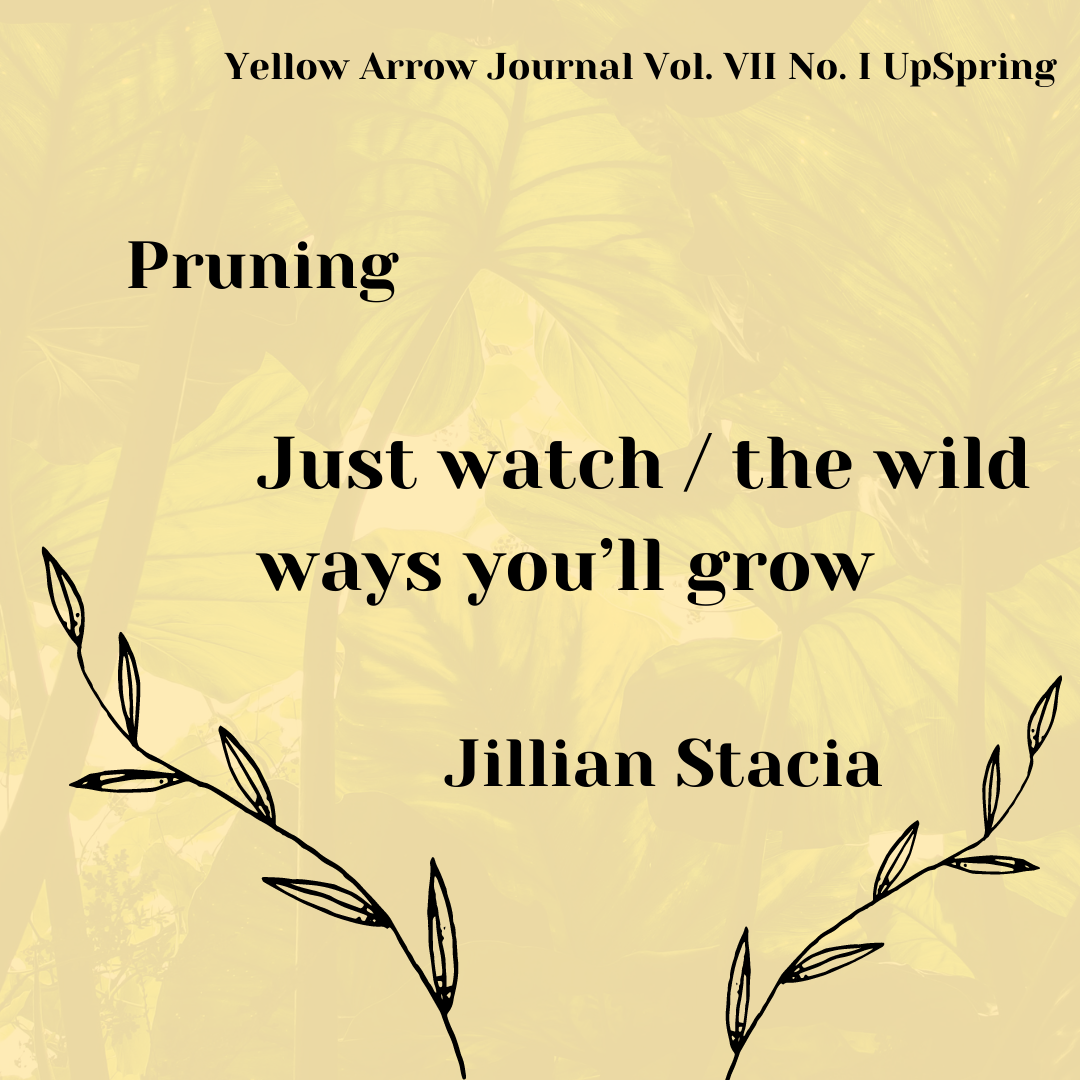
What I keep coming back to, in the end, are these last lines from Jillian Stacia’s poem, “Pruning”: “Just watch / the wild ways you’ll grow.” I think about those lines often, the way any great words stay with you—the way they settle themselves into your knowing. That’s also what it feels like to put together an issue of a literary journal, sort of. You can’t know exactly what it’s going to grow into, but after the process of reading hundreds of amazing submissions and narrowing and fitting and losing and gaining pieces, in the end, all you can say with awe is, “Wow, look at the wild ways you grew.”
Paperback and PDF versions are available from the Yellow Arrow bookstore. Discounts are also available (here) if you would like to purchase copies for friends and family (minimum purchase of five). You can also search for Yellow Arrow Journal on any e-book device or anywhere you purchase books, including Amazon and most other distribution channels. And don’t forget to join us for the reading of “Moments in Time: An UpSpring Reading” on June 28 at 7:00 pm EST. More information is forthcoming, but you can let us know that you plan on supporting contributors here.
Thank you to everyone who contributed to UpSpring, and to the many wonderful submitters whose pieces we couldn’t fit into this issue. It was a pleasure working with all of you, even if in very small ways. I hope you find words in this issue that settle into you like Jillian Stacia’s have for me. I hope you find within it many more wild ways to grow.
****
Yellow Arrow recently revamped and restructured its Yellow Arrow Journal subscription plan to include two levels. Do you think you are an Avid Reader or a Literary Lover? Find out more about the discounts and goodies involved at yellowarrowpublishing.com/store/yellow-arrow-journal-subscription. Yellow Arrow Publishing is a nonprofit supporting women writers through publication and access to the literary arts.
You can support us as we AWAKEN in a variety of ways: purchase one of our publications from the Yellow Arrow bookstore, join our newsletter, follow us on Facebook, Instagram, or Twitter or subscribe to our YouTube channel. Donations are appreciated via PayPal (staff@yellowarrowpublishing.com), Venmo (@yellowarrowpublishing), or US mail (PO Box 102, Glen Arm, MD 21057). More than anything, messages of support through any one of our channels are greatly appreciated.
Pivotal Moments: Yellow Arrow Journal (Vol. VII, No. 1) UpSpring
As Rebecca Pelky, guest editor of Yellow Arrow Journal Vol. VII, No. 1, UpSpring, made final decisions about the just released issue, she understood that an upspring for one person does not happen or resolve as it could or would for someone else. One moment in time more than likely means something different to everyone involved. This is why rather than focus on solely happy upsprings, the chosen pieces within the journal issue offer poignant, unique interpretations of what the theme means:
Some [pieces] focus on that thrilling moment of fruitfulness in which an upspring occurs, while others remind us that some upsprings happen only after or because of desperately difficult times. Any act of creation is necessarily tumultuous, so in these pages we celebrate while we also recognize and commiserate with all that birth and life and love entail, as only women can.
With this thought, we are thrilled to release UpSpring, the latest issue of Yellow Arrow Journal. We are privileged to share the voices within and on the cover. Thank you for supporting us and our authors and artists, and we hope you consider how your own pivotal moments, your own upsprings, reflect those explored within the journal.
The issue features Heather Brown Barrett, Sarah Helen Bates, Kamella Bird-Romero, Emma Bishop, Julia Burke, Zorina Exie Frey, Joyce Hayden, Raychelle Heath, Jericho M. Hockett, Whitney Hudak, Julia Hwang, Karen Kilcup, Merie Kirby, Ren Pike, Vanesha Pravin, Darah Schillinger, Kay Smith-Blum, Jillian Stacia, Liane St. Laurent, Jaime Warburton, Elyse Welles, Kory Wells, and Beth Winegarner. You can learn more about the beautiful cover art, “Spiritual Journey,” and how it reflects an upspring of our cover artist, April Graff, at yellowarrowpublishing.com/news/upspring-cover-reveal-spiritual-journey.
Rebecca was one of Yellow Arrow’s ANFRACTUOUS poets with her incredible piece “Nuhpuhk’hqash Qushki Qipit (Braids).” She holds a PhD from the University of Missouri, an MFA from Northern Michigan University, and is an Assistant Professor of Film Studies at Clarkson University. She is a member of the Brothertown Indian Nation of Wisconsin and a native of Michigan’s Upper Peninsula. Through a Red Place, her second poetry collection and winner of the 2021 Perugia Press Prize, was released in September 2021. Her first book, Horizon of the Dog Woman, was published by Saint Julian Press in 2020.
Paperback and PDF versions are now available from the Yellow Arrow bookstore. Discounts are also available (here) if you would like to purchase copies for friends and family (minimum purchase of five). You can also search for Yellow Arrow Journal on any e-book device or anywhere you purchase books, including Amazon and most other distribution channels.
On June 28, please join Rebecca and our authors for the live and virtual “Moments in Time: An UpSpring Reading.” More information is forthcoming, but you can let us know that you plan on supporting contributors here.
We hope you enjoy reading UpSpring as much as we enjoyed creating it. Congratulations to Rebecca for all her hard work. Thank you to the Yellow Arrow team for their diligence and thoughtful comments during the editing process. Cover design is by Alexa Laharty; editing is by Isabelle Anderson, Angela Firman, Siobhan McKenna, Ann Quinn, Piper Sartison, and Rachel Vinyard. And thank you for your continued encouragement of Yellow Arrow Publishing and the women involved in UpSpring.
*****

Yellow Arrow recently revamped and restructured its Yellow Arrow Journal subscription plan to include two levels. Do you think you are an Avid Reader or a Literary Lover? Find out more about the discounts and goodies involved at yellowarrowpublishing.com/store/yellow-arrow-journal-subscription. Yellow Arrow Publishing is a nonprofit supporting women writers through publication and access to the literary arts.
You can support us as we AWAKEN in a variety of ways: purchase one of our publications from the Yellow Arrow bookstore, join our newsletter, follow us on Facebook, Instagram, or Twitter or subscribe to our YouTube channel. Donations are appreciated via PayPal (staff@yellowarrowpublishing.com), Venmo (@yellowarrowpublishing), or US mail (PO Box 102, Glen Arm, MD 21057). More than anything, messages of support through any one of our channels are greatly appreciated.
A Spiritual Journey: Yellow Arrow Journal, Vol. VII, No. 1, UpSpring

By Annie Marhefka
I met April Graff, the cover artist of Yellow Arrow Journal, UpSpring (Vol. VII, No. 1) decades ago, but it’s been almost 20 years since I’ve spoken with her. Her husband, Monnie, and my older brother were dear friends and worked together as machinists for many years. My brother passed away in 2003 in a car accident on his way home from a shift working with Monnie; they were also greatly impacted by his death. I have this memory of April after my brother’s memorial service that has stuck with me all this time. I think of it whenever I think of her.
After the service, we had gone back to my parents’ house and everyone was standing in the kitchen sharing memories of my brother, and we were just talking about what you talk about at those things—how sudden it was, how shocked we were, how we couldn’t comprehend it just yet. My father in particular was really struggling and I remember watching him grip the kitchen counter and thinking it was the only thing holding him up.
It was right between Thanksgiving and Christmas and there was constant holiday music playing in the background. April started singing along quietly to “O Holy Night” and her voice was just incredible. She wasn’t showing off or looking for attention; it actually seemed like she couldn’t help herself but sing along, like maybe she didn’t even realize she was singing out loud. She was sitting on a barstool across the kitchen counter from my father and when my father heard her voice, he stood upright and asked everyone in the room to quiet down a little. Everyone went silent, including April. My father nodded in her direction and asked her to sing again. When you’re at an event like that, you never really know what you can say or do to help, and I could tell that April was shy or insecure about singing because she hesitated, but I think she also felt like, if this was what he needed, if this was what she could offer, she would do it for him. So despite her hesitation, she sang for him.
I think my father asked her to sing that song five or six times that night and every time, she obliged. Every time, the room went silent, and we just got wrapped up in her voice, the artistic flair she started weaving into the lyrics and the melody. It felt a little like we were watching her grow in her confidence and expand her creativity as the night went on. I don’t remember much about that night, the speeches people gave, or the condolences offered. But I’ll never forget April singing.
And now, almost 20 years later, April’s artwork, "Spiritual Journey," is featured on the cover of Yellow Arrow Journal Vol. VII, No. 1, UpSpring. Guest edited by Rebecca Pelky, a member of the Brothertown Indian Nation of Wisconsin and a native of Michigan’s Upper Peninsula. Some of the pieces in this issue focus on that thrilling moment of fruitfulness in which an upspring occurs while others remind us that some upsprings happen only after or because of desperately difficult times. “Spiritual Journey” fits into the latter.
I had the honor of interviewing April about her painting and where she is now after her own spiritual journey. She probably didn’t realize at the time how much she helped my family that night, and so to see April finding her voice in this new way, through painting, gives me so much hope that she can continue to use her story and her creativity to inspire and lift others. Here is my conversation with April.
Annie: Tell our Yellow Arrow community a little about yourself and your artwork.
April: I live with my two kids and my husband, Monnie, and our two fur babies in Westminster, Maryland. I have always been into the arts of all sorts—dancing, singing, drawing, painting. I found my love for painting while watching Bob Ross when I was a kid. To this day, he’s still soothing to me. That was where my love for painting started; I loved how it calmed me. I could even fall asleep watching his show!
I am seven years sober—will be eight years in November. When I went into my recovery, I was looking for things to help me cope other than the normal things people run to. My husband got me an art set and an easel because he knew I used to love painting. He got me the basics: little canvases, some oil paints, and an acrylic set. I had never worked with acrylic but started experimenting. I shared some pictures of what I made, and people started asking me for pieces. I wasn’t charging anything initially; I just loved the idea of having my art in people’s homes. Once the supplies started getting more expensive, I decided to start charging and that’s helped me try out different styles and techniques. The painting I did for UpSpring started out as an experiment, but I was feeling all the things that day and it all comes out on the canvas. It’s how I cope with everyday life. I was told to journal, but I can’t organize my thoughts enough. Painting is how I journal. Many people can’t interpret what I was feeling at the time, but I can look at a painting I made, and I can see exactly what I was feeling at that time. I love that no painting ever turns out the same.
Annie: Our theme for this issue of Yellow Arrow Journal is UpSpring. We received so many amazing pieces of writing from readers who connected with this theme. What does the theme mean to you?
April: Every dark place I was in, I’ve always reached out to the light, and you see that through the elements of darkness and light in the painting. I remember being at the rock bottom of my addiction and crying and wondering, why can’t I get out of this, why am I like this. [But], I want[ed] to see my kids grow, I want[ed] to get out of this dark place. Where the painting passes and connects and intertwines, I know that [that] is where I reached my rock bottom. I had lost all of me. Where it passes through is my spirit reaching back through to the person that I used to be, to become even better than the person I was once before. Through my journey of recovery, I found a peace I never knew before. I was always trying to overcome my environment; I was battling every day to not be a product of my environment. I fought hard to get out of that. I think you can see that when you look at the painting.
Annie: Our guest editor for this issue, Rebecca Pelky, also shared how she connected the theme to the idea of raising up: raising children, raising ourselves, raising awareness. What causes do you hope to raise awareness about?
April: There is a purpose for every one of us. I feel like my art is reaching out to other people to pull them in. Through sharing my experience, it’s so tough to see others struggling with addiction and suffering, I feel so helpless sometimes. But to know that I have helped other people is worth how tough it is—I’ve led others to recovery, helped people understand why their loved ones are addicted or that they have no control, that it has nothing to do with not loving them enough. In a way, my paintings are an extended hand, trying to pull other people up with me.
Annie: What does it mean to you to be able to share your art with others in this way? Who are you most excited to share your art with?
April: It’s always gut wrenching to share my work because I’m afraid somebody’s going to say that’s not art or wonder if the [price] I’m charging is worth it. My art is an expression of what I’m feeling and how do you come up with a price for that? When I found out my painting was going to be on the cover, I immediately wanted to share that with my brother. My brother is also an artist, and these days, it’s how we communicate. I’ve always respected him as an artist; he has a talent I’ve always envied. Even growing up, as a little girl, I would try to copy something he made, and he would get mad and say I plagiarized him. I was just looking up to him. I just wanted to be like him. As we got older, he started teaching me techniques, and I started teaching him. I wasn’t the tag along anymore; I was more accepted as a peer in his eyes, and I’ve always respected that side of him.
Annie: What would you say to others who maybe are going through their own difficult journey right now?
April: There’s a reason why you're here; there’s a purpose. Share your experience, share your journey with the world; inspire others to be more, be whatever they want to be. Strive for that every day.
Annie: What gives you inspiration?
April: There’s days where I can’t do it for myself and so I do it for the people that love me. There are days when I do it for the sun, the air, the people that can’t be here. I’m just trying to be here to live the life they couldn't. I remind myself that I’m a survivor, not a victim. I survived. I want other people to survive, to become warriors.
UpSpring is currently available for PREORDER from the Yellow Arrow bookstore. Wholesale copies (discounted copies in lots of 5) can also be purchased. The issue will be released on May 24. And join us for the virtual reading of UpSpring, “Moments in Time: An UpSpring Reading,” on June 28.
Yellow Arrow recently revamped and restructured it’s Yellow Arrow Journal subscription plan to include two levels. Do you think you are an Avid Reader or a Literary Lover? Find out more about the discounts and goodies involved at yellowarrowpublishing.com/store/yellow-arrow-journal-subscription.
Thank you, April, for letting us in on your spiritual journey.
April Graff is from Baltimore, Maryland. She now lives in Westminster with her two amazing children, husband, and two family pets. “Spiritual Journey” is her very first published piece of art.
Annie Marhefka is a writer, HR consultant, and mama residing in Baltimore, Maryland, with her husband John, their daughter Elena, and son Joseph. When she’s not reading or writing, she loves traveling, boating, and hiking with her family. Her work has been published by Coffee + Crumbs, Versification, Capsule Stories, Remington Review, and more. Annie is working on a memoir about mother/daughter relationships; you can find her writing on Instagram, Twitter, and at anniemarhefka.com.
*****
Yellow Arrow Publishing is a nonprofit supporting women writers through publication and access to the literary arts.
You can support us as we AWAKEN in a variety of ways: purchase one of our publications from the Yellow Arrow bookstore, join our newsletter, follow us on Facebook, Instagram, or Twitter or subscribe to our YouTube channel. Donations are appreciated via PayPal (staff@yellowarrowpublishing.com), Venmo (@yellowarrowpublishing), or US mail (PO Box 102, Glen Arm, MD 21057). More than anything, messages of support through any one of our channels are greatly appreciated.
Yellow Arrow Journal (VII/01) Submissions are Now Open!

Yellow Arrow Publishing is excited to announce submissions for our next issue of Yellow Arrow Journal, Vol. VII, No. 1 (spring 2022), are open March 1–31 addressing the overarching idea of r[a]ise. At its heart, r[a]ise brings up the idea that one rises as an individual and/or one raises others up. Rising is awakening but raising is also about what we do next as part of us but also outside ourselves: we raise children, raise food, raise awareness, raise questions. How do the two words interact in fruitful ways?”
This issue’s theme is
UpSpring
: to spring up
: a leap forward or upward
: to come into being
akin to a creation story (whether personal, cultural, or communal), a narrative of how something (someone) comes into being
Have you been raised by a community/communities that led to your own upspring?
Can a group or community upspring together? What kind of awakening might be needed for this to happen?
What upspring(s) have you brought into being? For someone or something else? Tell us about something or someone you raised.
What upsprings (in nature, in society, in your communities) have inspired an awakening?
Yellow Arrow Journal is looking for creative nonfiction, poetry, and cover art submissions by writers/artists that identify as women, on the theme of UpSpring. Submissions can be in any language as long as an English translation accompanies them. For more information regarding journal submission guidelines, please visit yellowarrowpublishing.com/submissions. Please read our guidelines carefully before submitting. To learn more about our editorial views and how important your voice is in your story, read About the Journal. This issue will be released in May 2022.
We would also like to welcome this issue’s guest editor: Rebecca Pelky. Rebecca was one of our ANFRACTUOUS poets with her incredible piece “Nuhpuhk’hqash Qushki Qipit (Braids).” She holds a PhD from the University of Missouri, an MFA from Northern Michigan University, and is an Assistant Professor of Film Studies at Clarkson University. She is a member of the Brothertown Indian Nation of Wisconsin and a native of Michigan’s Upper Peninsula. Through a Red Place, her second poetry collection and winner of the 2021 Perugia Press Prize, was released in September 2021. Her first book, Horizon of the Dog Woman, was published by Saint Julian Press in 2020.

We are also excited to announce that Rebecca will be teaching the workshop “Writing the Archive” for Yellow Arrow in April. The goal of this workshop is to introduce participants to various methods of writing creatively using archival materials as inspiration. While we often think of archives as places where research—in that most academic sense—occurs, archival documents can also be source material for creative inspiration. Archival material is mostly how Rebecca wrote her Perugia Press collection Through a Red Place.
Find out more about Rebecca at rebeccapelky.com.
Check back frequently and sign up for our newsletter as we are excited to reopen journal subscriptions soon!
The journal is just one of many ways that Yellow Arrow Publishing works to support and inspire women through publication and access to the literary arts. Since its founding in 2016, Yellow Arrow has worked tirelessly to make an impact on the local and global community by advocating for writers that identify as women. Yellow Arrow proudly represents the voices of women from around the globe. Creating diversity in the literary world and providing a safe space is deeply important. Every writer has a story to tell, every story is worth telling.
You can be a part of this mission and amazing experience by submitting to Yellow Arrow, taking a workshop, volunteering, and/or donating today.
*****
Yellow Arrow Publishing is a nonprofit supporting women writers through publication and access to the literary arts.
You can support us as we AWAKEN in a variety of ways: purchase one of our publications from the Yellow Arrow bookstore, join our newsletter, follow us on Facebook, Instagram, or Twitter or subscribe to our YouTube channel. Donations are appreciated via PayPal (staff@yellowarrowpublishing.com), Venmo (@yellowarrowpublishing), or US mail (PO Box 102, Glen Arm, MD 21057). More than anything, messages of support through any one of our channels are greatly appreciated.
Tôn Kutômkimun (How We Rise)
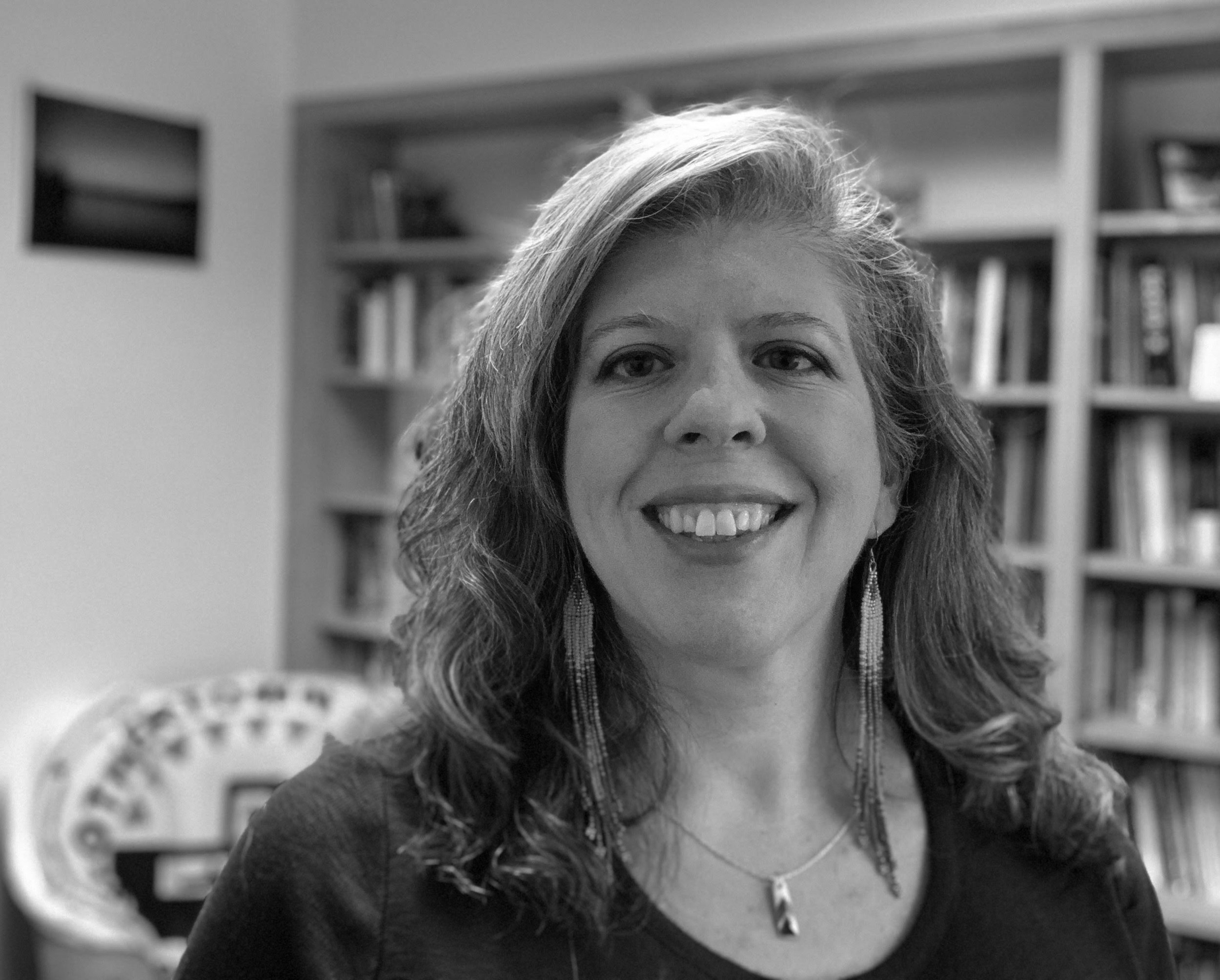
Yellow Arrow Publishing would like to announce the next guest editor for Yellow Arrow Journal, Rebecca Pelky. Rebecca will oversee the creation of our Vol. VII, No. 1 issue. Mark your calendars! Submissions open March 1 and the issue will be released in May.
This next issue of Yellow Arrow Journal will be on the overarching idea of r[a]ise. Rebecca states,
“I think that r[a]ise has the potential for myriad interpretations, but at its heart for me is the idea that one rises as an individual and/or one raises others up. Rising is awakening but raising is also about what we do next as part of us but also outside ourselves: we raise children, raise food, raise awareness, raise questions. How do the two words interact in fruitful ways?”
We are excited to announce the theme of Vol. VII, No. 1 next week.
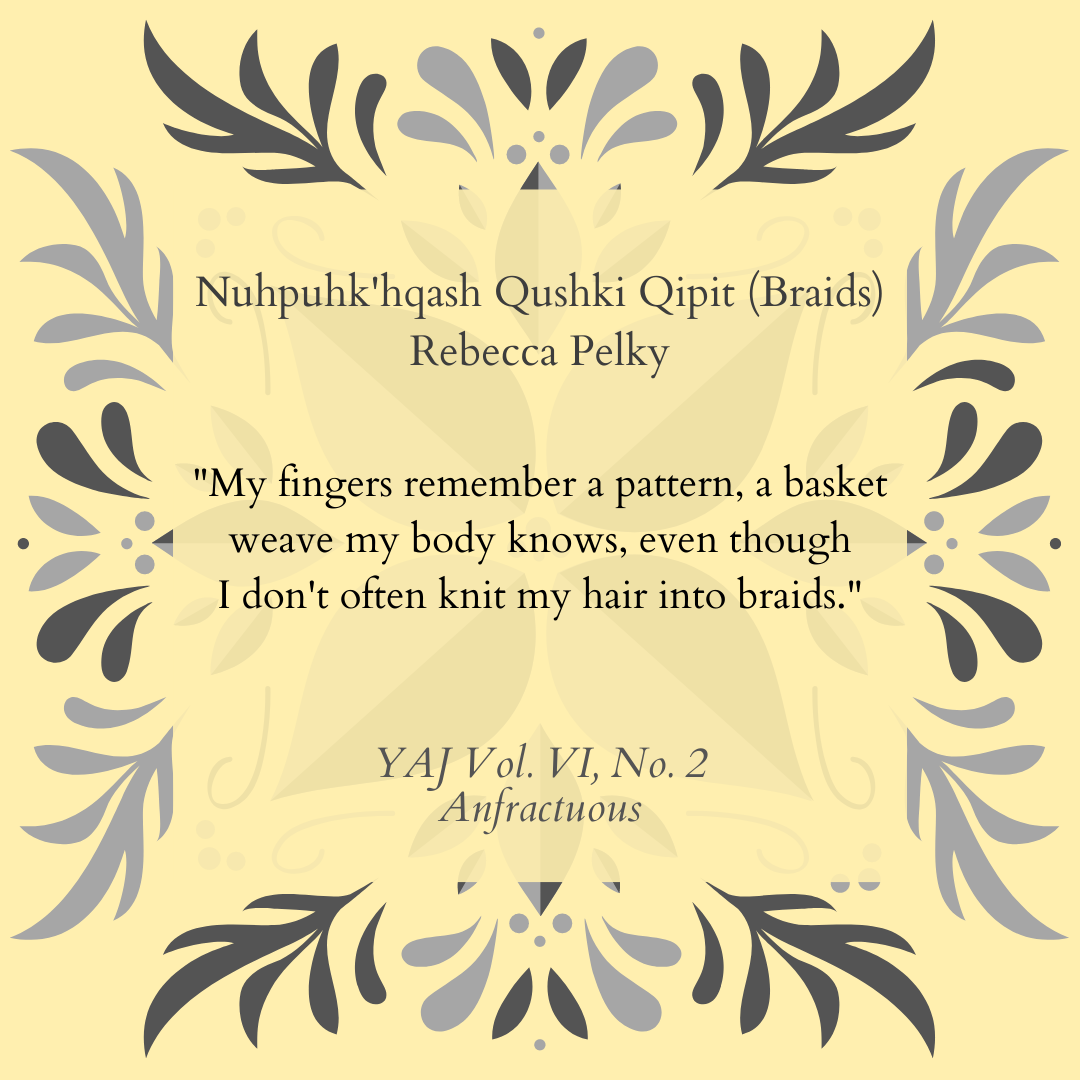
Rebecca was one of our ANFRACTUOUS poets with her incredible piece “Nuhpuhk’hqash Qushki Qipit (Braids).” She holds a PhD from the University of Missouri, an MFA from Northern Michigan University, and is an Assistant Professor of Film Studies at Clarkson University. She is a member of the Brothertown Indian Nation of Wisconsin and a native of Michigan’s Upper Peninsula. Through a Red Place, her second poetry collection and winner of the 2021 Perugia Press Prize, was released in September 2021. Her first book, Horizon of the Dog Woman, was published by Saint Julian Press in 2020.
We are also excited to announce that Rebecca will be teaching the workshop “Writing the Archive” for Yellow Arrow in April. The goal of this workshop is to introduce participants to various methods of writing creatively using archival materials as inspiration. While we often think of archives as places where research—in that most academic sense—occurs, archival documents can also be source material for creative inspiration. Archival material is mostly how Rebecca wrote her Perugia Press collection Through a Red Place.
Find out more about Rebecca at http://rebeccapelky.com/.
Please follow Yellow Arrow on Facebook and Instagram for the theme announcement. Below, you can read more about Rebecca’s perspectives on r[a]ise. We look forward to working with Rebecca over the next few months.
By Rebecca Pelky
Ihtôqat nutôcimohkawô. Let me tell you a story. It’s the story of The Three Sisters, Shwi Mitukushq. This story has many different versions among Indigenous peoples, and this is one of them. Once, there were three sisters living together. Each of these sisters was very different from the others, but they all enjoyed spending time in the field next to their house. The youngest, who was not yet grown, crawled along the ground. The middle sister liked to lounge against the eldest, enjoying the wind and sun on her face. The eldest, feeling responsible for the younger sisters, always stood straight and tall, keeping an eye on things—especially the wanderings of the youngest. One day, the eldest sister noticed a boy visiting the field. They were all curious about him because he was talking to the animals. The boy began to visit often, and always showed them interesting things. Then one night in late summer, the youngest sister disappeared. The two elder sisters mourned her loss, and though they searched, they couldn’t find her. Not long after, the middle sister also disappeared, and the eldest was left alone. She blamed herself for not watching over them carefully enough. In her loneliness over the winter, she began to age and wither away. Thankfully, in spring, her sisters returned. They had been so curious about the boy that they had followed him and then were unable to return because of winter’s arrival. Seeing how much distress they’d caused the sister who always looked after them, they vowed to never leave again. That’s why the three sisters—corn, beans, and squash—are always planted together. Each plant helps the others thrive: beans climb the sturdy corn stalks, which allow them to bask in the sun above the squash plants’ vines and broad leaves. In turn, beans provide nitrogen to the soil and also stabilize the corn during high winds. Meanwhile, the large squash leaves help the soil retain moisture by shading it. The three sisters grow best when they rise together.
As I write this blog post to introduce myself, I’m sitting at my desk in a house on land that once belonged to the Mohawk people, whose name for themselves is Kanien’kehá:ka (“People of the Flint”). The Kanien’kehá:ka are members of the Haudenosaunee Confederacy, which many know as the Iroquois Confederacy. I’m not Mohawk nor do I belong to another tribe in the Haudenosaunee Confederacy. Yet I share this to express my gratitude. For the Haudenosaunee and many other Indigenous Nations, including my own, gratitude is central to our worldview, and what is gratitude but the recognition that we don’t rise alone. In recognizing my privilege of existing and writing to you in this space, I hope to raise others up with me—raise awareness, knowledge, perceptions.
As I’ve learned more about the history of my Mohegan ancestors, I’ve also learned that I have many reasons to be grateful to the Haudenosaunee. Like the sisters, my people would have had a difficult time thriving without them. In the 18th century, around the time of the Revolutionary War, my Indigenous ancestors were trying to move west, out from under the influence of colonial alcohol and land grabs. They, along with people from several other tribes, established a town in what would become Upstate New York. They built a church and called their town Brothertown, or, in Mohegan, Eeyamquittoowauconnuck. This was only possible because the Oneida Nation welcomed them into their territory, vowing that, “. . . and now brethren we receive you into our body as it were, now we may say we have one head, one heart, and one blood. . . . And if the evil spirit stirs up any nation whatsoever or person against you and causes your blood to be spilt we shall take it as if it was done unto us; or as if they spilt the blood from our own bodies. And we shall be ever ready to defend you and help you or even be ready to protect you according to our abilities. Brethren, we look upon you as a sixth brother. . . . The Oneidas, Kiyougas, Manticucks, Tuscaroras, and Tdelenhanas, they are your elder brothers. But as for the Mohawks, Onandagas, and Senecas, they are your fathers . . .” At the heart of this welcome, and indeed at the heart of the many Indigenous worldviews is that the success of a community outweighs the success of the individual—we should raise each other up as we rise ourselves. Even as my ancestors migrated again to Michigan territory (which would become Wisconsin), the Oneida, some of whom also moved to Wisconsin, continued to be close friends to the Brothertown Nation. That relationship remains to this day.
It’s all been a kind of awakening, as I learn more about what it means to be a Mohegan of Brothertown (and Mohican and Eastern Cherokee and African and German and British and French). Which parts of myself do I need to raise up? Which parts of myself need me as an ally? It’s a strange paradox to contain so many people—the colonizer and the colonized. But those parts also have to coexist in order for me to thrive. That’s not always easy, but I remember the lessons of the three sisters. I remember the lessons from my Brothertown ancestors—how Mohegan, Narragansett, Tunxis, Pequot, Niantic, and Montaukett peoples built a town and a church together, and together, have raised each other up for over 240 years.
*****
Yellow Arrow Publishing is a nonprofit supporting women writers through publication and access to the literary arts.
You can support us as we AWAKEN in a variety of ways: purchase one of our publications from the Yellow Arrow bookstore, join our newsletter, follow us on Facebook, Instagram, or Twitter or subscribe to our YouTube channel. Donations are appreciated via PayPal (staff@yellowarrowpublishing.com), Venmo (@yellowarrowpublishing), or US mail (PO Box 102, Glen Arm, MD 21057). More than anything, messages of support through any one of our channels are greatly appreciated.
Behind the Issue: ANFRACTUOUS (Yellow Arrow Journal, Vol. VI, No. 2)

By Keshni Naicker Washington
“Of all the stories we tell ourselves and others, the most significant follow the words ‘I am . . .’”
To be a writer, poet, or artist is to be an outsider. We give form to our experiences, creating channels and access points for others to connect into in the process. And once a thing has form, we can choose to carry it, put it down, or step beyond it. Belonging is not something we negotiate with the external world, it’s inside us.
To be a writer, poet, or artist is to be brave enough to press the submit button that sends your work into the hands of strangers, risking it being received with resonance or not, and being willing to do that over and over again.

As guest editor of Yellow Arrow Journal ANFRACTUOUS, I had the unique opportunity to be on the other side of that button for the first time. I remembered the sting of the rejections I have received as a writer and so I was apprehensive about the task of choosing between submissions. But the process followed by the team and helmed by Kapua Iao, Editor-in-Chief, laid out a firm path. Due to the volume of submissions, I was soon chin-deep into the “blind” reading process (reading the pieces without any author identification) with Yellow Arrow staff members as we voted on our ‘favorites.’ The high caliber and vast landscape covered by the entries took me on many worthwhile journeys. I remain in awe of the courage and authenticity with which each piece was shared by its creator. The responsibility of making the final choices weighed me down for several days but it also felt right that it should be so difficult.
The Yellow Arrow team’s experience and wisdom certainly smoothed the process and steered my adherence to the theme of the issue—ANFRACTUOUS—and the pieces’ cohesion with each other as we strung them together intentionally to create a progressive and overarching story of the twists and turns of belonging-ness. ANFRACTUOUS starts with the etherealness of a cloud and the search for a home in the opening poem “Homebound” by Sylvia Niederberger and ends with the insight of hindsight on a full life lived in “At Last” by Mary Marca. Along the way we get a peek into the search for belonging that spans not only the continent of North America but across oceans to Africa and Europe and India, as well.
The pieces in this Yellow Arrow Journal collection explore these ideas of belonging-ness and the winding and intricate paths of diverse human experience. Some wrestle with the present-day and some cast a searchlight on the past. Meaning is examined in the land or places we leave or cleave to. And ultimately all included authors are standing apart and forging their own sense of belonging-ness as they bravely own their story and offer it to the world as a signal fire for others between these pages. For this, they (and everyone who submitted) have my sincere admiration and gratitude, and so, too, does the staff of Yellow Arrow Publishing, who give their time to create spaces where these signal fires can exist and breathe and take pride in stewarding new voices into the literary world.
Life is a process of becoming. I believe that the purpose of art and writing is to help us hold a mirror to the world and ourselves.
Paperback and PDF versions are available from the Yellow Arrow bookstore. Discounts are also available (here) if you would like to purchase copies for friends and family (minimum purchase of five). A great opportunity with Christmas just around the corner! You can also search for Yellow Arrow Journal on any e-book device or anywhere you purchase books, including Amazon and most other distribution channels.
And if you are interested in reading what our incredible authors thought of the theme, pick up a copy of the PDF version along with the paperback. Included within the PDF version only are the authors’ and Keshni’s responses to the following question: what/who/where was a turning point toward acceptance/belonging? Take some time and reflect on your own response. Is there a turning point for you?
One final note. With this blog, we are excited to release the prerecorded reading of Anfractuous, “An Exploration of Belonging: The Anfractuous Reading,” on the Yellow Arrow YouTube channel today.
Get the full reading here and please support Yellow Arrow by subscribing to our YouTube channel.
I hope by reading the offerings in this issue and listening to the authors’ voices you will be inspired to reflect on your own identification that follows the words “I am . . .”
It has been an honor to be invited by the Yellow Arrow team to contribute to such a mission in the creation of the ANFRACTUOUS issue. Available now! Go get your copy!
*****
If you haven’t had the opportunity yet, please make sure to donate to our Turning the Next Page fundraising campaign. Yellow Arrow is able to share stories of writers who identify as women because of our incredible community of supporters. Your assistance contributes to the publication of our journal as well as our incredible chapbooks and zines.
Yellow Arrow Publishing is a nonprofit supporting women writers through publication and access to the literary arts. Thank you for supporting independent publishing.
Accepting Yourself: Yellow Arrow Journal (Vol. VI, No. 2) ANFRACTUOUS
“Of all the stories we tell ourselves and others, the most significant follow the words ‘I am . . .’”
Keshni Naicker Washington’s first sentence to the introduction of ANFRACTUOUS, Yellow Arrow Journal Vol. VI, No. 2 (fall 2021), sets the tone for the entire issue. One that explores the idea of belonging and unbelonging; as Keshni, the issue’s wonderful guest editor, explains, “. . . we become some self-fashioned mosaic of belonging unique to our own choices and the intricate twists of our experiences.” What does it mean to belong and who gets to decide when/how someone belongs?
When we first announced the theme ANFRACTUOUS (full of windings and intricate turnings, things that twist and turn but do not break), we weren’t sure what to expect, if submitters would explore the conscious/unconscious decisions that make us who we are. But they did, and we laughed and cried and commiserated and sympathized. Our hearts soared while reading the over one hundred submissions we received. Thank you to everyone who took the time to send us their stories. Ultimately, we had to narrow down our finalists; the chosen pieces and contributors resonated with Keshni, the Yellow Arrow team, and each other by weaving a beautiful story about belonging-ness. We hope that you, our dear readers, are ready to take this voyage with our authors and with Keshni. Thank you, Keshni, for putting together such an extraordinary issue.
Paperback and PDF versions are now available from the Yellow Arrow bookstore. Discounts are also available (here) if you would like to purchase copies for friends and family (minimum purchase of five). A great opportunity with Christmas just around the corner! You can also search for Yellow Arrow Journal on any e-book device or anywhere you purchase books, including Amazon and most other distribution channels.
And if you are interested in reading what our incredible authors thought of the theme, pick up a copy of the PDF version along with the paperback. Included within the PDF version only are the authors’ and Keshni’s responses to the following question: what/who/where was a turning point toward acceptance/belonging? Take some time and reflect on your own response. Is there a turning point for you?
One final note, don’t forget to check out our prerecorded reading of Anfractuous, “An Exploration of Belonging: The Anfractuous Reading,” which will be released on the Yellow Arrow YouTube channel on November 30. In the meantime, here’s a sneak peek.
We hope you enjoy reading ANFRACTUOUS as much as we enjoyed creating it. Thank you for your continued encouragement of Yellow Arrow Publishing and the women involved in ANFRACTUOUS.
*****
If you haven’t had the opportunity yet, please make sure to donate to our Turning the Next Page fundraising campaign. Yellow Arrow is able to share stories of writers who identify as women because of our incredible community of supporters. Your assistance contributes to the publication of our journal as well as our incredible chapbooks and zines.
Yellow Arrow Publishing is a nonprofit supporting women writers through publication and access to the literary arts. Thank you for supporting independent publishing.
Yellow Arrow Journal Submissions are Now Open!

Yellow Arrow Publishing is excited to announce that submissions for our next issue of Yellow Arrow Journal, Vol. VI, No. 2 (fall 2021) is open September 1–30 addressing the topic of “belonging-ness,” exploring what it means to belong or un-belong, our nearness or distance (intimacy or alienation) from others and ourselves.
This issue’s theme will be:
Anfractuous:
full of windings and intricate turnings
things that twist and turn but do not break
How has your “belonging-ness” been shaped by your own personal life journey? Have you taken any sharp unpredictable turns, or has it been a slower accumulation or a shedding?
Is it necessary to “belong” to be happy? How has your sense of who you are been a process of “un-belonging”?
How have your circumstances (the land you live in or don’t live in/your family history) or your conscious choices (your chosen family/career/passions) tempered or shaped your understanding of your own belonging?
Yellow Arrow Journal is looking for creative nonfiction, poetry, and cover art submissions by writers/artists that identify as women, on the theme of Anfractuous. Submissions can be in any language as long as an English translation accompanies it. For more information regarding journal submission guidelines, please visit yellowarrowpublishing.com/submissions. Please read our guidelines carefully before submitting. To learn more about our editorial views and how important your voice is in your story, read About the Journal. This issue will be released in November 2021.
We would also like to welcome this issue’s guest editor: Keshni Naicker Washington. Keshni considers her creative endeavors a means of lighting signal fires for others. Born and raised in an apartheid segregated neighborhood in Kwa-Zulu Natal, South Africa, she now also calls Washington, D.C. home. And after nine years here has finally gotten used to Orion being the right way up in the night sky. Her stories are influenced by her evolving definition of home and the tides of political and social change that move us all. She is an alumnus of VONA and TIN HOUSE writing workshops. Connect with her keshniwashington.com and on Instagram @knwauthor. You can also learn more about Keshni through her Vol. V, No. 3 (Re)Formation piece “Alien” and her Yellow Arrow Journal .W.o.W. #20.
The journal is just one of many ways that Yellow Arrow Publishing works to support and inspire women through publication and access to the literary arts. Since its founding in 2016, Yellow Arrow has worked tirelessly to make an impact on the local and global community by advocating for writers that identify as women. Yellow Arrow proudly represents the voices of women from around the globe. Creating diversity in the literary world and providing a safe space are deeply important. Every writer has a story to tell, every story is worth telling.
You can be a part of this mission and amazing experience by submitting to Yellow Arrow, joining our virtual poetry workshop, volunteering, and/or donating today. Follow us on Facebook and Instagram to learn more about future publishing and workshop opportunities. Publications are available at our bookstore and through most distributors.
*****
Yellow Arrow Publishing is a nonprofit supporting women writers through publication and access to the literary arts. To learn more about publishing, volunteering, or donating, visit yellowarrowpublishing.com.
Meet an Artist: Megha Balooni

from the 2021 art series
Storytelling takes place in many different forms, not just writing. When an artist shares a piece with others they also share a piece of who they are with their audience. We see the expression of their aesthetic, culture, and identity woven into their work.
This is definitely visible in the artwork for Yellow Arrow Journal. During each journal submission period, we ask for creative nonfiction, poetry, and cover art that reflects a chosen theme. We get incredible artwork created in various media and choose the one that best represents the theme.
To celebrate our talented cover artists, we will be releasing a series of blogs to share their stories and the importance that art has on their lives.
The fourth artist that we are featuring in our Art Series is Megha Balooni. Megha is an architect currently residing in India. Realizing her love for stories—written and visual—from early on, she believes these two mediums to be her most strong communications tool. Through her visual designs, she is striving to curate a more inclusive and optimistic world. Her works take inspiration from nature, emotions, and expressions. She also contributes to World Architecture Community, an online architectural publication platform, where she enjoys curating interviews. She enjoys reading, cooking, and spending time wondering. Her art piece, “Lidya,” was seen on the cover of Yellow Arrow Journal, Resilience: Vol. V, No. 1, Winter 2020.
You can find Megha at thelidyart.com or on Instagram and Facebook. And in September, you can see her incredible artwork on the covers of Yellow Arrow’s EMERGE zines: Pandemic Stories and Coming into View. More information about EMERGE will be available soon.
Megha recently took some time to answer a few questions for us.
What do you love most about art and why?
Just the fluidity and how there is no right or wrong in art. Humans are conditioned to abide by rules otherwise we would go bonkers. But with art, you can truly discover yourself. It can be a way for you to express and cope. It can be a way to feel good about yourself, it could be healing.
What are your top five tips for aspiring artists?

Some learnings that I can definitely say apply to all creative endeavors: make a vision board that includes your inspiration and aspirations, have faith in yourself and your abilities, allow yourself to learn and unlearn as you grow (shed that past skin if it doesn’t feel like you anymore!), there’s space for everyone to thrive, and don’t allow your insecurities project onto your personality. Things might seem rocky and too bright some days but if you keep pursuing, it will create a path for you. And lastly, love what you do!
In three words how would you describe your aesthetic in art?
My aesthetic takes inspiration from nature, emotions, and female expressions. It’s a culmination of what I’m feeling the most at the moment which contributes to the colour palette and textures.
Thank you, Megha for answering our questions. You can purchase a PDF of Resilience in the Yellow Arrow bookstore, along with other Yellow Arrow publications.
*****
The 2021 art series was created and put together by Marketing Associate, Michelle Lin. Yellow Arrow Publishing is a nonprofit supporting women writers through publication and access to the literary arts. Thank you for supporting independent publishing.
Meet an Artist: Ann Marie Sekeres

from the 2021 art series
Storytelling takes place in many different forms, not just writing. When an artist shares a piece with others they also share a piece of who they are with their audience. We see the expression of their aesthetic, culture, and identity woven into their work.
This is definitely visible in the artwork for Yellow Arrow Journal. During each journal submission period, we ask for creative nonfiction, poetry, and cover art that reflects a chosen theme. We get incredible artwork created in various media and choose the one that best represents the theme.
To celebrate our talented cover artists, we will be releasing a series of blogs to share their stories and the importance that art has on their lives.

The third artist that we are featuring in our Art Series is Ann Marie Sekeres. Ann Marie is an illustrator whose drawings have appeared in publications worldwide. She recently illustrated the cover for the samurai by Linda M. Crate, published by Yellow Arrow. She lives in the New York area and draws every day. Follow her work on Instagram @annmarieprojects and at annmarieprojects.com. Her art piece, “Couch,” was seen on the cover of Yellow Arrow Journal HOME: Vol. V, No. 2, Spring 2020.
Ann Marie recently took some time to answer a few questions for us.
If you weren’t an artist today, what would you be doing?

I’m 51. I think part of getting older is that you no longer identify yourself by one label or profession. I do a lot of different stuff. I’m an artist when I’m drawing. I’m a student when I try to speak French. It’s okay to do a million different things and some of them, not very well. I didn’t feel that way as a kid. I wanted to be one great thing. Life, at least mine, turned out much different than that.
Who is your favorite artist and why?
Florine Stettheimer. For embracing the girly in early American modernism.
What inspired the piece that you created for Yellow Arrow?
I was thinking of Henri Matisse and his shapes and drawings. That was the goal.
Thank you, Ann Marie, for answering our questions. You can purchase a PDF of HOME in the Yellow Arrow bookstore, along with other Yellow Arrow publications.
*****
The 2021 art series was created and put together by Marketing Associate, Michelle Lin. Yellow Arrow Publishing is a nonprofit supporting women writers through publication and access to the literary arts. Like us on Facebook and Instagram for news about the next journal submissions period. Thank you for supporting independent publishing.